



2½ Euro – Portugal
Non-circulating coins
Commemoration: FIFA World Cup Russia 2018
Portugal
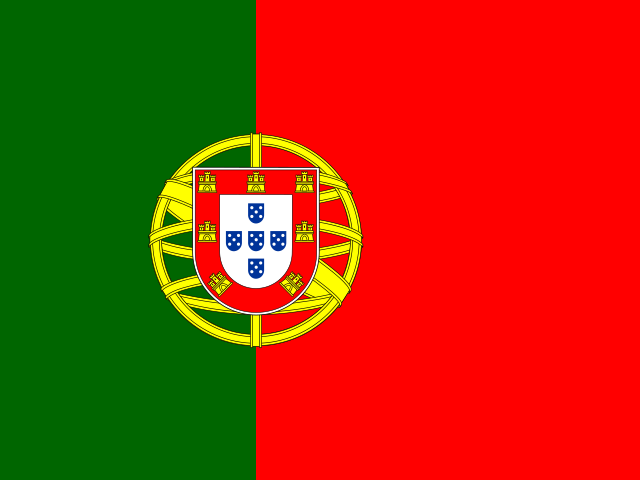


Obverse
Inscription:
CAMPEONATO DO MUNDO DA FIFA TM
PORTUGAL
2018
PORTUGAL
2018
Translation:
FIFA WORLD CUP TM
PORTUGAL
2018
PORTUGAL
2018
Script: Latin
Languages: Portuguese, English
Engraver: João Duarte
Reverse
Edge
Categories
| Sport> Football> FIFA World Cup |
Mintings
| Year | Mint Mark | Mintage | Quality | Collection |
|---|---|---|---|---|
| 2018 | INCM | 2,673 | Proof |
Historical background
In 2018, Portugal's currency situation was firmly anchored within the Eurozone, having used the euro as its sole legal tender since 2002. As a member of the single currency, Portugal did not have an independent monetary policy; interest rates and broader monetary decisions were set by the European Central Bank (ECB) to suit the needs of the entire Eurozone. This framework provided stability and eliminated exchange rate risk with its main trading partners, but it also meant Portugal could not devalue its currency to boost competitiveness, a tool it had relied on periodically before adopting the euro.
The year was marked by continued economic recovery and fiscal consolidation following the severe austerity measures of the 2010-2014 bailout period. The Bank of Portugal reported steady GDP growth, falling unemployment, and a primary budget surplus. This positive trend, supported by the ECB's accommodative policies including low interest rates and quantitative easing, helped maintain favorable sovereign borrowing costs. Portugal successfully exited its post-bailout surveillance program in 2017, and in 2018 its government bonds saw increased demand, with yields on 10-year debt falling to historic lows—a sign of restored market confidence within the euro framework.
However, underlying challenges persisted related to the euro's structure. Portugal's public and private debt levels remained among the highest in the EU, constraining fiscal flexibility. While the euro provided macroeconomic stability, it also locked in competitiveness issues, as unit labor costs were higher than the Eurozone average. The economy's reliance on tourism and exports meant it was sensitive to external euro-area demand and ECB policy shifts. Thus, in 2018, the currency situation was one of stable integration but with lingering vulnerabilities, highlighting the dual reality of euro membership: protection from currency crises alongside the need for continuous internal structural reforms to adjust within a fixed monetary union.
The year was marked by continued economic recovery and fiscal consolidation following the severe austerity measures of the 2010-2014 bailout period. The Bank of Portugal reported steady GDP growth, falling unemployment, and a primary budget surplus. This positive trend, supported by the ECB's accommodative policies including low interest rates and quantitative easing, helped maintain favorable sovereign borrowing costs. Portugal successfully exited its post-bailout surveillance program in 2017, and in 2018 its government bonds saw increased demand, with yields on 10-year debt falling to historic lows—a sign of restored market confidence within the euro framework.
However, underlying challenges persisted related to the euro's structure. Portugal's public and private debt levels remained among the highest in the EU, constraining fiscal flexibility. While the euro provided macroeconomic stability, it also locked in competitiveness issues, as unit labor costs were higher than the Eurozone average. The economy's reliance on tourism and exports meant it was sensitive to external euro-area demand and ECB policy shifts. Thus, in 2018, the currency situation was one of stable integration but with lingering vulnerabilities, highlighting the dual reality of euro membership: protection from currency crises alongside the need for continuous internal structural reforms to adjust within a fixed monetary union.



✨ Legendary