

20 fen – Taiwan Province
Add to wishlist
China
Context
Year: 1894
Country: China
Issuer: Taiwan Province
Ruler: Guangxu
Currency:
(1893—1895)
Demonetized: Yes
Material
References
Y: #
Numista: #274207
Value
Bullion value: $11.31
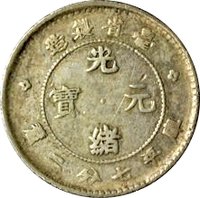
Obverse
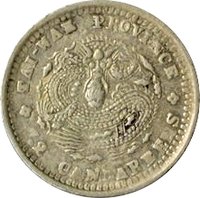
Reverse
Description:
Dragon encircling a pearl, surrounded by English text.
Inscription:
TAI-WAN PROVINCE
1 MACE AND 4.4 CANDAREENS
1 MACE AND 4.4 CANDAREENS
Script: Latin
Edge
Reeded.
Categories
| Mythology> Fantastic animal |
Mintings
| Year | Mint Mark | Mintage | Quality | Collection |
|---|---|---|---|---|
| 1894 | — | — |
Historical background
In 1894, Taiwan was under the administrative control of the Qing Dynasty as a prefecture of Fujian Province, but its monetary landscape was characterized by extreme complexity and fragmentation. The primary circulating currency was the silver tael, a unit of weight rather than a coin, leading to a proliferation of differing local standards (such as the Taiwan Tael or Liang) for settling accounts. Alongside this, a vast array of physical silver in the form of sycee (shoe-shaped ingots) and foreign silver trade dollars—most notably the Mexican "Eagle" Dollar and later the Japanese Yen—circulated for larger transactions. For everyday use, the official Qing copper cash coins (wen) with a square hole were standard, but their supply was often insufficient, leading to chronic shortages of small change.
This multi-currency system created significant commercial friction. Exchange rates between silver taels, foreign dollars, and copper cash were highly unstable and varied from one locality to another, complicating tax collection and trade. Furthermore, the period saw widespread circulation of privately minted and often debased copper coins, as well as "hard cash notes" or private scrip issued by local merchants and pawnshops to alleviate the small-change shortage. The Qing authorities attempted to maintain control by operating official mints in Taipei and Tainan, but their output could not keep pace with economic demand or curb the influx of foreign and substandard currencies.
The monetary chaos of 1894 was directly tied to Taiwan's growing importance in regional trade and the weakening grip of the late Qing state. This unstable situation would be abruptly and fundamentally transformed the following year by the Treaty of Shimonoseki (1895), which ceded Taiwan to Japan following the First Sino-Japanese War. The Japanese colonial administration quickly moved to impose a unified, modern currency system based on the Japanese Yen, systematically replacing the Qing-era mosaic of currencies and bringing Taiwan into Japan's monetary sphere, thus ending the distinct provincial currency situation of 1894.
This multi-currency system created significant commercial friction. Exchange rates between silver taels, foreign dollars, and copper cash were highly unstable and varied from one locality to another, complicating tax collection and trade. Furthermore, the period saw widespread circulation of privately minted and often debased copper coins, as well as "hard cash notes" or private scrip issued by local merchants and pawnshops to alleviate the small-change shortage. The Qing authorities attempted to maintain control by operating official mints in Taipei and Tainan, but their output could not keep pace with economic demand or curb the influx of foreign and substandard currencies.
The monetary chaos of 1894 was directly tied to Taiwan's growing importance in regional trade and the weakening grip of the late Qing state. This unstable situation would be abruptly and fundamentally transformed the following year by the Treaty of Shimonoseki (1895), which ceded Taiwan to Japan following the First Sino-Japanese War. The Japanese colonial administration quickly moved to impose a unified, modern currency system based on the Japanese Yen, systematically replacing the Qing-era mosaic of currencies and bringing Taiwan into Japan's monetary sphere, thus ending the distinct provincial currency situation of 1894.

✨ Legendary