

2 Pounds (Charles Dickens) – United Kingdom
Circulating commemorative coins
Commemoration: 200th anniversary of birth of Charles Dickens
United Kingdom
Context
Year: 2012
Issuer: United Kingdom 
Ruler: Elizabeth II
Currency:
(since 1971)
Total mintage: 8,315,563
Material

References
KM: #Click to copy to clipboard1224
Numista: #27379
Value
Exchange value: 2 GBP = $2.71
Inflation-adjusted value: 3.11 GBP
Obverse
Description:
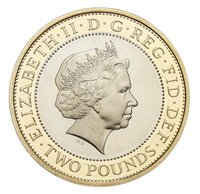
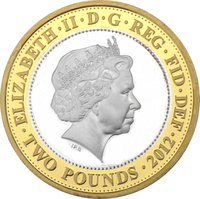
Queen Elizabeth IV facing right, wearing the Girls of Great Britain and Ireland tiara.
Inscription:
ELIZABETH·II·D·G·REG·FID·DEF
IRB
·TWO POUNDS·2012·
IRB
·TWO POUNDS·2012·
Translation:
Elizabeth the Second, by the Grace of God, Queen, Defender of the Faith
Two Pounds 2012
Two Pounds 2012
Script: Latin
Engraver: Ian Rank-Broadley
Reverse
Description:
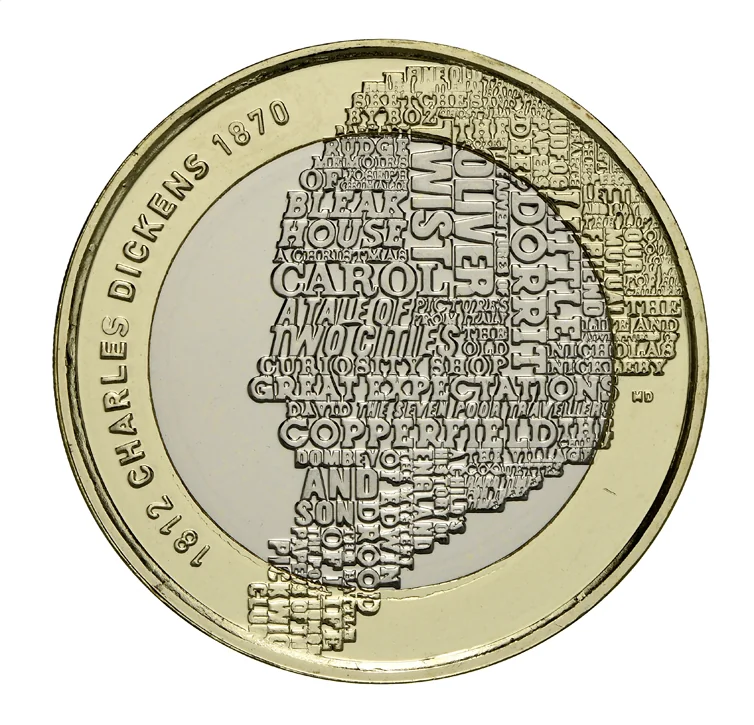
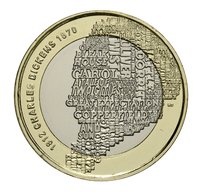
A Charles Dickens profile composed of his titles.
Inscription:
1812 CHARLES DICKENS 1870
Script: Latin
Engraver: Matthew Dent
Edge
Milled with incuse lettering
Legend:
SOMETHING WILL TURN UP
Categories
| Art> Literature |
| Event> Birth anniversary |
Mints
| Name | Mark |
|---|---|
| Royal Mint | — |
Mintings
| Year | Mint Mark | Mintage | Quality | Collection |
|---|---|---|---|---|
| 2012 | — | 8,190,000 | ||
| 2012 | — | 100,486 | BU | |
| 2012 | — | 25,077 | Proof |
Historical background
In 2012, the United Kingdom's currency situation was dominated by the enduring aftermath of the 2008 financial crisis and the escalating Eurozone sovereign debt crisis. The British pound sterling (GBP), while not part of the single currency, was significantly affected by the turmoil on its doorstep. The Bank of England (BoE), under Governor Sir Mervyn King, maintained an ultra-loose monetary policy, holding the base interest rate at a historic low of 0.5% since March 2009 and continuing its Quantitative Easing (QE) asset-purchase programme to stimulate the stagnant economy. This environment generally kept sterling under pressure, though it served as a relative "safe haven" compared to the euro.
The pound exhibited notable volatility, particularly against the euro. As investors fled the Eurozone crisis, sterling strengthened to a three-and-a-half-year high near €1.28 in July 2012. However, this strength was double-edged, threatening the UK's export competitiveness. Against the US dollar, sterling was more subdued, trading in a broad range between $1.52 and $1.63. Domestic concerns, including a double-dip recession confirmed in the first half of the year and the government's ongoing austerity programme, weighed on confidence and limited any sustained appreciation.
Underlying the year's fluctuations was intense market scrutiny of the UK's own fiscal health and the BoE's commitment to inflation targeting. While inflation remained stubbornly above the 2% target, the central bank prioritized growth, leaving the door open for further QE. Furthermore, the enduring debate about the UK's relationship with the European Union began to surface as a currency risk, with political uncertainty starting to factor into long-term sterling valuations. Thus, 2012 was a year where sterling was buffeted by external storms while navigating persistent domestic economic weakness.
The pound exhibited notable volatility, particularly against the euro. As investors fled the Eurozone crisis, sterling strengthened to a three-and-a-half-year high near €1.28 in July 2012. However, this strength was double-edged, threatening the UK's export competitiveness. Against the US dollar, sterling was more subdued, trading in a broad range between $1.52 and $1.63. Domestic concerns, including a double-dip recession confirmed in the first half of the year and the government's ongoing austerity programme, weighed on confidence and limited any sustained appreciation.
Underlying the year's fluctuations was intense market scrutiny of the UK's own fiscal health and the BoE's commitment to inflation targeting. While inflation remained stubbornly above the 2% target, the central bank prioritized growth, leaving the door open for further QE. Furthermore, the enduring debate about the UK's relationship with the European Union began to surface as a currency risk, with political uncertainty starting to factor into long-term sterling valuations. Thus, 2012 was a year where sterling was buffeted by external storms while navigating persistent domestic economic weakness.
🌱 Very Common