

1 Cent – Netherlands Antilles
Netherlands
Context
Years: 1952–1970
Country: Netherlands 
Issuer: Netherlands Antilles
Ruler: Juliana
Currency:
(since 1828)
Demonetized: Yes
Total mintage: 9,851,100
Material
References
KM: #Click to copy to clipboard1
Numista: #2725
Value
Exchange value: 0.01 ANG
Obverse
Description:
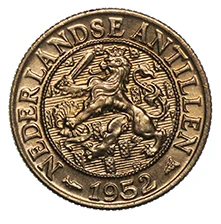
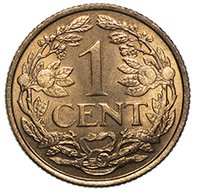
A crowned lion holding a sword and seven arrows, before a striped base with escutcheons, adapted from the Dutch coat of arms.
Inscription:
NEDERLANDSE ANTILLEN 1963
Translation:
NETHERLANDS ANTILLES 1963
Script: Latin
Languages: Papiamento, Dutch
Engraver: Johannes Cornelis Wienecke
Reverse
Edge
Reeded
Categories
| Symbols> Coat of Arms |
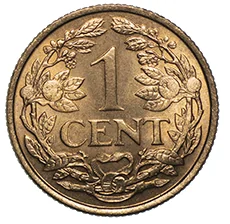
| Symbol> Wreath |
Mints
| Name | Mark |
|---|---|
| Royal Dutch Mint | — |
Mintings
| Year | Mint Mark | Mintage | Quality | Collection |
|---|---|---|---|---|
| 1952 | — | 100 | Proof | |
| 1952 | — | 1,000,000 | ||
| 1954 | — | 1,000,000 | ||
| 1954 | — | 200 | Proof | |
| 1957 | — | 1,000,000 | ||
| 1957 | — | 250 | Proof | |
| 1959 | — | 1,000,000 | ||
| 1959 | — | 250 | Proof | |
| 1960 | — | 300 | Proof | |
| 1961 | — | 1,000,000 | ||
| 1961 | — | — | Proof | |
| 1963 | — | 1,000,000 | ||
| 1963 | — | — | Proof | |
| 1964 | — | — | Proof | |
| 1965 | — | 1,200,000 | ||
| 1965 | — | — | Proof | |
| 1967 | — | 850,000 | ||
| 1967 | — | — | Proof | |
| 1968 | — | 900,000 | ||
| 1969 | — | 700,000 | ||
| 1970 | — | 200,000 | ||
| 1970 | — | — | Proof |
Historical background
In 1952, the currency situation in the Netherlands Antilles was defined by its status as a constituent country within the Kingdom of the Netherlands and its historical economic linkages. The official currency was the Netherlands Antillean guilder (NAƒ), which had been pegged at a fixed rate to the U.S. dollar since 1971. However, in 1952, this peg was different; the guilder was firmly anchored to the Dutch guilder as part of the monetary system of the Kingdom. This arrangement reflected the islands' colonial-era economic ties to the Netherlands, with trade and financial policy heavily influenced by Amsterdam.
The territory's economy in this period was undergoing significant transition. While the refinery on Curaçao, operated since 1918, was a major economic pillar and a key source of foreign exchange (primarily U.S. dollars), the post-World War II era saw moves toward greater political autonomy. The monetary link to the Dutch guilder provided stability but also tied the islands' currency to the economic conditions and policies of a European nation recovering from war, which did not always align with the Antilles' own Caribbean economic realities and its dollar-based oil trade.
Consequently, the currency system of 1952 was a blend of colonial inheritance and practical necessity. The Netherlands Antillean guilder served as a symbol of political belonging to the Kingdom, while the everyday economy, especially the vital oil sector, operated extensively with U.S. dollars. This dual dynamic created a complex financial environment, setting the stage for the eventual decisive shift to a dollar peg two decades later, which would better serve the islands' geographic and commercial orientation.
The territory's economy in this period was undergoing significant transition. While the refinery on Curaçao, operated since 1918, was a major economic pillar and a key source of foreign exchange (primarily U.S. dollars), the post-World War II era saw moves toward greater political autonomy. The monetary link to the Dutch guilder provided stability but also tied the islands' currency to the economic conditions and policies of a European nation recovering from war, which did not always align with the Antilles' own Caribbean economic realities and its dollar-based oil trade.
Consequently, the currency system of 1952 was a blend of colonial inheritance and practical necessity. The Netherlands Antillean guilder served as a symbol of political belonging to the Kingdom, while the everyday economy, especially the vital oil sector, operated extensively with U.S. dollars. This dual dynamic created a complex financial environment, setting the stage for the eventual decisive shift to a dollar peg two decades later, which would better serve the islands' geographic and commercial orientation.
🌱 Very Common