

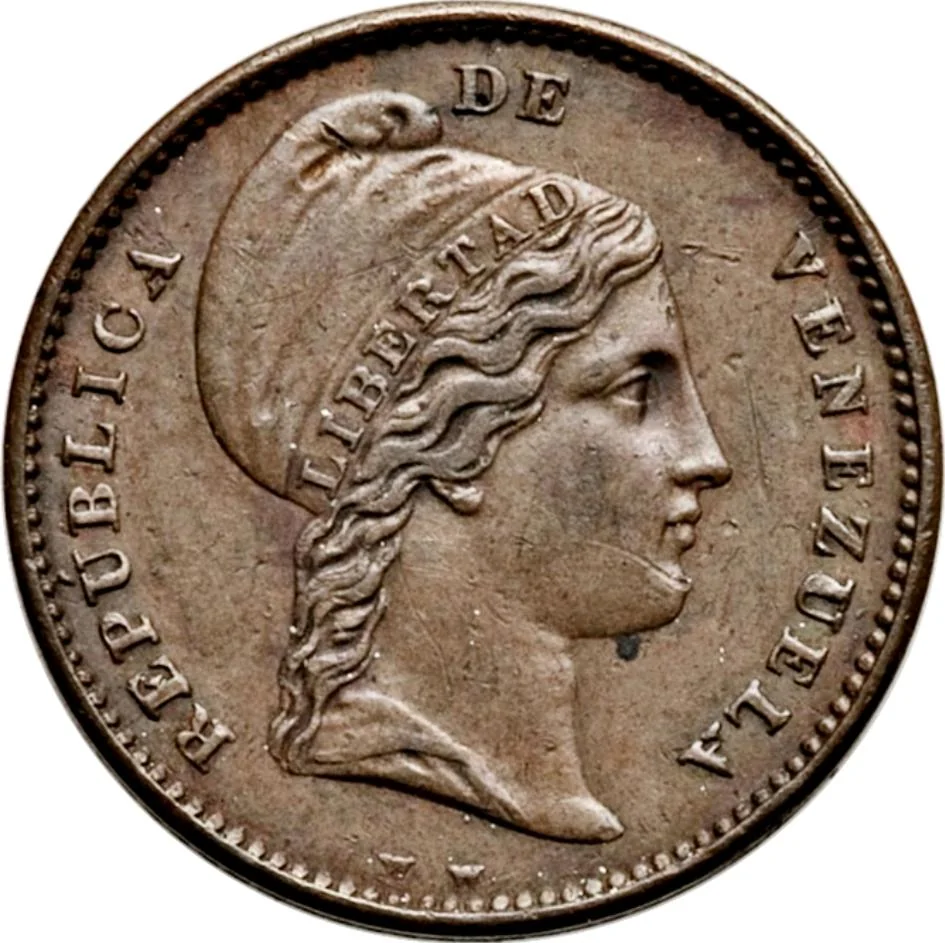
Obverse
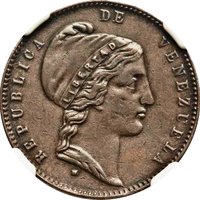
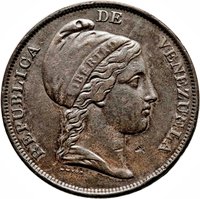
Description:
Liberty cap right, initials below.
Inscription:
REPUBLICA DE VENEZUELA
Translation:
Republic of Venezuela
Script: Latin
Language: Spanish
Engraver: William Wyon
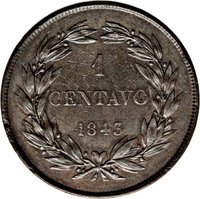
Reverse
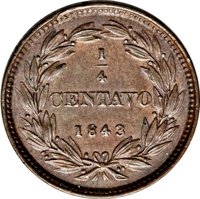
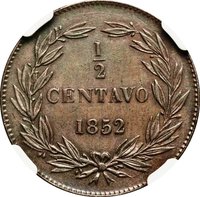
Description:
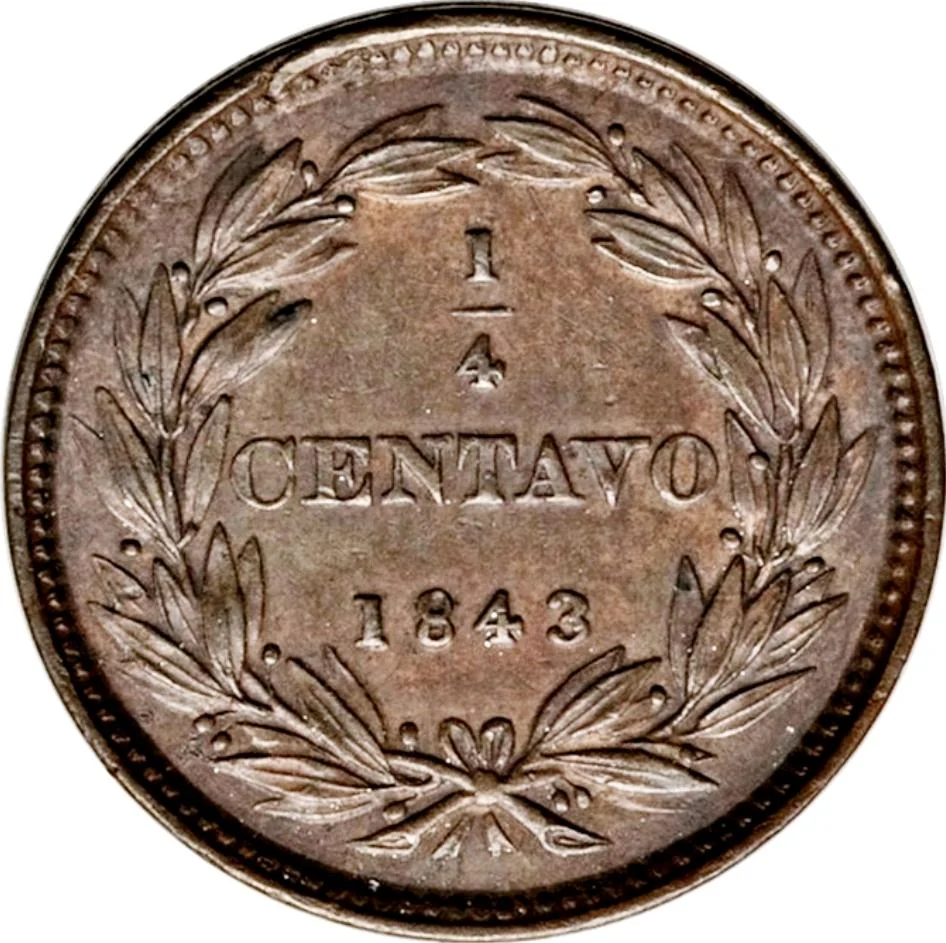
Value and date encircled.
Inscription:
1/4
CENTAVO
1843
CENTAVO
1843
Script: Latin
Engraver: William Wyon
Edge
Diagonally reeded edge
Mints
| Name | Mark |
|---|---|
| Royal Mint (Tower Hill) | — |
| Heaton and Sons / The Mint Birmingham | H |
Mintings
| Year | Mint Mark | Mintage | Quality | Collection |
|---|---|---|---|---|
| 1843 | — | 3,841,957 | ||
| 1852 | H | 2,000,000 |
Historical background
In 1843, Venezuela’s currency situation was characterized by chronic scarcity and disorder, a legacy of the recently concluded War of Independence (1811-1823) and subsequent political instability. The fledgling republic struggled with a fragmented monetary system where a multitude of coins circulated simultaneously. These included worn and clipped Spanish colonial pieces (like pesos and reales), coins from other Latin American nations, and even counterfeits, all with fluctuating and uncertain values that varied by region. The government lacked both the authority and the bullion reserves to impose a uniform national currency, hindering commerce and economic recovery.
The state’s primary response to this crisis and its own fiscal shortfalls was the continued issuance of moneda macuquina—crudely cut and hammered silver coins that were often debased. While intended to facilitate everyday transactions, these coins were easily counterfeited and their inconsistent silver content eroded public trust. Furthermore, attempts to introduce paper money had already failed disastrously in the previous decade, leaving a deep public suspicion of fiat currency. Consequently, foreign gold and silver coins, especially those from Britain, France, and the United States, became the preferred medium for significant transactions and international trade, underscoring the weakness of the national monetary authority.
This chaotic environment severely constrained economic development. The lack of a stable and trustworthy currency discouraged investment, complicated tax collection for the government, and created a significant barrier to internal trade. The situation in 1843 thus reflected a broader post-colonial challenge: the need to build not just political institutions but also the financial infrastructure essential for a modern nation-state. Real monetary stability would remain elusive for decades, awaiting greater political consolidation and the eventual revenue generated by the coffee export boom later in the century.
The state’s primary response to this crisis and its own fiscal shortfalls was the continued issuance of moneda macuquina—crudely cut and hammered silver coins that were often debased. While intended to facilitate everyday transactions, these coins were easily counterfeited and their inconsistent silver content eroded public trust. Furthermore, attempts to introduce paper money had already failed disastrously in the previous decade, leaving a deep public suspicion of fiat currency. Consequently, foreign gold and silver coins, especially those from Britain, France, and the United States, became the preferred medium for significant transactions and international trade, underscoring the weakness of the national monetary authority.
This chaotic environment severely constrained economic development. The lack of a stable and trustworthy currency discouraged investment, complicated tax collection for the government, and created a significant barrier to internal trade. The situation in 1843 thus reflected a broader post-colonial challenge: the need to build not just political institutions but also the financial infrastructure essential for a modern nation-state. Real monetary stability would remain elusive for decades, awaiting greater political consolidation and the eventual revenue generated by the coffee export boom later in the century.
Series: 1843 Venezuela circulation coins
⭐ Rare