

10 cash – South Xinjiang
Add to wishlist
China
Context
Year: 1909
Country: China
Issuer: South Xinjiang
Ruler: Xuantong
Currency:
(1759—1909)
Demonetized: Yes
Material
Diameter: 25 mm
Weight: 3.27 g
Shape: Round with a square hole
Composition: Copper
Magnetic: No
Technique: Cast
Alignment: Medal alignment
flip
References
Numista: #272405
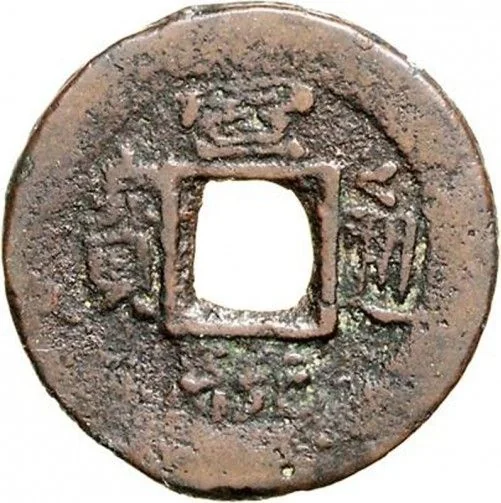
Obverse
Description:
Four Chinese characters read vertically, right to left.
Inscription:
宣
寶 通
統
寶 通
統
Translation:
Xuan Tong Treasure Circulate
Scripts: Chinese (traditional, regular script)
Language: Chinese
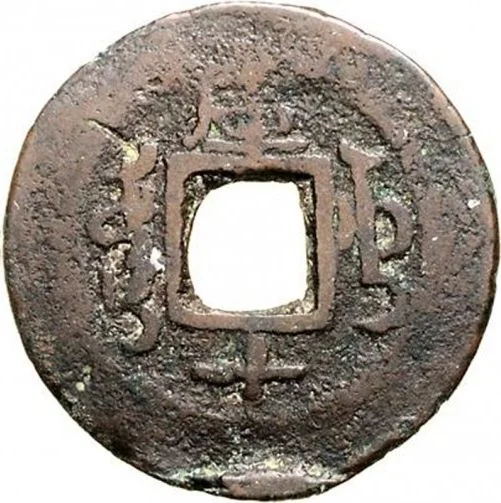
Reverse
Description:
One Chinese character above and below, one Uyghur word to the right, and one Manchu word to the left.
Inscription:
庫
ᡠᠰᠢ اوشى
十
ᡠᠰᠢ اوشى
十
Translation:
Treasury
Official
Ten
Official
Ten
Edge
Plain
Mints
| Name | Mark |
|---|---|
| Kucha Mint | — |
Mintings
| Year | Mint Mark | Mintage | Quality | Collection |
|---|---|---|---|---|
| 1909 | — | — |
Historical background
In 1909, the currency situation in South Xinjiang (the Tarim Basin region) was characterized by profound complexity and instability, a direct legacy of the area's position at the crossroads of empires. While nominally under the control of the late Qing dynasty, the region's economy operated with a chaotic multiplicity of currencies. The official currency, the Xinjiang tangka (or dang), a silver-based coin minted in provincial capitals like Kashgar, circulated alongside older Kashgar pul coins (copper and brass) for smaller transactions. Crucially, vast quantities of Imperial Russian rubles, both paper notes and silver coins from the Tsarist state, dominated larger commerce due to Russia's overwhelming commercial influence through the Treaty of St. Petersburg (1881). This created a tri-metallic system (silver, copper, paper) without fixed exchange rates, leading to constant fluctuation and arbitrage.
The root of the monetary disorder lay in the Qing's weakened state and its inability to enforce a unified fiscal system. Provincial authorities, under Governor Xinjiang Zuo in Ürümqi, struggled with severe budgetary shortfalls and often resorted to debasing the local coinage to cover expenses. This meant the silver content of the tangka could vary significantly between mints and years, undermining public trust. Simultaneously, the inflow of Russian rubles, tied to the vibrant cross-border trade in cotton, textiles, and tea, made the Russian currency a more reliable store of value. Consequently, major merchants and bazaars often priced goods and conducted contracts in rubles, effectively creating a dual-currency economy that marginalized the official Qing currency.
This monetary fragmentation had severe consequences for the local population and governance. Exchange rates between silver tangka, copper pul, and paper rubles were set by money changers (sarraf) and subject to manipulation, exploiting peasants and small traders. Tax collection became fraught, as officials demanded payment in specific currencies, forcing conversions at unfavorable rates. The situation reflected the broader political reality: Qing sovereignty in South Xinjiang was eroding, challenged by Russian economic hegemony and local power structures. The chaotic currency system of 1909 thus foreshadowed the greater turmoil to come, persisting through the fall of the Qing in 1911 and into the early Republican era, where it remained a significant obstacle to economic integration and stability.
The root of the monetary disorder lay in the Qing's weakened state and its inability to enforce a unified fiscal system. Provincial authorities, under Governor Xinjiang Zuo in Ürümqi, struggled with severe budgetary shortfalls and often resorted to debasing the local coinage to cover expenses. This meant the silver content of the tangka could vary significantly between mints and years, undermining public trust. Simultaneously, the inflow of Russian rubles, tied to the vibrant cross-border trade in cotton, textiles, and tea, made the Russian currency a more reliable store of value. Consequently, major merchants and bazaars often priced goods and conducted contracts in rubles, effectively creating a dual-currency economy that marginalized the official Qing currency.
This monetary fragmentation had severe consequences for the local population and governance. Exchange rates between silver tangka, copper pul, and paper rubles were set by money changers (sarraf) and subject to manipulation, exploiting peasants and small traders. Tax collection became fraught, as officials demanded payment in specific currencies, forcing conversions at unfavorable rates. The situation reflected the broader political reality: Qing sovereignty in South Xinjiang was eroding, challenged by Russian economic hegemony and local power structures. The chaotic currency system of 1909 thus foreshadowed the greater turmoil to come, persisting through the fall of the Qing in 1911 and into the early Republican era, where it remained a significant obstacle to economic integration and stability.

✨ Legendary