

1 Cash – Rebellion in Zhejiang
China
Context
Years: 1860–1863
Country: China 
Issuer: Rebellion in Zhejiang
Currency:
(1858—1864)
Demonetized: Yes
Material
Diameter: 25 mm
Weight: 6.54 g
Shape: Round with a square hole
Composition: Brass
Magnetic: No
Technique: Cast
Alignment: Medal alignment

flip
References
Numista: #271977
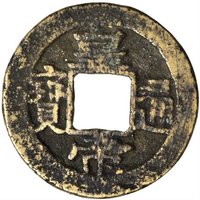
Obverse
Description:
Four Chinese characters read vertically, right to left.
Inscription:
嗣
寶 通
統
寶 通
統
Translation:
Legitimate Treasure, Circulating throughout the Realm.
Scripts: Chinese (traditional, regular script)
Language: Chinese
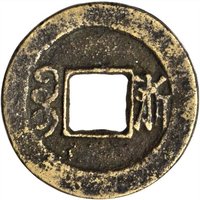
Reverse
Description:
Blank (uniface).
Edge
Plain
Mintings
| Year | Mint Mark | Mintage | Quality | Collection |
|---|---|---|---|---|
| — | — | — |
Historical background
The currency crisis during the 1860 Zhejiang rebellion, primarily the Taiping-led assault on Hangzhou, was a direct consequence of the wider monetary collapse engulfing the Qing Empire. By the mid-19th century, the state's traditional bimetallic system—silver taels for large transactions and bronze-alloy cash coins for daily use—was under severe strain. A massive outflow of silver due to the Opium Wars and trade deficits, coupled with rampant debasement of copper coinage by both official and private mints, had created severe inflation and shattered public trust in the currency. This systemic fragility meant that as the Taiping Heavenly Kingdom's armies captured key cities and mints in the Yangtze Valley, they disrupted the already tenuous supply of sound coinage to Zhejiang, exacerbating pre-existing scarcity and volatility.
Within the war zone, the crisis manifested as a desperate struggle for functional money. The Qing authorities, their finances shattered, reportedly resorted to issuing low-quality, easily forged iron cash coins and heavily discounted paper notes to pay troops and officials, which were widely rejected by a skeptical populace. Simultaneously, the invading Taiping forces issued their own distinctive coinage in captured cities like Shaoxing, attempting to assert sovereignty and fund their war effort. However, their coins, while often of higher metallic quality than late Qing issues, circulated only in pockets of control and failed to stabilize the economy. The result was a fractured monetary landscape where old Qing coins, new Taiping coins, private merchant notes, and imported foreign silver dollars all competed, with values shifting wildly based on military fortunes and local trust.
This monetary chaos crippled the local economy, fueling the rebellion's social discontents. Peasants and merchants faced ruin as the value of savings evaporated and market transactions became fraught with uncertainty. The scarcity of reliable small-denomination cash coins paralyzed everyday commerce, causing severe hardship. Ultimately, the currency situation was both a symptom and an accelerator of the collapse of Qing governmental authority in the region. It demonstrated how the loss of monetary sovereignty—the inability to provide a stable medium of exchange—was as critical a failure as military defeat, eroding the very foundations of economic life and pushing the war-ravaged population deeper into crisis.
Within the war zone, the crisis manifested as a desperate struggle for functional money. The Qing authorities, their finances shattered, reportedly resorted to issuing low-quality, easily forged iron cash coins and heavily discounted paper notes to pay troops and officials, which were widely rejected by a skeptical populace. Simultaneously, the invading Taiping forces issued their own distinctive coinage in captured cities like Shaoxing, attempting to assert sovereignty and fund their war effort. However, their coins, while often of higher metallic quality than late Qing issues, circulated only in pockets of control and failed to stabilize the economy. The result was a fractured monetary landscape where old Qing coins, new Taiping coins, private merchant notes, and imported foreign silver dollars all competed, with values shifting wildly based on military fortunes and local trust.
This monetary chaos crippled the local economy, fueling the rebellion's social discontents. Peasants and merchants faced ruin as the value of savings evaporated and market transactions became fraught with uncertainty. The scarcity of reliable small-denomination cash coins paralyzed everyday commerce, causing severe hardship. Ultimately, the currency situation was both a symptom and an accelerator of the collapse of Qing governmental authority in the region. It demonstrated how the loss of monetary sovereignty—the inability to provide a stable medium of exchange—was as critical a failure as military defeat, eroding the very foundations of economic life and pushing the war-ravaged population deeper into crisis.
✨ Legendary