

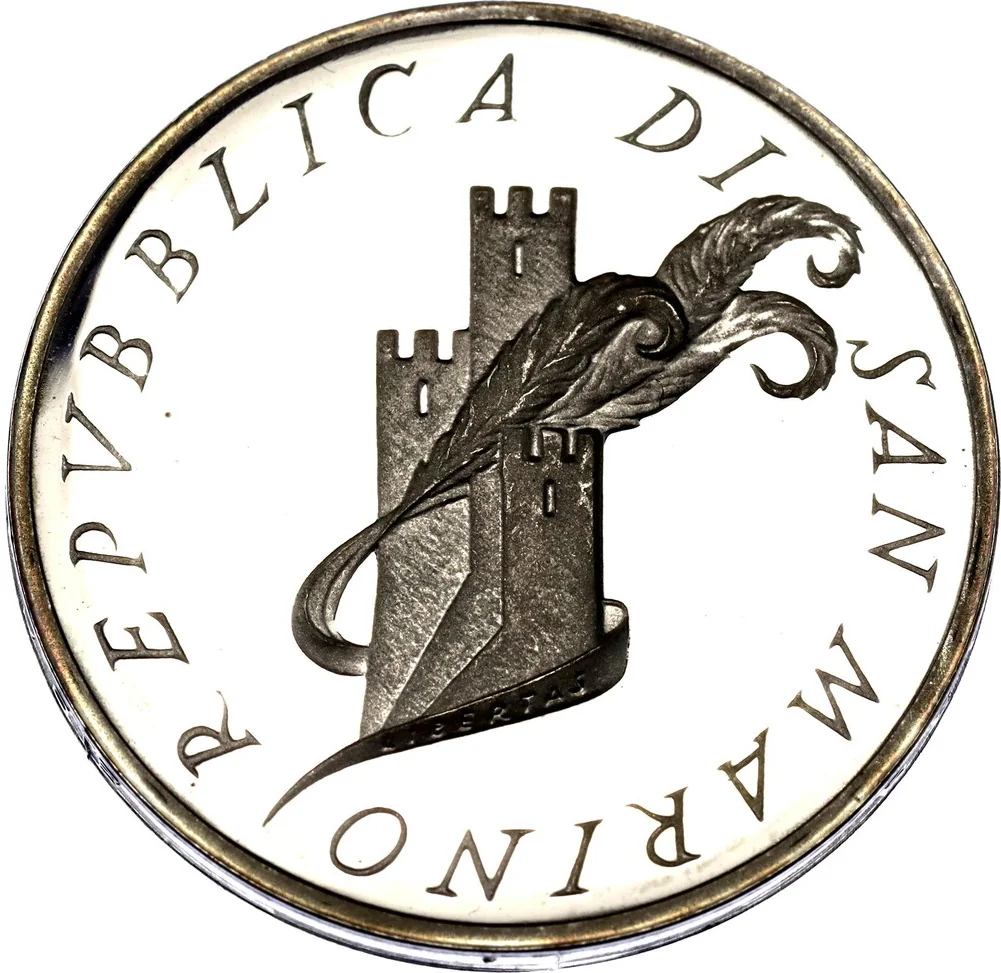
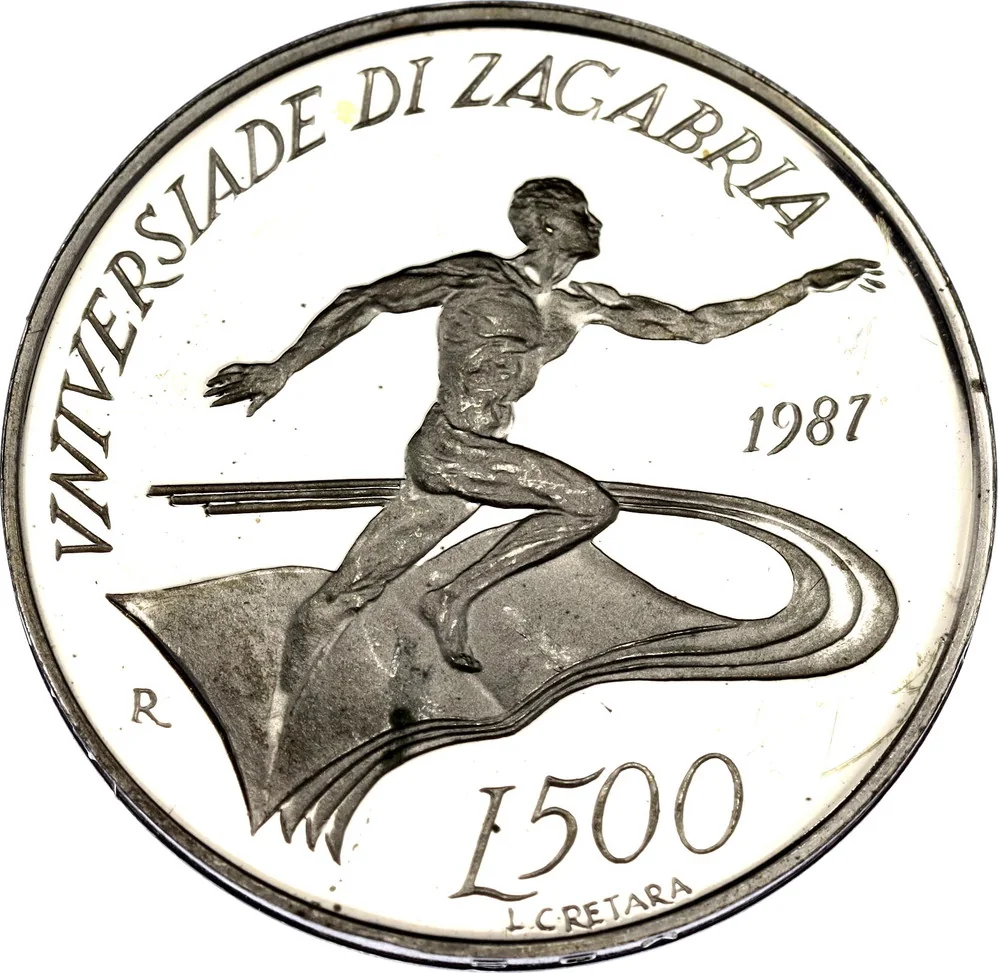
500 Lire – San Marino
Non-circulating coins
Commemoration: Zagreb University Games
San Marino
Context
Year: 1987
Issuer: San Marino 
Period:
(since 301)
Currency:
(1864—2001)
Demonetized: Yes
Total mintage: 45,000
Material
References
KM: #Click to copy to clipboard213
Numista: #27160
Value
Exchange value: 500 SML
Bullion value: $26.68
Obverse
Reverse
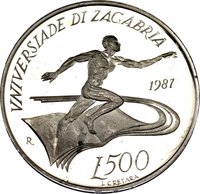
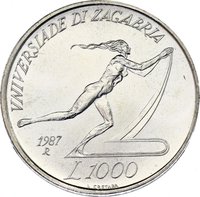
Description:
Sprint.
Inscription:
VNIVERSADE DI ZAGABRIA
L 500
1987
R
L.CRETARA
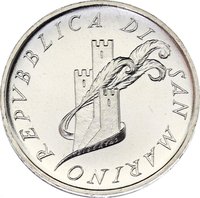
L 500
1987
R
L.CRETARA
Script: Latin
Engraver: Laura Cretara
Edge
Mints
| Name | Mark |
|---|---|
| Rome | R |
Historical background
In 1987, San Marino's currency situation was intrinsically tied to that of Italy, operating under a formal monetary convention that had been in place since 1939 and reaffirmed in a 1979 agreement. This pact granted San Marino the right to issue its own distinctive coinage, the Sammarinese lira, which was legally equivalent to the Italian lira and circulated interchangeably within the republic. However, the authority to issue banknotes remained exclusively with Italy's Banca d'Italia, meaning paper currency in circulation was entirely Italian, while San Marino minted its own limited quantities of coins, often prized by collectors.
The year fell within a period of significant economic challenge for the Italian lira zone, characterized by high inflation and periodic devaluations within the European Monetary System. Consequently, San Marino had no independent monetary policy; its economy was directly affected by Italy's struggles to maintain currency stability. This dependency meant that Sammarinese fiscal and economic policies were heavily oriented toward maintaining alignment with Rome, as any divergence could have triggered capital flight or trade disruption.
Despite these constraints, the arrangement provided stability for the microstate, ensuring seamless financial integration with its much larger neighbor, which surrounded it and dominated its trade. The late 1980s context was one of quiet endurance of this system, with no serious move toward monetary independence. This would remain the status quo until the profound shift a decade later, when both Italy and San Marino abandoned the lira entirely to adopt the euro as their common currency in 1999 and 2002.
The year fell within a period of significant economic challenge for the Italian lira zone, characterized by high inflation and periodic devaluations within the European Monetary System. Consequently, San Marino had no independent monetary policy; its economy was directly affected by Italy's struggles to maintain currency stability. This dependency meant that Sammarinese fiscal and economic policies were heavily oriented toward maintaining alignment with Rome, as any divergence could have triggered capital flight or trade disruption.
Despite these constraints, the arrangement provided stability for the microstate, ensuring seamless financial integration with its much larger neighbor, which surrounded it and dominated its trade. The late 1980s context was one of quiet endurance of this system, with no serious move toward monetary independence. This would remain the status quo until the profound shift a decade later, when both Italy and San Marino abandoned the lira entirely to adopt the euro as their common currency in 1999 and 2002.
🌟 Limited