

100 Lire – San Marino
San Marino
Context
Year: 1993
Issuer: San Marino 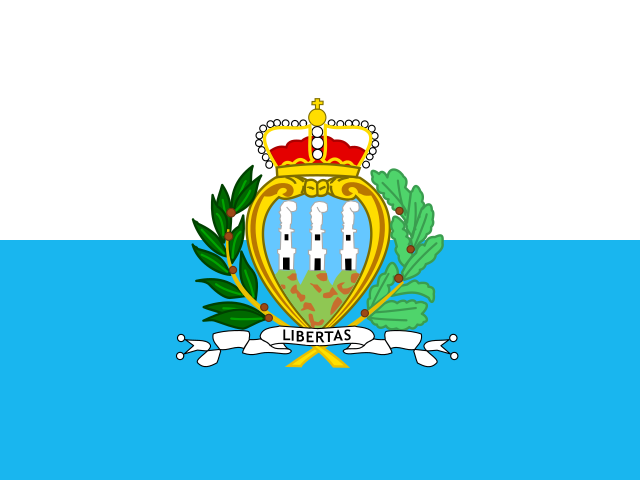
Period:
(since 301)
Currency:
(1864—2001)
Demonetization: 1 March 2002
Total mintage: 35,000
Material
Diameter: 21.79 mm
Weight: 4.5 g
Thickness: 1.63 mm
Shape: Round
Composition: Copper-nickel
Technique: Milled
Alignment: Coin alignment
flip
References
KM: #Click to copy to clipboard299
Numista: #27144
Value
Exchange value: 100 SML
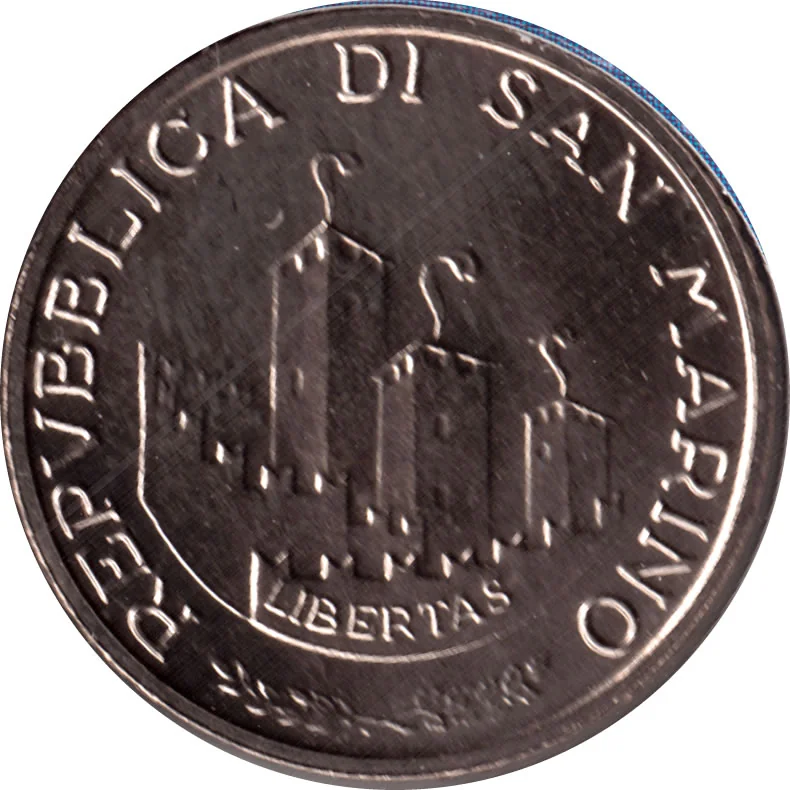
Obverse
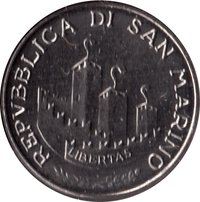
Description:
Coat of arms of San Marino.
Inscription:
REPVBBLICA DI SAN MARINO
LIBERTAS
LIBERTAS
Script: Latin
Engraver: Eugenio Driutti
Designer: Gian Franco Malison
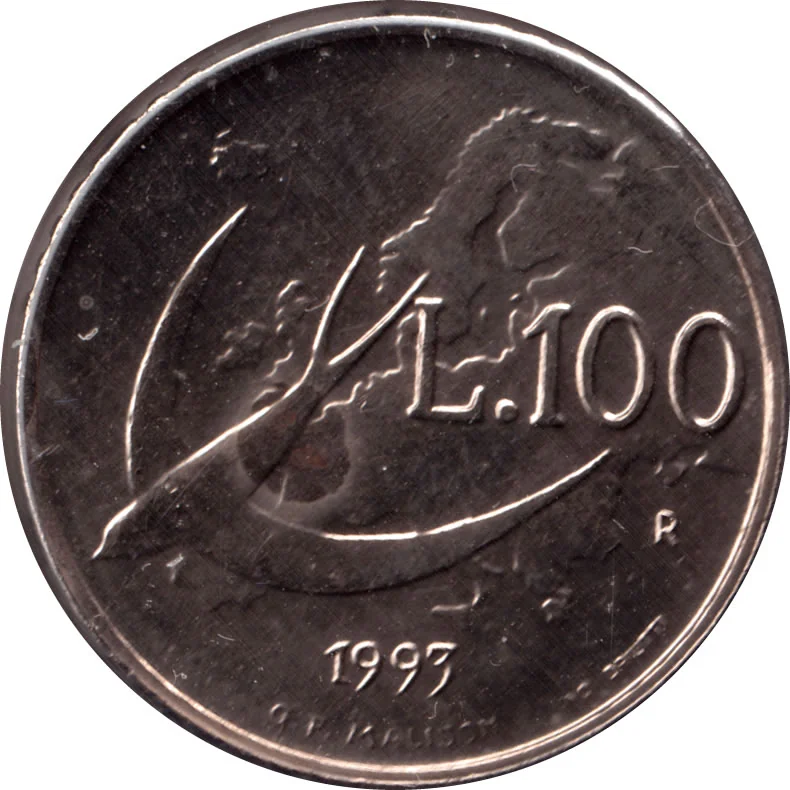
Reverse
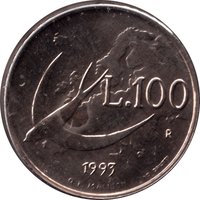
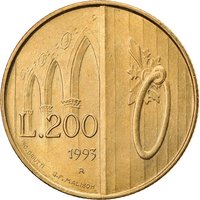
Description:
Swallow migration over Western Europe.
Inscription:
L.100
1993
R
1993
R
Script: Latin
Engraver: Eugenio Driutti
Designer: Gian Franco Malison
Edge
Segmented reeding
Categories
| Animal> Bird |
| Building> Castle or fortification |
| Map |
Mints
| Name | Mark |
|---|---|
| Rome | R |
Mintings
| Year | Mint Mark | Mintage | Quality | Collection |
|---|---|---|---|---|
| 1993 | R | 35,000 | In sets |
Historical background
In 1993, the currency situation in San Marino was intrinsically tied to its relationship with Italy, governed by a series of bilateral agreements. The Republic used the Italian Lira as its official legal tender, a system formalized in a 1939 Convention and reaffirmed in a 1991 monetary agreement. This arrangement granted San Marino the right to issue its own limited quantities of coinage, the Sammarinese Lira, which was minted in Italy and circulated at par with the Italian currency. However, these coins were primarily commemorative and for collectors, with day-to-day commerce overwhelmingly conducted using Italian banknotes and coins.
The year 1993 fell within a period of significant monetary turbulence for the Italian Lira, which directly impacted San Marino. Following the European Exchange Rate Mechanism (ERM) crisis of September 1992, the Lira had been forced to devalue and was temporarily suspended from the ERM. Consequently, San Marino, without an independent monetary policy, was passively subjected to the Lira's depreciation and high inflation. This underscored the nation's vulnerability to Italian economic conditions and highlighted the limitations of its monetary sovereignty under the existing agreements.
Looking forward, the events of 1993 reinforced San Marino's strategic interest in aligning with the emerging European monetary project. While not a member of the European Community, the republic began serious negotiations to ensure its place within the future Eurozone system. These efforts would culminate in a 1998 agreement with the European Community and Italy, allowing San Marino to adopt the euro as its official currency in 2002 (with the right to issue its own limited euro coins), thereby securing monetary stability and ending its exclusive, and sometimes precarious, dependency on the Italian Lira.
The year 1993 fell within a period of significant monetary turbulence for the Italian Lira, which directly impacted San Marino. Following the European Exchange Rate Mechanism (ERM) crisis of September 1992, the Lira had been forced to devalue and was temporarily suspended from the ERM. Consequently, San Marino, without an independent monetary policy, was passively subjected to the Lira's depreciation and high inflation. This underscored the nation's vulnerability to Italian economic conditions and highlighted the limitations of its monetary sovereignty under the existing agreements.
Looking forward, the events of 1993 reinforced San Marino's strategic interest in aligning with the emerging European monetary project. While not a member of the European Community, the republic began serious negotiations to ensure its place within the future Eurozone system. These efforts would culminate in a 1998 agreement with the European Community and Italy, allowing San Marino to adopt the euro as its official currency in 2002 (with the right to issue its own limited euro coins), thereby securing monetary stability and ending its exclusive, and sometimes precarious, dependency on the Italian Lira.
🌟 Uncommon