

½ piastre – Syria
Add to wishlist
Syria
Context
Years: 1935–1936
Issuer: Syria
Period:
(1930—1946)
Currency:
(since 1919)
Demonetized: Yes
Total mintage: 1,400,000
Material
Diameter: 21 mm
Weight: 4 g
Shape: Round
Composition: Nickel brass
Magnetic: No
Technique: Milled
Alignment: Coin alignment
flip
References
KM: #
Numista: #2711
Value
Exchange value: 0.005 SYP
Obverse
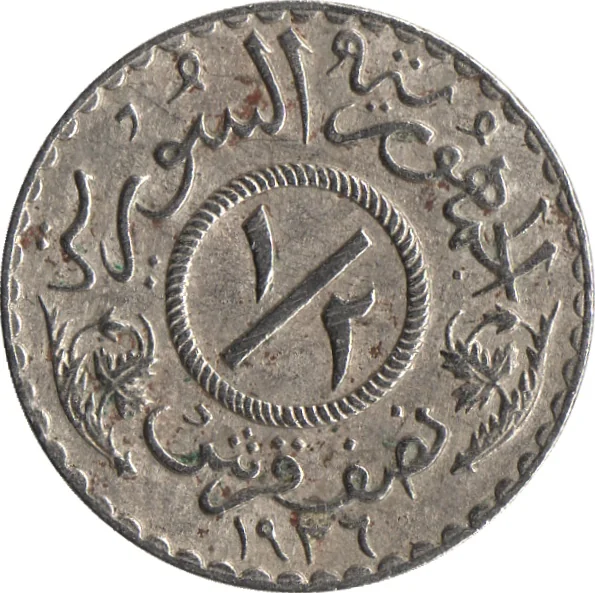
Description:
Arabic numeral in a circle.
Inscription:
الجمهورية السورية
١/٢
نصف قرش
١٩٣٦
١/٢
نصف قرش
١٩٣٦
Translation:
Syrian Republic
1/2
Half Qirsh
1936
1/2
Half Qirsh
1936
Script: Arabic
Language: Arabic
Engraver: Lucien Georges Bazor
Reverse
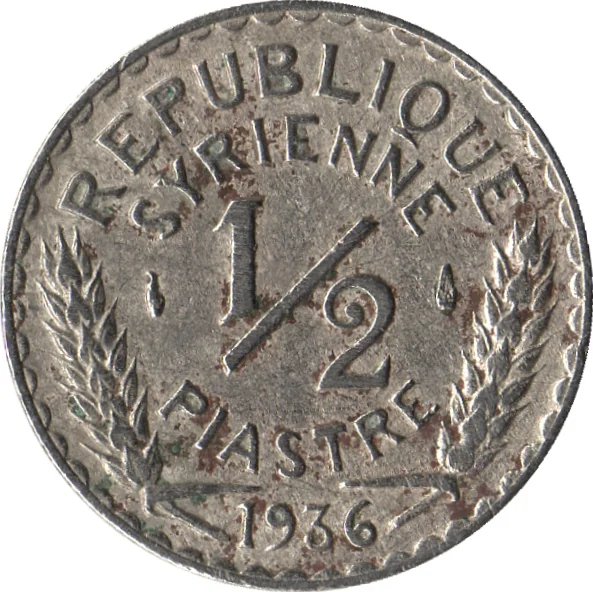
Description:
Two oat sprigs flank the denomination.
Inscription:
REPUBLIQUE
SYRIENNE
1/2
PIASTRE
1936
SYRIENNE
1/2
PIASTRE
1936
Translation:
SYRIAN REPUBLIC
1/2
PIASTER
1936
1/2
PIASTER
1936
Script: Latin
Language: French
Engraver: Lucien Georges Bazor
Edge
Plain
Mints
| Name | Mark |
|---|---|
| Monnaie de Paris | — |
Mintings
| Year | Mint Mark | Mintage | Quality | Collection |
|---|---|---|---|---|
| 1935 | — | 600,000 | ||
| 1936 | — | 800,000 |
Historical background
In 1935, Syria's currency situation was defined by its status as a French mandate, established after the fall of the Ottoman Empire. The monetary system was under the control of the French-sponsored Banque de Syrie et du Grand-Liban (BSGL), which held the exclusive right to issue currency. The circulating banknotes, the Syrian pound or livre syrienne, were effectively pegged to the French franc, ensuring monetary stability but explicitly tying Syria's economy to that of its mandatory power. This arrangement facilitated trade with France but limited autonomous financial policy.
The currency itself was modern for its time, featuring bilingual notes in Arabic and French, and was fully convertible. The BSGL maintained a currency board system, holding substantial reserves in French francs and gold to fully back the issued notes, which fostered public confidence in the money's value. This stability stood in contrast to the volatility experienced in the final years of Ottoman rule and provided a predictable environment for commerce during a period of infrastructure development and nascent national industry.
However, this imposed financial architecture was a point of political contention. Syrian nationalists viewed the BSGL's control as a symbol of colonial domination and economic dependency, arguing that it served French commercial interests above Syrian developmental needs. While the currency was technically stable in 1935, the underlying resentment towards foreign control over such a vital lever of sovereignty was a growing undercurrent, foreshadowing future battles for economic independence that would follow political independence in the years after World War II.
The currency itself was modern for its time, featuring bilingual notes in Arabic and French, and was fully convertible. The BSGL maintained a currency board system, holding substantial reserves in French francs and gold to fully back the issued notes, which fostered public confidence in the money's value. This stability stood in contrast to the volatility experienced in the final years of Ottoman rule and provided a predictable environment for commerce during a period of infrastructure development and nascent national industry.
However, this imposed financial architecture was a point of political contention. Syrian nationalists viewed the BSGL's control as a symbol of colonial domination and economic dependency, arguing that it served French commercial interests above Syrian developmental needs. While the currency was technically stable in 1935, the underlying resentment towards foreign control over such a vital lever of sovereignty was a growing undercurrent, foreshadowing future battles for economic independence that would follow political independence in the years after World War II.
🌱 Fairly Common