

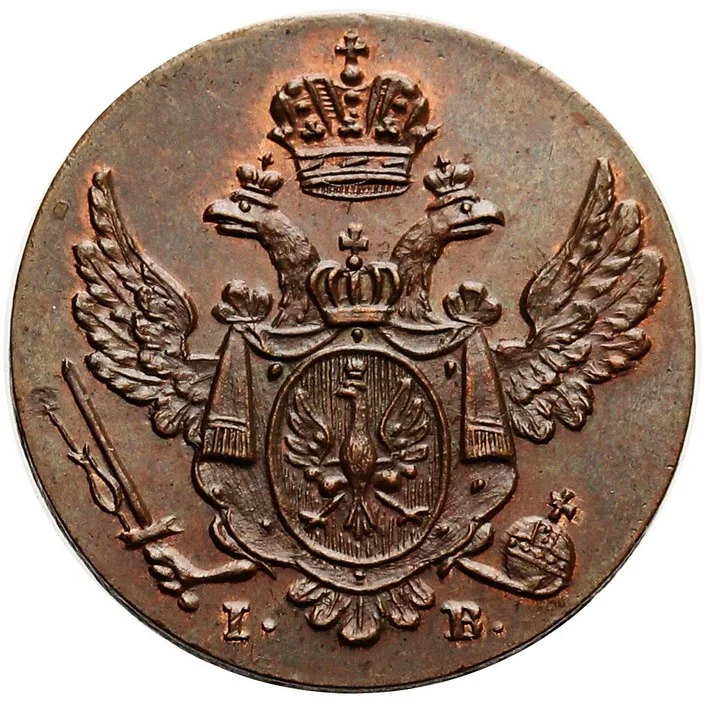
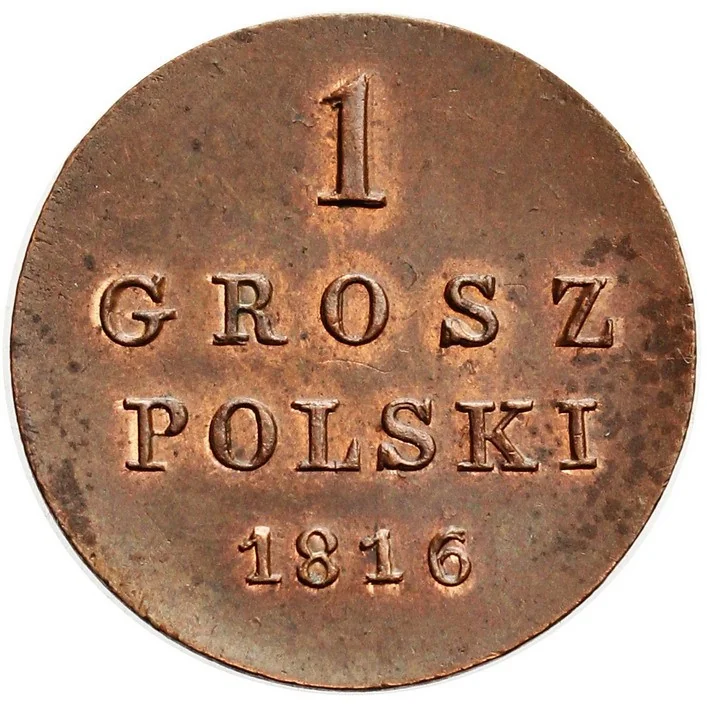
1 Grosz – Congress Kingdom of Poland
Poland
Context
Years: 1815–1835
Country: Poland 
Issuer: Congress Kingdom of Poland
Ruler: Alexander I
Currency:
(1815—1841)
Demonetized: Yes
Total mintage: 14,276,644
Material
References
Numista: #27032
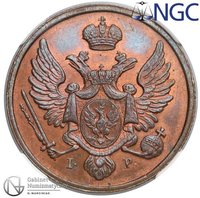
Obverse
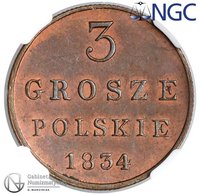
Reverse
Edge
Plain
Mintings
| Year | Mint Mark | Mintage | Quality | Collection |
|---|---|---|---|---|
| 1815 | IB | — | ||
| 1816 | IB | 1,873,070 | ||
| 1817 | — | 3,091,936 | ||
| 1818 | IB | — | ||
| 1818 | IB | — | Proof | |
| 1819 | — | — | ||
| 1820 | — | 371,700 | ||
| 1821 | — | 571,278 | ||
| 1822 | — | — | ||
| 1828 | FH | 1,189,568 | ||
| 1829 | FH | 931,167 | ||
| 1830 | FH | 1,568,652 | ||
| 1830 | KG | — | ||
| 1831 | KG | 1,776,820 | ||
| 1832 | KG | 1,558,658 | ||
| 1833 | KG | 374,760 | ||
| 1833 | KG | — | Proof | |
| 1834 | IP | — | ||
| 1834 | IP | — | Proof | |
| 1834 | KG | 427,348 | ||
| 1835 | IP | 541,687 |
Historical background
Following its creation at the 1815 Congress of Vienna, the Congress Kingdom of Poland found itself in a complex monetary situation, caught between its political autonomy within the Russian Empire and the practical need for economic integration. The Kingdom was granted its own constitution and financial system, which included the right to mint its own currency. Consequently, the Polish złoty (often called the złotówka) was established as the official currency, with its value pegged to the Russian monetary system at a fixed rate of 1 złoty = 15 Russian kopeks.
The new currency, introduced in 1816, was a tangible symbol of the Kingdom's distinct status. Coins were minted bearing the portrait of the Russian Tsar (who was also the King of Poland) and Polish inscriptions, including the national coat of arms. However, this monetary autonomy was more theoretical than absolute. The fixed exchange rate tightly bound the Polish economy to the Russian one, and the monetary policy was ultimately subject to the interests of St. Petersburg. Furthermore, both Russian and Polish currencies circulated simultaneously within the Kingdom, creating a de facto dual-currency system.
This arrangement reflected the broader political compromise of the Congress Kingdom: a facade of Polish self-governance underpinned by ultimate Russian control. The currency system functioned adequately in the early years, facilitating trade and stability. However, it was inherently fragile, as any significant economic divergence between Poland and Russia or shifts in Russian imperial policy could destabilize it. This monetary dependency would later mirror the Kingdom's political fate, as its autonomy was gradually eroded following the November Uprising of 1830-31, after which the Polish monetary system was fully integrated into the Russian Empire.
The new currency, introduced in 1816, was a tangible symbol of the Kingdom's distinct status. Coins were minted bearing the portrait of the Russian Tsar (who was also the King of Poland) and Polish inscriptions, including the national coat of arms. However, this monetary autonomy was more theoretical than absolute. The fixed exchange rate tightly bound the Polish economy to the Russian one, and the monetary policy was ultimately subject to the interests of St. Petersburg. Furthermore, both Russian and Polish currencies circulated simultaneously within the Kingdom, creating a de facto dual-currency system.
This arrangement reflected the broader political compromise of the Congress Kingdom: a facade of Polish self-governance underpinned by ultimate Russian control. The currency system functioned adequately in the early years, facilitating trade and stability. However, it was inherently fragile, as any significant economic divergence between Poland and Russia or shifts in Russian imperial policy could destabilize it. This monetary dependency would later mirror the Kingdom's political fate, as its autonomy was gradually eroded following the November Uprising of 1830-31, after which the Polish monetary system was fully integrated into the Russian Empire.
🌟 Limited