

5 centimes – Algeria
Add to wishlist
Circulating commemorative coins
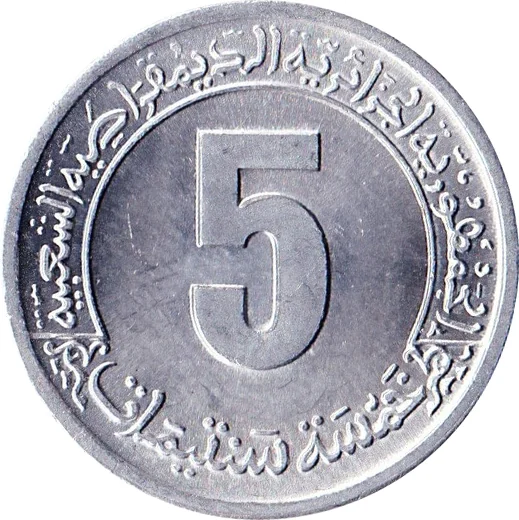
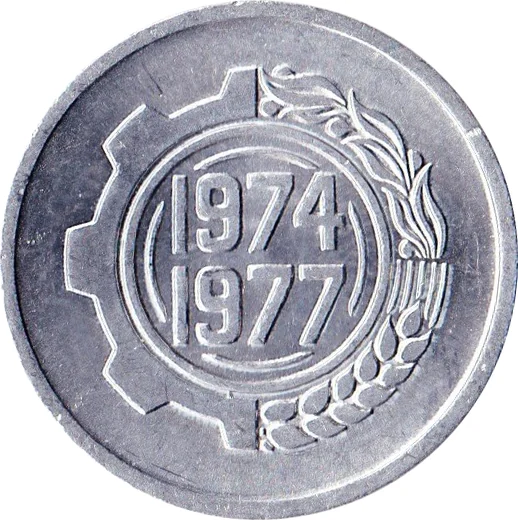
Commemoration: FAO - 2nd Quadrennial Plan (1974-1977)
Algeria
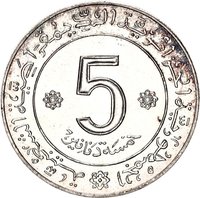
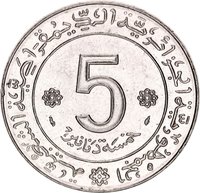
Obverse
Reverse
Description:
Start and end dates of the second quadrennial plan, encircled by gears and cereal ears.
Inscription:
1974
1977
1977
Script: Latin
Edge
Plain
Categories
| Organization> FAO |
| Symbol> Wreath |
Mints
| Name | Mark |
|---|---|
| Kremnica | — |
Mintings
| Year | Mint Mark | Mintage | Quality | Collection |
|---|---|---|---|---|
| 1974 | — | 10,000,000 |
Historical background
In 1974, Algeria's currency situation was fundamentally shaped by the nation's socialist-oriented economic model and its heavy reliance on hydrocarbon exports. Following independence in 1962, the Algerian dinar (DZD) was established, replacing the Algerian new franc. By the early 1970s, the state, under President Houari Boumediene, exercised strict control over the economy and the financial system, including a fixed exchange rate regime. The dinar's value was administratively set by the Banque d'Algérie and was not freely convertible, reflecting a policy of economic insulation and protection of domestic industry.
The year 1974 proved to be a period of significant financial strength for Algeria, directly influenced by the 1973 oil crisis. The quadrupling of global oil prices by OPEC, of which Algeria was a vocal member, led to a massive influx of petrodollars. This hydrocarbon revenue boom transformed the country's foreign exchange reserves, providing the state with substantial capital for its ambitious industrialization drives, known as the "industrializing industries" strategy. Consequently, the external pressure on the dinar was minimal, as the balance of payments was strongly positive, supported almost entirely by oil and gas exports.
However, this apparent strength masked underlying vulnerabilities. The economy was becoming increasingly monolithic, with the currency's stability and the state's spending capacity entirely tethered to volatile international oil markets. The fixed exchange rate, while stable in the short term, discouraged non-hydrocarbon exports and contributed to import dependency for consumer goods. Therefore, the robust currency situation of 1974 was not a product of diversified economic strength but a temporary fiscal surplus, storing challenges related to long-term sustainability and over-reliance on a single resource that would become acute in the following decades.
The year 1974 proved to be a period of significant financial strength for Algeria, directly influenced by the 1973 oil crisis. The quadrupling of global oil prices by OPEC, of which Algeria was a vocal member, led to a massive influx of petrodollars. This hydrocarbon revenue boom transformed the country's foreign exchange reserves, providing the state with substantial capital for its ambitious industrialization drives, known as the "industrializing industries" strategy. Consequently, the external pressure on the dinar was minimal, as the balance of payments was strongly positive, supported almost entirely by oil and gas exports.
However, this apparent strength masked underlying vulnerabilities. The economy was becoming increasingly monolithic, with the currency's stability and the state's spending capacity entirely tethered to volatile international oil markets. The fixed exchange rate, while stable in the short term, discouraged non-hydrocarbon exports and contributed to import dependency for consumer goods. Therefore, the robust currency situation of 1974 was not a product of diversified economic strength but a temporary fiscal surplus, storing challenges related to long-term sustainability and over-reliance on a single resource that would become acute in the following decades.
🌱 Very Common