

1 pound (Ba'ath Party) – Syria
Add to wishlist
Circulating commemorative coins
Commemoration: 25th Anniversary of Ba'ath Party
Syria
Context
Year: 1972
Islamic (Hijri) Year:: 1392
Issuer: Syria
Period:
(since 1961)
Currency:
(since 1919)
Demonetized: Yes
Total mintage: 10,000,000
Material
References
KM: #
Numista: #2688
Value
Exchange value: 1 SYP
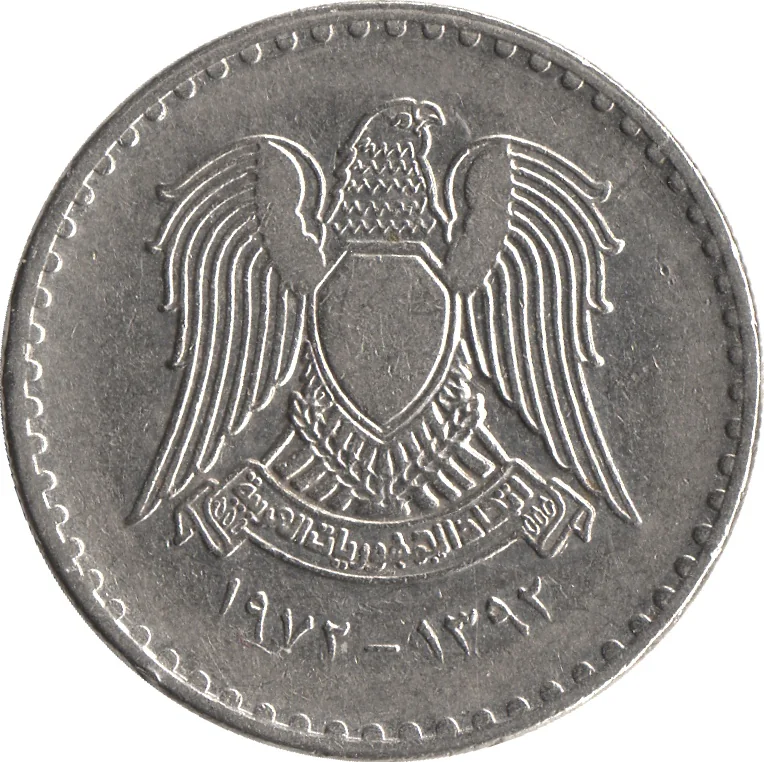
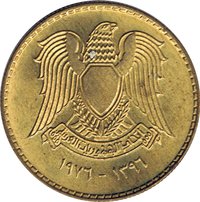
Obverse
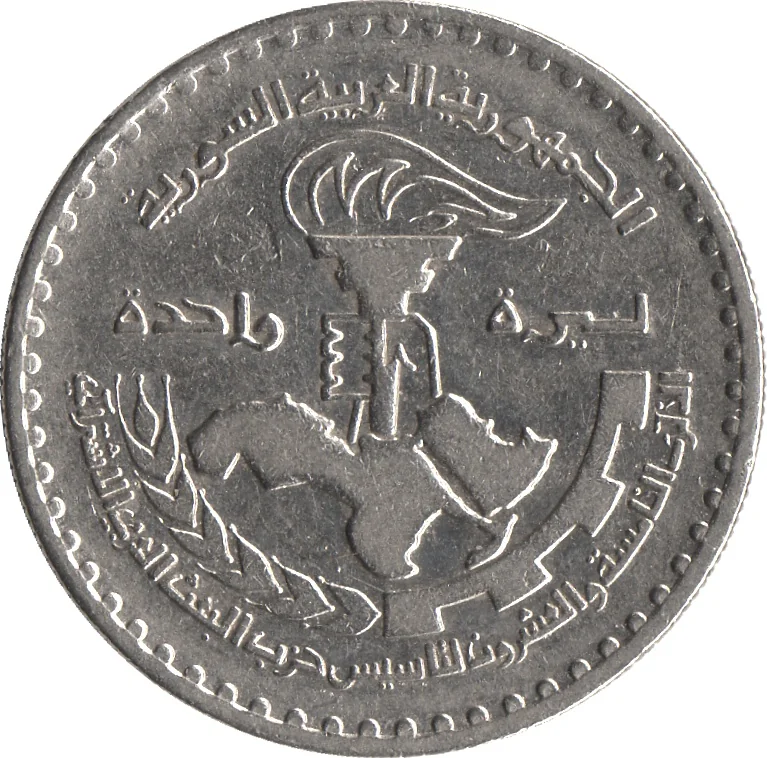
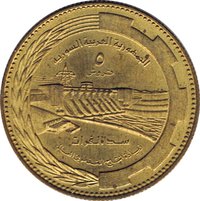
Reverse
Description:
Stylized map of the Arab League with a torch.
Inscription:
الجمهورية العربية السورية
ليرة واحدة
الذكرى الخامسة والعشرون لتاسيس حزب البعث العربي الإشتراكي
ليرة واحدة
الذكرى الخامسة والعشرون لتاسيس حزب البعث العربي الإشتراكي
Translation:
The Syrian Arab Republic
One Lira
The Twenty-Fifth Anniversary of the Founding of the Arab Socialist Ba'ath Party
One Lira
The Twenty-Fifth Anniversary of the Founding of the Arab Socialist Ba'ath Party
Script: Arabic
Language: Arabic
Edge
Reeded
Categories
| Animal> Bird |
| Map |
| Symbols> Coat of Arms |
Mintings
| Year | Mint Mark | Mintage | Quality | Collection |
|---|---|---|---|---|
| 1972 | — | 10,000,000 |
Historical background
In 1972, Syria's currency situation was characterized by relative stability under a centrally planned economy and the enduring influence of the 1947 Currency Law. The official currency was the Syrian pound (S£), also known as the lira, which was issued and controlled by the Central Bank of Syria. The country maintained a fixed exchange rate system, pegged primarily to the US dollar, with an official rate that had remained largely unchanged for years. This stability was artificially maintained through strict capital controls, import licensing, and state management of foreign exchange, insulating the domestic economy from external market pressures.
This rigid control was a feature of the socialist-oriented economic policies of the Ba'ath Party government, which had consolidated power in 1970 under Hafez al-Assad. The state directed economic activity, with key sectors nationalized, and used the currency system to finance development plans and control inflation. Foreign exchange reserves were allocated by the government for priority imports like industrial machinery and armaments, rather than consumer goods. While this provided surface-level stability, it also fostered a growing disparity between the official exchange rate and the black-market rate, as trade restrictions and limited convertibility created excess demand for hard currencies.
Overall, the 1972 currency landscape reflected a closed, state-directed economy. The fixed parity and controls prevented overt crisis but masked underlying inefficiencies and a growing reliance on black markets for foreign currency. This system would face mounting pressures in subsequent decades due to increased military spending, population growth, and the eventual shift away from state socialism, but in the early 1970s, it appeared as a stable, if inflexible, component of the regime's control.
This rigid control was a feature of the socialist-oriented economic policies of the Ba'ath Party government, which had consolidated power in 1970 under Hafez al-Assad. The state directed economic activity, with key sectors nationalized, and used the currency system to finance development plans and control inflation. Foreign exchange reserves were allocated by the government for priority imports like industrial machinery and armaments, rather than consumer goods. While this provided surface-level stability, it also fostered a growing disparity between the official exchange rate and the black-market rate, as trade restrictions and limited convertibility created excess demand for hard currencies.
Overall, the 1972 currency landscape reflected a closed, state-directed economy. The fixed parity and controls prevented overt crisis but masked underlying inefficiencies and a growing reliance on black markets for foreign currency. This system would face mounting pressures in subsequent decades due to increased military spending, population growth, and the eventual shift away from state socialism, but in the early 1970s, it appeared as a stable, if inflexible, component of the regime's control.
🌱 Fairly Common