

1000 rials – Iran
Add to wishlist
Circulating commemorative coins
Commemoration: Half of Sha'ban
Iran
Context
Year: 2011
Iranian - Persian Year:: 1390
Issuer: Iran
Period:
(since 1979)
Currency:
(since 1932)
Total mintage: 60,000,000
Material
Diameter: 23.7 mm
Weight: 4.6 g
Thickness: 1.61 mm
Shape: Round
Composition: Copper-aluminium-nickel
Technique: Milled
Alignment: Coin alignment
flip
References
KM: #
Numista: #26843
Value
Exchange value: 1000 IRR
Obverse
Description:
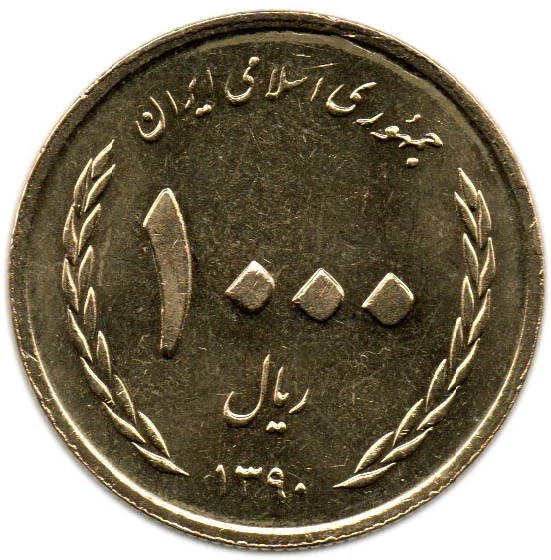
Iran, 1000 Rials, Wheat Spikes coin.
Inscription:
جمُهوری اسلامی ایران
۱۰۰۰
ریال
۱۳۹۰
۱۰۰۰
ریال
۱۳۹۰
Translation:
Islamic Republic of Iran
1000
Rials
1390
1000
Rials
1390
Language: Persian
Reverse
Description:
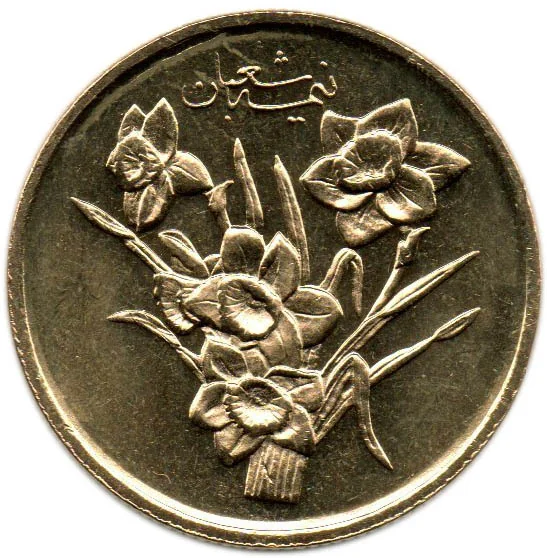
Half of Sha'ban: Twelfth Imam's birth, marked by narcissus (his mother's name, Nargess).
Inscription:
نیمـه شعبان
Translation:
The middle of Sha'ban
Language: Arabic
Edge
Reeded
Mintings
| Year | Mint Mark | Mintage | Quality | Collection |
|---|---|---|---|---|
| 2011 | — | 60,000,000 |
Historical background
In 2011, Iran's currency, the rial, faced severe and mounting pressure, marking the beginning of a prolonged crisis that would define its economy for the next decade. The primary catalyst was the significant escalation of international sanctions, particularly those imposed by the United States and the European Union targeting Iran's vital oil exports and central bank transactions. These measures severely restricted Iran's ability to access the global financial system and earn foreign exchange, creating a critical shortage of hard currency. Concurrently, domestic economic mismanagement, fiscal deficits, and high inflation—officially around 20% but believed by many to be higher—eroded confidence in the rial, prompting a flight to safer assets like gold and U.S. dollars.
The situation manifested in a rapidly growing black market for foreign currency, where the rial's value diverged sharply from the government's official, overvalued exchange rate. While the central bank maintained an official rate of approximately 10,600 rials to the U.S. dollar for prioritized imports, the open market rate plummeted, losing about 40% of its value in the latter half of 2011 alone. This dual-rate system fostered corruption, rent-seeking, and a inefficient allocation of resources, as access to cheap dollars became a lucrative privilege. The government's response, including attempts to unify rates and crack down on black-market traders, proved ineffective against the overwhelming market forces and speculative pressure driven by geopolitical uncertainty.
Ultimately, the currency turmoil of 2011 was a direct symptom of the collision between external isolation and internal economic vulnerabilities. It signaled a turning point where sanctions began to bite deeply, moving beyond government balance sheets to directly impact the cost of living for ordinary Iranians. The rapid devaluation increased the price of imported goods, fueling inflation and shrinking purchasing power, which laid the groundwork for the more dramatic currency collapses and widespread economic hardship that would follow in the coming years.
The situation manifested in a rapidly growing black market for foreign currency, where the rial's value diverged sharply from the government's official, overvalued exchange rate. While the central bank maintained an official rate of approximately 10,600 rials to the U.S. dollar for prioritized imports, the open market rate plummeted, losing about 40% of its value in the latter half of 2011 alone. This dual-rate system fostered corruption, rent-seeking, and a inefficient allocation of resources, as access to cheap dollars became a lucrative privilege. The government's response, including attempts to unify rates and crack down on black-market traders, proved ineffective against the overwhelming market forces and speculative pressure driven by geopolitical uncertainty.
Ultimately, the currency turmoil of 2011 was a direct symptom of the collision between external isolation and internal economic vulnerabilities. It signaled a turning point where sanctions began to bite deeply, moving beyond government balance sheets to directly impact the cost of living for ordinary Iranians. The rapid devaluation increased the price of imported goods, fueling inflation and shrinking purchasing power, which laid the groundwork for the more dramatic currency collapses and widespread economic hardship that would follow in the coming years.
🌱 Common