

1 Ruble – Russian Empire
Non-circulating coins
Commemoration: Alexander II Memorial
Russia
Context
Year: 1898
Country: Russia 
Issuer: Russian Empire
Ruler: Nicholas II
Currency:
(1700—1917)
Demonetized: Yes
Total mintage: 5,000
Material
References
Y: #Click to copy to clipboard61
Numista: #26840
Value
Bullion value: $51.15
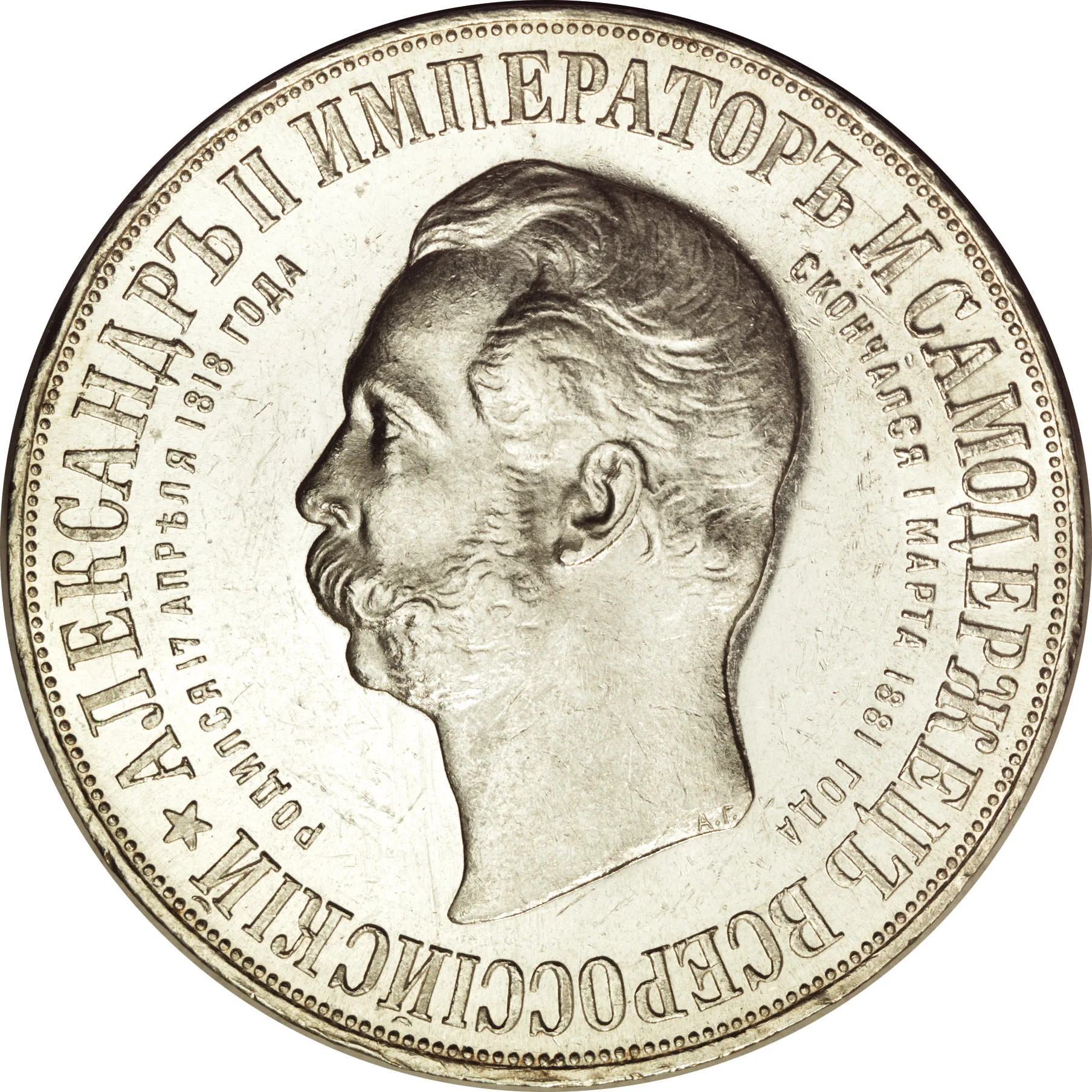
Obverse
Description:
Emperor Alexander II portrait.
Inscription:
АЛЕКСАНДРЪ II ИМПЕРАТОРЪ И САМОДЕРЖЕЦЪ ВСЕРОССІЙСКІЙ *
РОДИЛСЯ I7 АПРѢЛЯ I8I8 ГОДА
СКОНЧАЛСЯ I МАРТА I88I ГОДА
РОДИЛСЯ I7 АПРѢЛЯ I8I8 ГОДА
СКОНЧАЛСЯ I МАРТА I88I ГОДА
Translation:
ALEXANDER II EMPEROR AND AUTOCRAT OF ALL RUSSIA *
BORN 17 APRIL 1818 YEAR
DIED 1 MARCH 1881 YEAR
BORN 17 APRIL 1818 YEAR
DIED 1 MARCH 1881 YEAR
Script: Cyrillic
Language: Russian
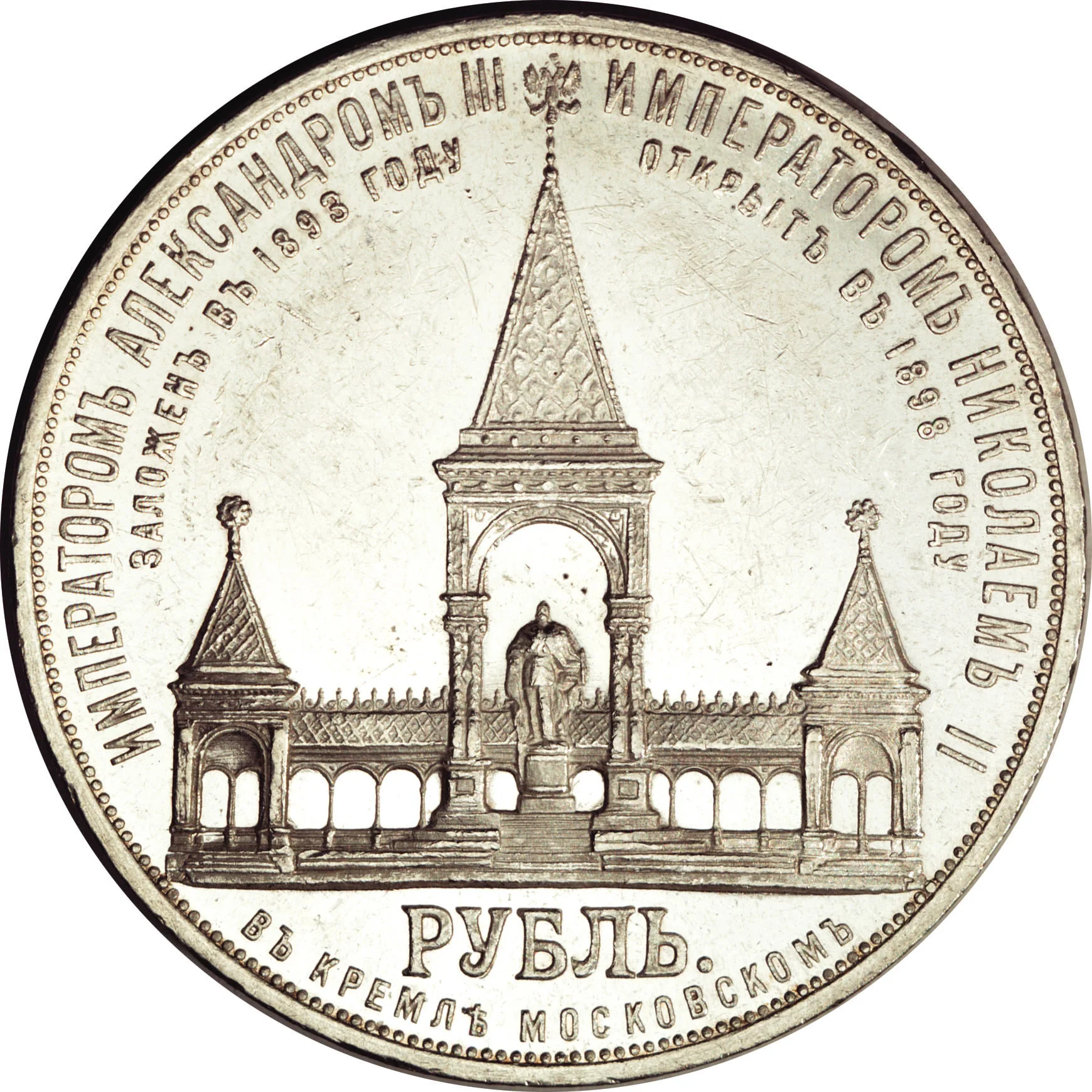
Reverse
Description:
Tsar Alexander II Monument
Inscription:
ИМПЕРАТОРОМЪ АЛЕКСАНДРОМЪ III
ЗАЛОЖЕНЪ ВЪ 1893 ГОДУ
ИМПЕРАТОРОМЪ НИКОЛАЕМЪ II
ОТКРЫТЪ ВЪ 1898 ГОДУ
РУБЛЬ.
ВЪ КРЕМЛѢ МОСКОВСКОМЪ
ЗАЛОЖЕНЪ ВЪ 1893 ГОДУ
ИМПЕРАТОРОМЪ НИКОЛАЕМЪ II
ОТКРЫТЪ ВЪ 1898 ГОДУ
РУБЛЬ.
ВЪ КРЕМЛѢ МОСКОВСКОМЪ
Translation:
BY EMPEROR ALEXANDER III
LAID DOWN IN THE YEAR 1893
BY EMPEROR NICHOLAS II
OPENED IN THE YEAR 1898
RUBLE.
IN THE MOSCOW KREMLIN
LAID DOWN IN THE YEAR 1893
BY EMPEROR NICHOLAS II
OPENED IN THE YEAR 1898
RUBLE.
IN THE MOSCOW KREMLIN
Script: Cyrillic
Language: Russian
Edge
Smooth with inscription
Legend:
ЧИСТАГО СЕРЕБРА 4 ЗОЛОТНИКА 21 ДОЛѦ ( А • Г )
Translation:
Four Zolotniks and Twenty-One Dolya of Pure Silver (A • G)
Language: Russian
Mints
| Name | Mark |
|---|---|
| Saint Petersburg | — |
Mintings
| Year | Mint Mark | Mintage | Quality | Collection |
|---|---|---|---|---|
| 1898 | АГ | 5,000 |
Historical background
By 1898, the currency system of the Russian Empire was defined by the landmark monetary reform of 1897, masterminded by Finance Minister Sergei Witte. This reform decisively ended a long period of paper currency instability and formally placed Russia on the gold standard. The core of the reform was the devaluation of the paper ruble and its firm pegging to gold, with the new gold ruble (containing 0.774235 grams of pure gold) established as the fundamental monetary unit. The State Bank was granted the exclusive right to issue paper credit rubles, which were now fully convertible into gold coins upon demand, restoring domestic and international confidence in the Russian currency.
The immediate effects were transformative. The stable gold-backed ruble attracted a significant influx of foreign investment, particularly from France and Belgium, which was crucial for financing Russia's rapid industrialization in the late Tsarist period. It facilitated international trade, provided predictable exchange rates, and integrated Russia more firmly into the global financial system. The reform also mandated that at least half of the circulating paper money be backed by gold reserves, a rule that imposed fiscal discipline on the government and helped curb inflationary pressures that had plagued the earlier, fiduciary-based system.
However, this gold-based stability came with inherent vulnerabilities and social costs. The regime's commitment to maintaining the gold convertibility required maintaining high interest rates and a consistent trade surplus to accumulate specie, which often translated into heavy taxation on the peasantry through grain exports. The system was also highly sensitive to external shocks, as seen in the financial panic of 1899-1900, which tested the new standard shortly after its implementation. While a symbol of modern statecraft and economic prestige for the Empire, the gold standard created a rigid financial structure that prioritized international credibility over domestic flexibility, storing up tensions that would become apparent in the crises of the early 20th century.
The immediate effects were transformative. The stable gold-backed ruble attracted a significant influx of foreign investment, particularly from France and Belgium, which was crucial for financing Russia's rapid industrialization in the late Tsarist period. It facilitated international trade, provided predictable exchange rates, and integrated Russia more firmly into the global financial system. The reform also mandated that at least half of the circulating paper money be backed by gold reserves, a rule that imposed fiscal discipline on the government and helped curb inflationary pressures that had plagued the earlier, fiduciary-based system.
However, this gold-based stability came with inherent vulnerabilities and social costs. The regime's commitment to maintaining the gold convertibility required maintaining high interest rates and a consistent trade surplus to accumulate specie, which often translated into heavy taxation on the peasantry through grain exports. The system was also highly sensitive to external shocks, as seen in the financial panic of 1899-1900, which tested the new standard shortly after its implementation. While a symbol of modern statecraft and economic prestige for the Empire, the gold standard created a rigid financial structure that prioritized international credibility over domestic flexibility, storing up tensions that would become apparent in the crises of the early 20th century.
💎 Extremely Rare