

2.5 Lira (Green Cross Organisation) – Turkey
Non-circulating coins
Commemoration: 100th Anniversary of the Green Cross Organisation
Turkey
Context

Material

References
KM: #Click to copy to clipboard1475
Numista: #268321
Value
Exchange value: 2.5 TRY = $0.06
Inflation-adjusted value: 15.45 TRY
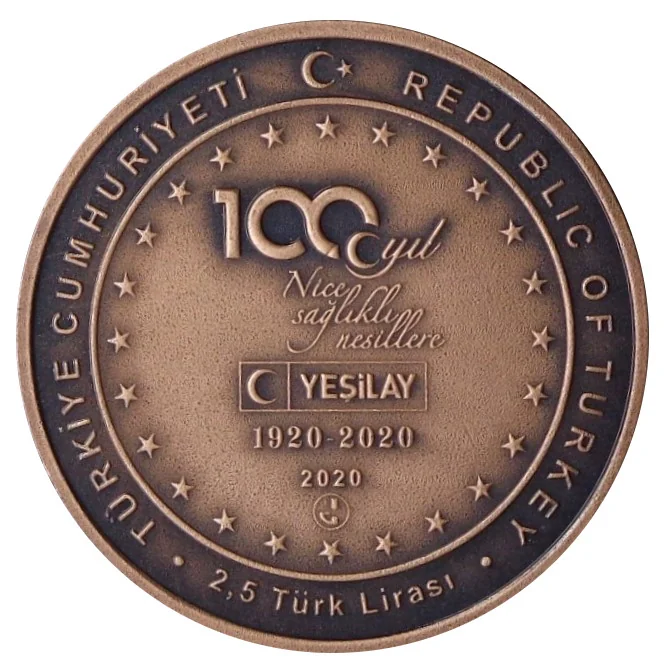
Obverse
Description:
100+ texts with asterisks.
Inscription:
TÜRKIYE CUMHURIYETI REPUBLIC OF TURKEY
100 YIL
Nice
saglikli nesillere
YESILAY
1920 - 2020
2020
• 2,5 Türk Lirasi •
100 YIL
Nice
saglikli nesillere
YESILAY
1920 - 2020
2020
• 2,5 Türk Lirasi •
Translation:
REPUBLIC OF TURKEY
100 YEARS
Nice
to healthy generations
GREEN CRESCENT
1920 - 2020
2020
• 2.5 TURKISH LIRA •
100 YEARS
Nice
to healthy generations
GREEN CRESCENT
1920 - 2020
2020
• 2.5 TURKISH LIRA •
Script: Latin
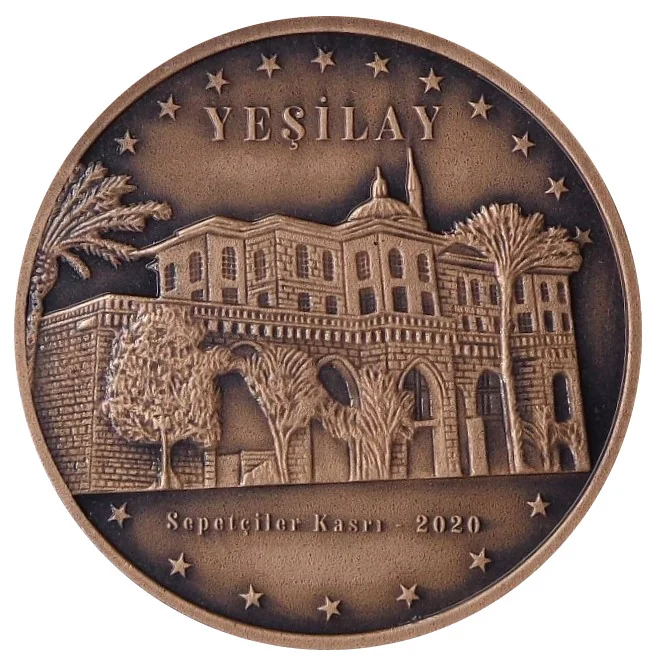
Reverse
Description:
Sepetçiler Palace, now the Green Crescent Headquarters, framed by star-scattered trees.
Inscription:
YESILAY
Sepetciler Kasri - 2020
Sepetciler Kasri - 2020
Script: Latin
Edge
Milled
Categories
| Health |
Mints
| Name | Mark |
|---|---|
| Turkish State Mint | — |
Mintings
| Year | Mint Mark | Mintage | Quality | Collection |
|---|---|---|---|---|
| 2020 | — | 2,152 |
Historical background
In 2020, Turkey's currency, the lira, entered a period of severe and sustained depreciation, marking one of its most challenging years. The currency had already been under pressure for several years due to persistent high inflation, large current account deficits, and dwindling foreign exchange reserves. However, 2020 exacerbated these issues with the dual shock of the COVID-19 pandemic, which crippled tourism revenue and disrupted global trade, and escalating geopolitical tensions. These factors combined to trigger a sharp loss of investor confidence, leading to significant capital outflows and increasing the lira's vulnerability.
The domestic policy environment under President Recep Tayyip Erdoğan further complicated the situation. Contrary to conventional economic theory, Erdoğan persistently advocated for lower interest rates to combat inflation, pressuring the central bank to keep borrowing costs low. This unorthodox approach, amid rising inflation and a falling currency, eroded the credibility of monetary policy. Investors grew increasingly concerned about the central bank's independence and its ability to stabilize prices, fearing that political considerations were overriding economic fundamentals. The situation was compounded by the depletion of the central bank's foreign reserves in attempts to defend the lira through costly market interventions.
By the end of 2020, the consequences were stark. The Turkish lira had lost approximately 20% of its value against the US dollar over the course of the year, hitting repeated record lows. Annual inflation remained stubbornly high in double digits, severely eroding citizens' purchasing power. The currency crisis set the stage for deeper economic turmoil, forcing a eventual but volatile shift in monetary policy in late 2020 and into 2021, as authorities began to acknowledge the unsustainable nature of their stance in the face of mounting economic pressure.
The domestic policy environment under President Recep Tayyip Erdoğan further complicated the situation. Contrary to conventional economic theory, Erdoğan persistently advocated for lower interest rates to combat inflation, pressuring the central bank to keep borrowing costs low. This unorthodox approach, amid rising inflation and a falling currency, eroded the credibility of monetary policy. Investors grew increasingly concerned about the central bank's independence and its ability to stabilize prices, fearing that political considerations were overriding economic fundamentals. The situation was compounded by the depletion of the central bank's foreign reserves in attempts to defend the lira through costly market interventions.
By the end of 2020, the consequences were stark. The Turkish lira had lost approximately 20% of its value against the US dollar over the course of the year, hitting repeated record lows. Annual inflation remained stubbornly high in double digits, severely eroding citizens' purchasing power. The currency crisis set the stage for deeper economic turmoil, forcing a eventual but volatile shift in monetary policy in late 2020 and into 2021, as authorities began to acknowledge the unsustainable nature of their stance in the face of mounting economic pressure.


💎 Extremely Rare