

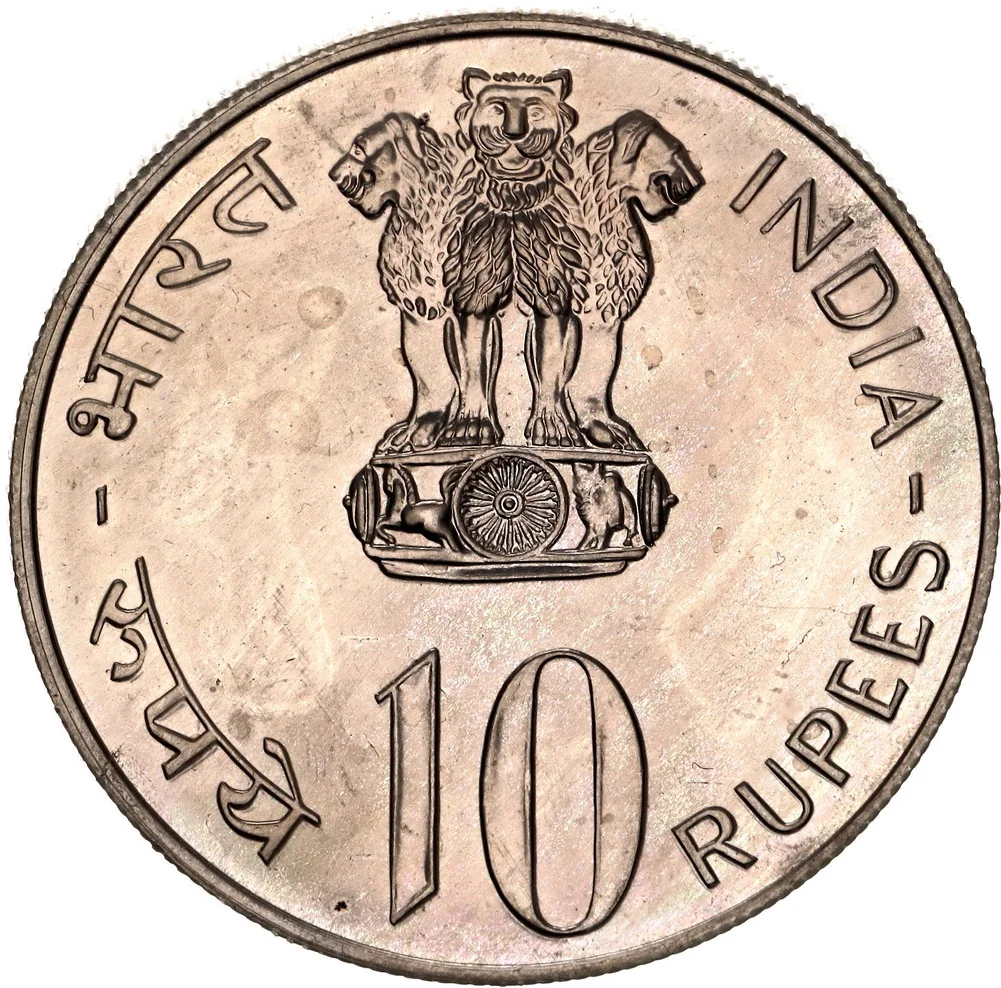
10 rupees – India
Non-circulating coins
Commemoration: F.A.O.
India
Context

Material
Diameter: 39 mm
Weight: 24.7 g
Shape: Round
Composition: Copper-nickel
Technique: Milled
Alignment: Medal alignment
flip

References
KM: #Click to copy to clipboard193
Numista: #26809
Value
Exchange value: 10 INR = $0.11
Inflation-adjusted value: 296.60 INR
Obverse
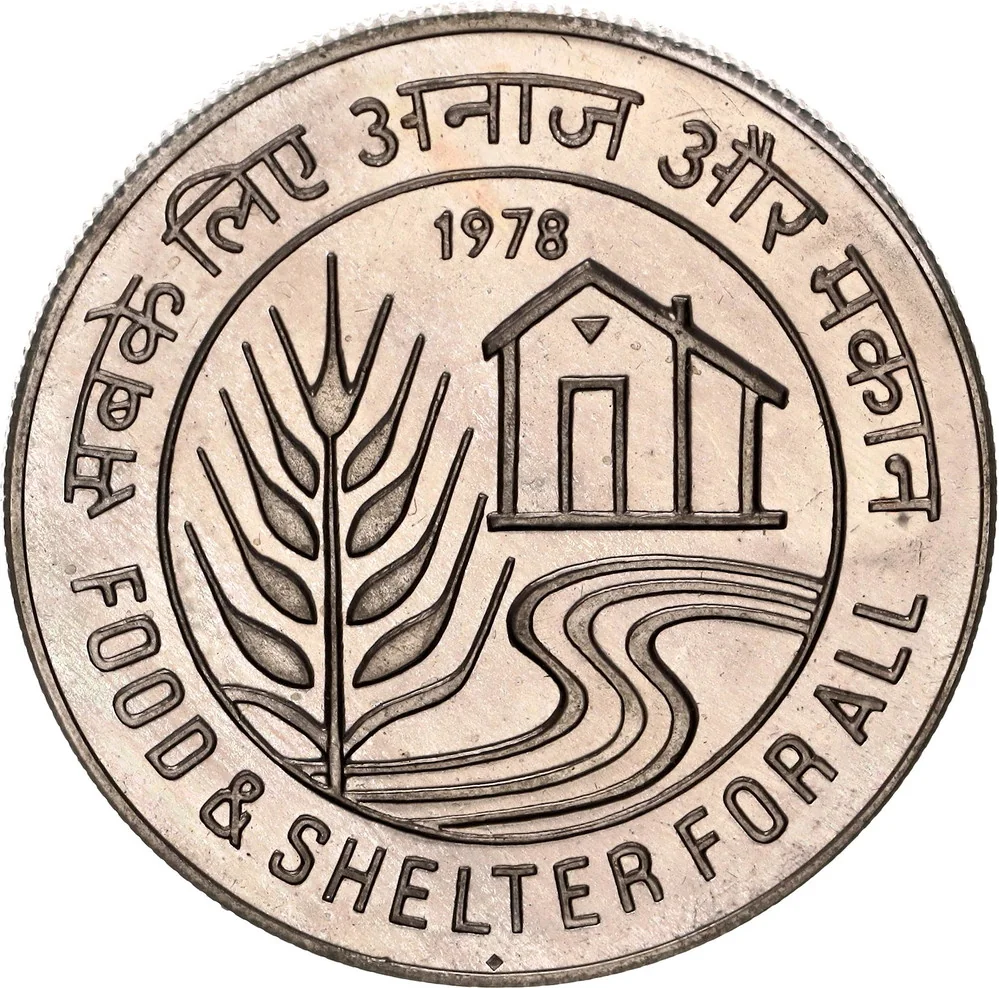
Reverse
Description:
Grain, house, and road in a circle.
Inscription:
सबके लिए अनाज और मकान
1978
FOOD & SHELTER FOR ALL
1978
FOOD & SHELTER FOR ALL
Translation:
FOOD & SHELTER FOR ALL
1978
1978
Language: Hindi
Edge
Milled
Categories
| Organization> FAO |
Mints
| Name | Mark |
|---|---|
| Mumbai / Bombay | ♦ |
| Mumbai / Bombay | B |
Historical background
In 1978, India's currency situation was dominated by the controversial High Denomination Bank Notes (Demonetisation) Act of January 16, 1978. This policy, enacted by the Morarji Desai-led Janata Party government, demonetized high-value banknotes of ₹1,000, ₹5,000, and ₹10,000. The stated objectives were to curb illegal activities—specifically "black money" accumulated through tax evasion, corruption, and smuggling—and to counter counterfeit currency used for financing activities detrimental to the national economy. The move was presented as a decisive strike against the parallel black economy that had grown significantly during the preceding years.
The economic context and impact of this demonetisation were markedly different from the more recent 2016 effort. The 1978 action targeted a much smaller segment of the currency in circulation, as these high-denomination notes constituted only about 1-2% of the total money supply. Consequently, the disruption to the everyday economy was limited, as the vast majority of citizens relied on lower-value notes. Furthermore, the process was implemented with relative efficiency, allowing for a smooth exchange of old notes at banks with minimal public inconvenience compared to later episodes.
However, the policy's effectiveness in achieving its core goal of extinguishing black wealth was widely debated. Critics argued that most illicit wealth was held not in cash but in assets like gold, real estate, and overseas accounts, and that those with large cash hoards had likely found ways to pre-emptively convert their notes. Ultimately, while the move signaled a political stance against corruption, its tangible economic impact was limited. It remained a notable, though not overwhelmingly disruptive, chapter in India's monetary history until the far more sweeping demonetisation of 2016.
The economic context and impact of this demonetisation were markedly different from the more recent 2016 effort. The 1978 action targeted a much smaller segment of the currency in circulation, as these high-denomination notes constituted only about 1-2% of the total money supply. Consequently, the disruption to the everyday economy was limited, as the vast majority of citizens relied on lower-value notes. Furthermore, the process was implemented with relative efficiency, allowing for a smooth exchange of old notes at banks with minimal public inconvenience compared to later episodes.
However, the policy's effectiveness in achieving its core goal of extinguishing black wealth was widely debated. Critics argued that most illicit wealth was held not in cash but in assets like gold, real estate, and overseas accounts, and that those with large cash hoards had likely found ways to pre-emptively convert their notes. Ultimately, while the move signaled a political stance against corruption, its tangible economic impact was limited. It remained a notable, though not overwhelmingly disruptive, chapter in India's monetary history until the far more sweeping demonetisation of 2016.

🌟 Limited