

1 angel – Isle of Man
Add to wishlist
Context
Year: 2011
Country: British Crown dependencies
Issuer: Isle of Man
Ruler: Elizabeth II
Currency:
(since 1984)
Total mintage: 500
Material
References
Numista: #267896
Obverse
Description:
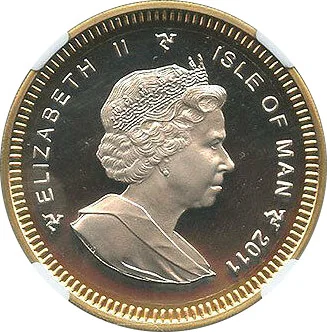
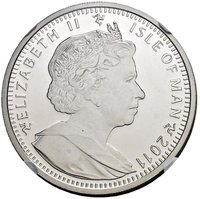
Queen Elizabeth II right-facing portrait in the "Girls of Great Britain and Ireland" Tiara, surrounded by legend and date.
Inscription:
ELIZABETH II ISLE OF MAN 2011
IRB
IRB
Translation:
ELIZABETH II ISLE OF MAN 2011
IRB
IRB
Script: Latin
Language: English
Designer: Ian Rank-Broadley
Reverse
Description:
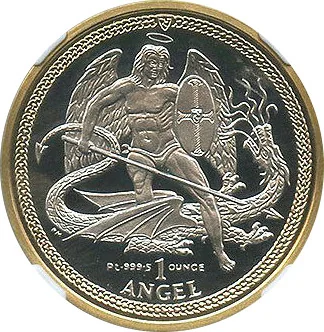
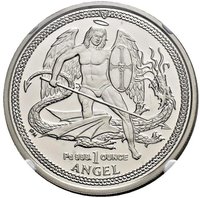
Archangel Michael defeating a dragon, with "Pt 9995 1 ounce ANGEL" inscribed below.
Inscription:
Pt 9995 1 ounce ANGEL
Script: Latin
Edge
Reeded
Categories
| Mythology> Fantastic animal |
| Symbol> Allegory |
| Symbol> Triskelion |
Mints
| Name | Mark |
|---|---|
| Pobjoy Mint | (PM) |
Mintings
| Year | Mint Mark | Mintage | Quality | Collection |
|---|---|---|---|---|
| 2011 | PM | 500 |
Historical background
In 2011, the Isle of Man's currency situation was defined by its long-standing and stable arrangement with the United Kingdom. The Manx government issued its own distinct banknotes and coins (pounds sterling, but with unique Manx designs), which circulated alongside Bank of England notes. Crucially, the Isle of Man pound was not a separate currency but was pegged at par with sterling, a relationship underpinned by a currency union and backed by reserves held in UK government securities. This system provided economic stability and facilitated seamless trade with its largest partner, the UK.
The year 2011 fell within the broader context of the global financial crisis and subsequent European sovereign debt crisis. While the Isle of Man's banking sector faced scrutiny and pressure, its currency peg remained secure. The primary focus for the Manx authorities was not on monetary policy—which was effectively set by the Bank of England—but on fiscal consolidation and maintaining the island's reputation as a well-regulated finance centre. There were no significant debates or moves to alter the fundamental currency link with sterling during this period.
Therefore, the background for 2011 is one of continuity. The island benefited from the credibility of the pound sterling during a time of global economic uncertainty, while retaining the symbolic sovereignty of its own note issue. The stability of this arrangement stood in contrast to the currency turmoil seen in the Eurozone, reinforcing the Isle of Man's chosen policy of a fixed, dependent monetary system linked to the UK.
The year 2011 fell within the broader context of the global financial crisis and subsequent European sovereign debt crisis. While the Isle of Man's banking sector faced scrutiny and pressure, its currency peg remained secure. The primary focus for the Manx authorities was not on monetary policy—which was effectively set by the Bank of England—but on fiscal consolidation and maintaining the island's reputation as a well-regulated finance centre. There were no significant debates or moves to alter the fundamental currency link with sterling during this period.
Therefore, the background for 2011 is one of continuity. The island benefited from the credibility of the pound sterling during a time of global economic uncertainty, while retaining the symbolic sovereignty of its own note issue. The stability of this arrangement stood in contrast to the currency turmoil seen in the Eurozone, reinforcing the Isle of Man's chosen policy of a fixed, dependent monetary system linked to the UK.

✨ Legendary