

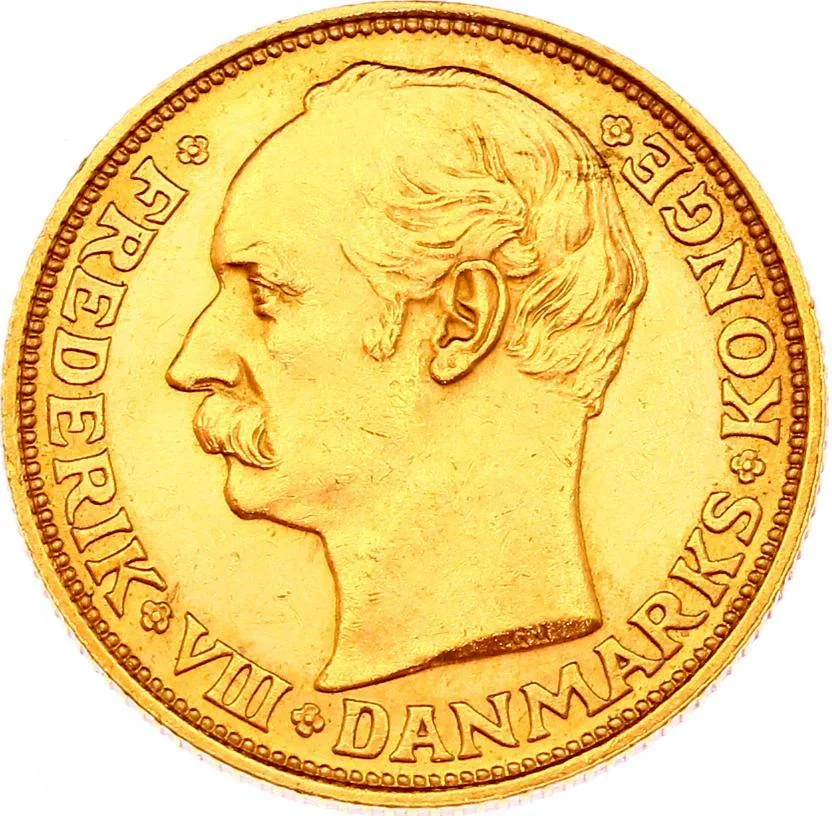
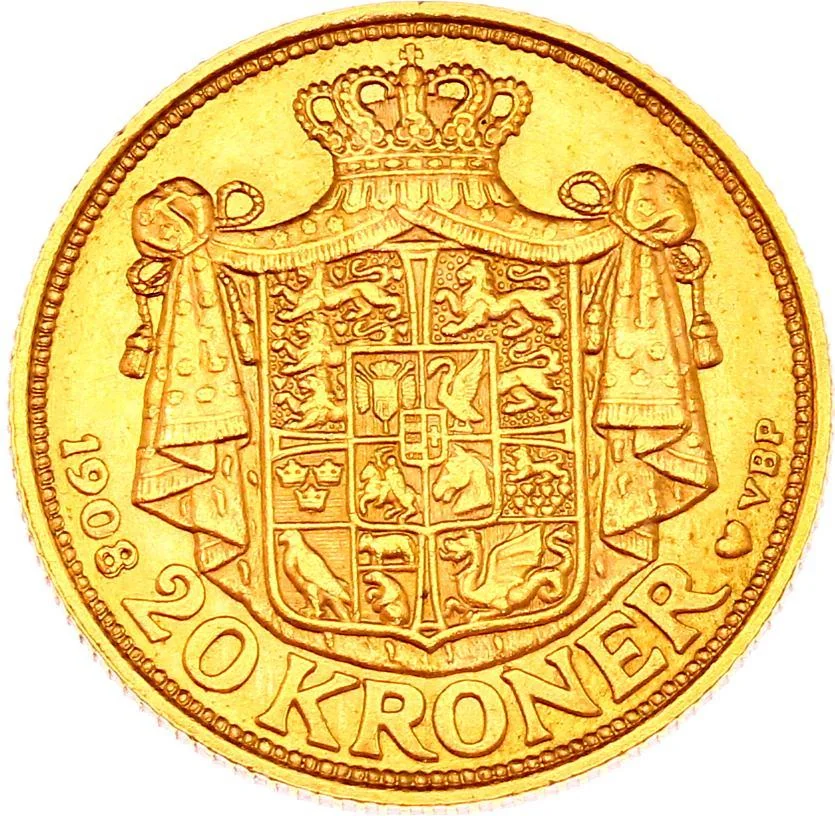
20 kroner – Denmark
Add to wishlist
Denmark
Context
Years: 1908–1912
Issuer: Denmark
Ruler: Frederick VIII
Currency:
(since 1873)
Total mintage: 1,175,000
Material
References
KM: #
Numista: #26770
Value
Exchange value: 20 DKK
Bullion value: $1255.59
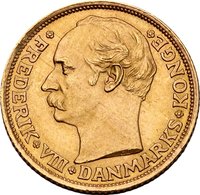
Obverse
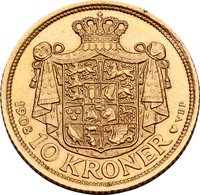
Reverse
Edge
Reeded
Mints
| Name | Mark |
|---|---|
| Royal Danish Mint | — |
Mintings
| Year | Mint Mark | Mintage | Quality | Collection |
|---|---|---|---|---|
| 1908 | VBP; | 243,000 | ||
| 1909 | VBP; | 365,000 | ||
| 1910 | VBP; | 200,000 | ||
| 1911 | VBP; | 183,000 | ||
| 1912 | VBP; | 184,000 |
Historical background
In 1908, Denmark operated under the classical gold standard, a system it had adhered to since 1873. The Danish krone was legally defined as a fixed quantity of gold, and the Nationalbank was obligated to exchange banknotes for gold on demand. This system provided monetary stability and facilitated international trade by fixing exchange rates with other major gold-standard nations like the United Kingdom and Germany. Denmark's currency was thus part of an integrated global financial architecture, with its value secured by the central bank's gold reserves.
The period around 1908 was one of economic transition and growth for Denmark. The agricultural sector, dominant but undergoing modernization, was increasingly export-oriented, shipping butter, bacon, and eggs primarily to the British market. This reliance on trade made the fixed exchange rates of the gold standard particularly valuable, as it eliminated currency risk for exporters and importers. However, it also meant Denmark's monetary policy was largely dictated by international gold flows rather than domestic economic conditions, a trade-off for stability.
Despite this outward stability, the global gold standard system was showing underlying strains by 1908. International financial crises, like the Panic of 1907 in the United States, could and did cause liquidity shortages and gold outflows even in distant economies like Denmark's. The Nationalbank had to maintain high interest rates at times to attract and retain gold, which could dampen domestic investment. Consequently, while the krone was firmly anchored and credible, Danish policymakers were quietly aware of the system's rigidity and vulnerability to international shocks, presaging the challenges that would ultimately lead to the standard's collapse during World War I.
The period around 1908 was one of economic transition and growth for Denmark. The agricultural sector, dominant but undergoing modernization, was increasingly export-oriented, shipping butter, bacon, and eggs primarily to the British market. This reliance on trade made the fixed exchange rates of the gold standard particularly valuable, as it eliminated currency risk for exporters and importers. However, it also meant Denmark's monetary policy was largely dictated by international gold flows rather than domestic economic conditions, a trade-off for stability.
Despite this outward stability, the global gold standard system was showing underlying strains by 1908. International financial crises, like the Panic of 1907 in the United States, could and did cause liquidity shortages and gold outflows even in distant economies like Denmark's. The Nationalbank had to maintain high interest rates at times to attract and retain gold, which could dampen domestic investment. Consequently, while the krone was firmly anchored and credible, Danish policymakers were quietly aware of the system's rigidity and vulnerability to international shocks, presaging the challenges that would ultimately lead to the standard's collapse during World War I.
🌟 Limited