

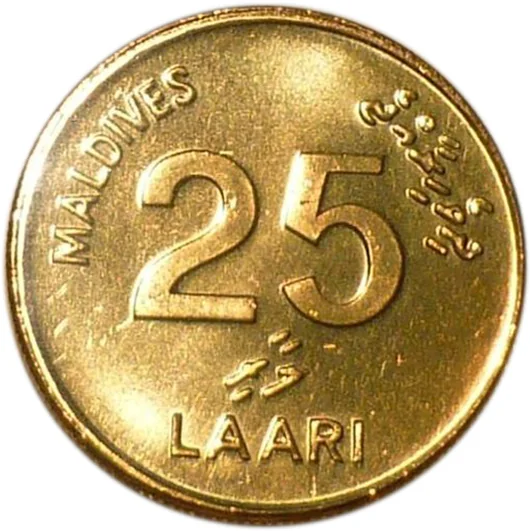
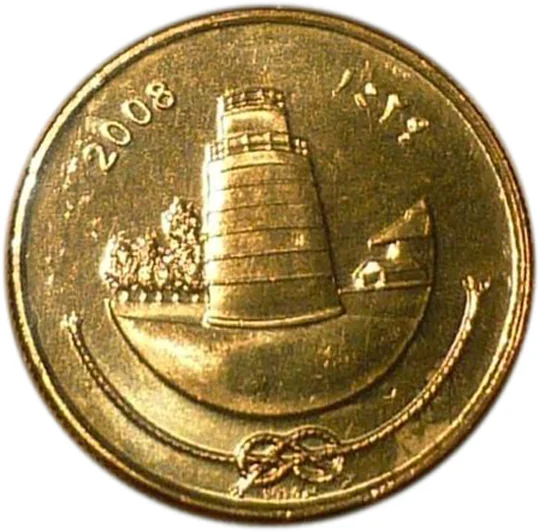
25 laari – Maldives
Add to wishlist
Maldives
Context
Material
References
KM: #
Numista: #26761
Value
Exchange value: 0.25 MVR
Obverse
Reverse
Edge
Reeded
Categories
| Building> Religious building |
Mints
| Name | Mark |
|---|---|
| Royal Mint | — |
Mintings
| Year | Mint Mark | Mintage | Quality | Collection |
|---|---|---|---|---|
| 2008 | — | — |
Historical background
In 2008, the Maldives faced a significant and multifaceted currency situation, deeply intertwined with the global financial crisis and domestic economic pressures. The country, heavily reliant on tourism and imports, was vulnerable to external shocks. The global downturn threatened tourist arrivals, a critical source of foreign exchange earnings, while soaring international oil and food prices dramatically increased the import bill. This created a severe strain on foreign currency reserves, which were needed to maintain the fixed exchange rate of the Maldivian Rufiyaa (MVR), pegged to the US Dollar within a band.
The currency peg, managed by the Maldives Monetary Authority (MMA), came under intense pressure. To defend the peg, the MMA was forced to sell US dollars, leading to a sharp decline in official reserves. By the end of 2008, gross international reserves had fallen to precarious levels, covering only about one month of imports. This depletion raised serious concerns about the sustainability of the peg and sparked fears of a potential devaluation, which would have increased the cost of living by making imports even more expensive for the population.
The situation culminated in a balance of payments crisis and was a key factor in the broader macroeconomic instability that year. It exposed the structural weaknesses of the Maldivian economy, including a large fiscal deficit fueled by high public spending and subsidies. The currency crisis of 2008 was therefore a pivotal moment, prompting the new government that took office in November 2008 to seek urgent financial assistance from the International Monetary Fund (IMF) by early 2009 to stabilize the economy and restore confidence in the currency regime.
The currency peg, managed by the Maldives Monetary Authority (MMA), came under intense pressure. To defend the peg, the MMA was forced to sell US dollars, leading to a sharp decline in official reserves. By the end of 2008, gross international reserves had fallen to precarious levels, covering only about one month of imports. This depletion raised serious concerns about the sustainability of the peg and sparked fears of a potential devaluation, which would have increased the cost of living by making imports even more expensive for the population.
The situation culminated in a balance of payments crisis and was a key factor in the broader macroeconomic instability that year. It exposed the structural weaknesses of the Maldivian economy, including a large fiscal deficit fueled by high public spending and subsidies. The currency crisis of 2008 was therefore a pivotal moment, prompting the new government that took office in November 2008 to seek urgent financial assistance from the International Monetary Fund (IMF) by early 2009 to stabilize the economy and restore confidence in the currency regime.
🌱 Very Common