

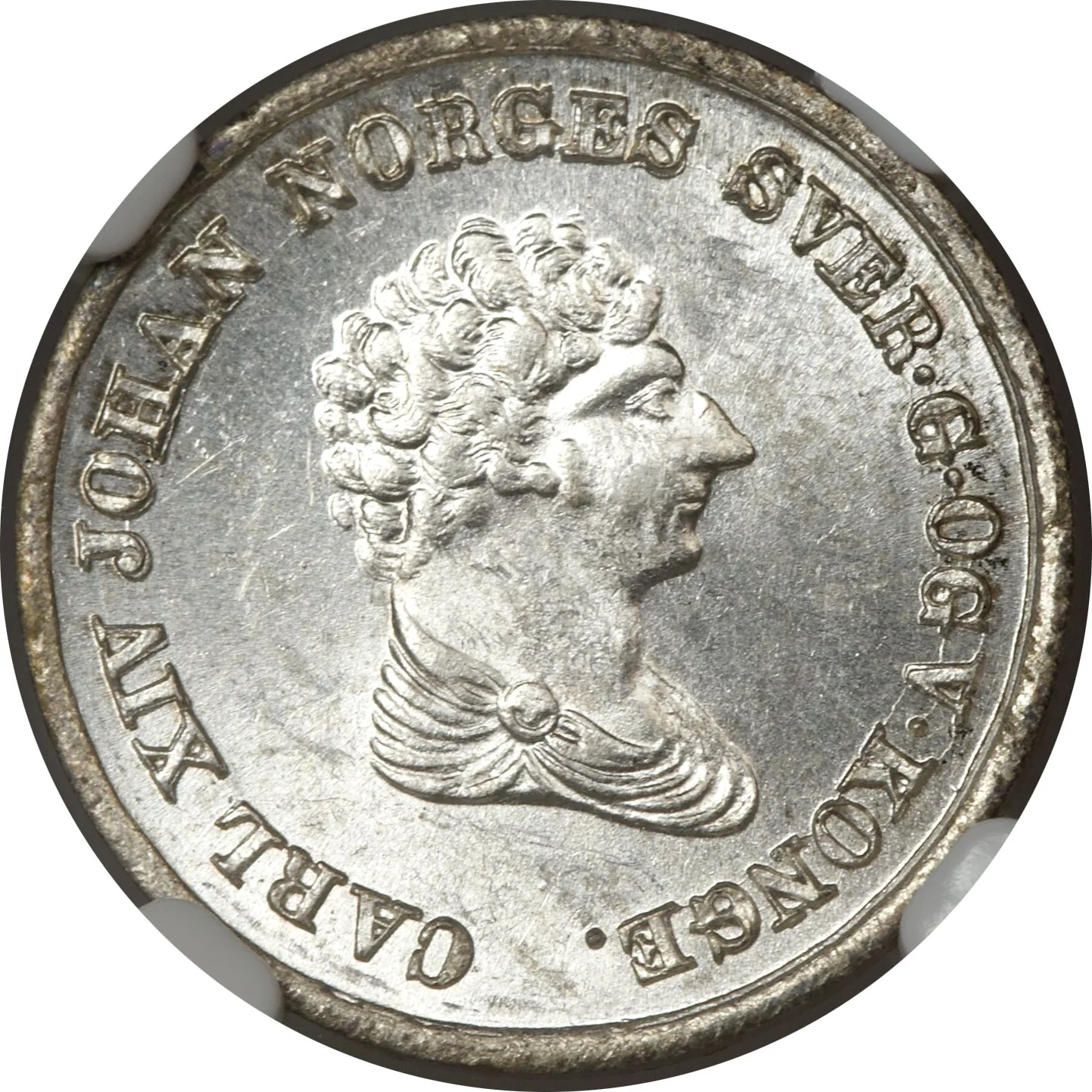
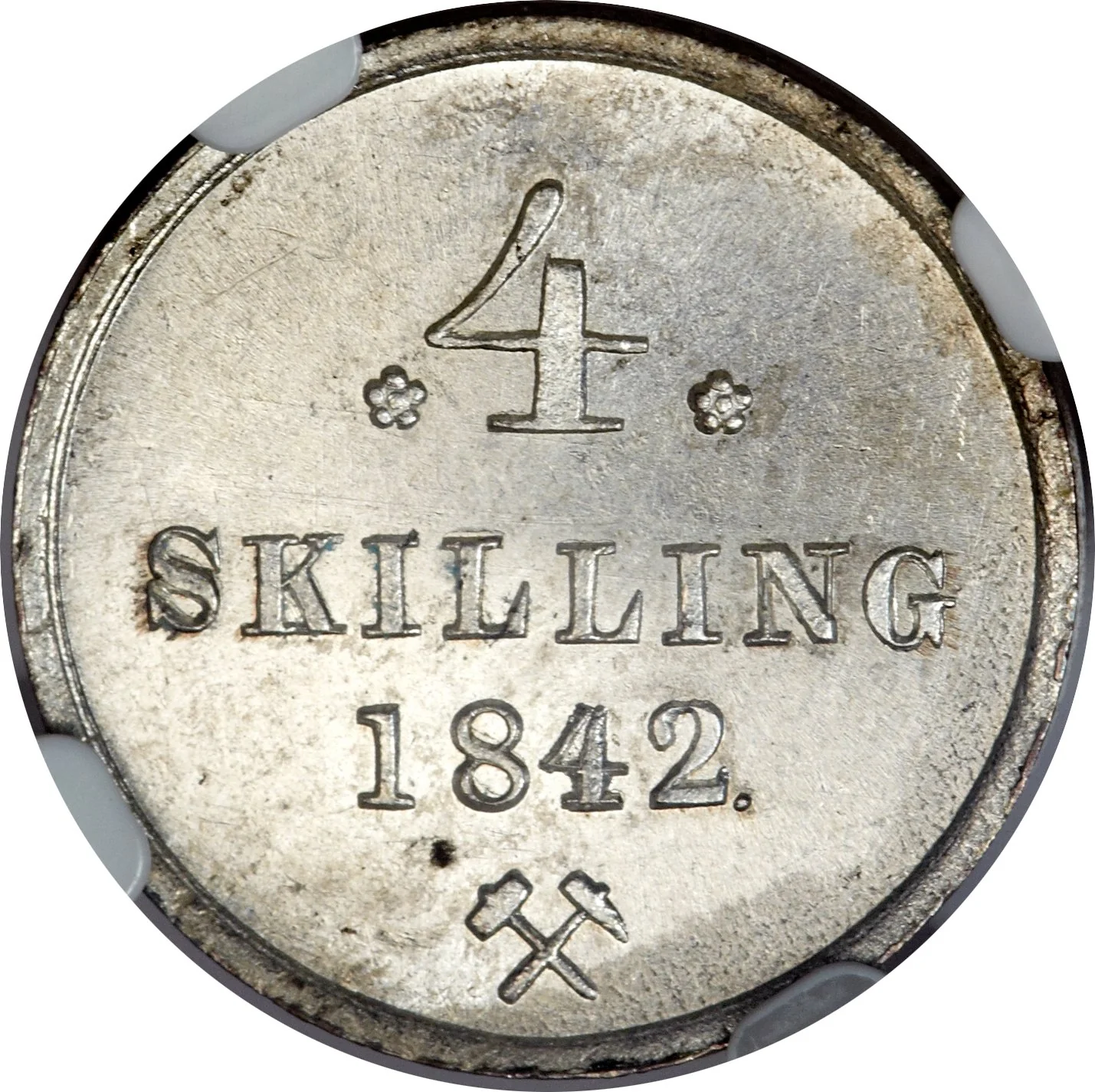
4 skilling – Norway
Add to wishlist
Norway
Context
Year: 1842
Issuer: Norway
Ruler: Charles III John
Currency:
(1816—1875)
Demonetized: Yes
Total mintage: 750,000
Material
References
KM: #
Numista: #26751
Obverse
Reverse
Description:
Value and date stacked.
Mintmark under date.
Solid rim ring.
Mintmark under date.
Solid rim ring.
Inscription:
🏵4🏵
SKILLING
1842.
⚒
SKILLING
1842.
⚒
Script: Latin
Edge
Mints
| Name | Mark |
|---|---|
| Norwegian Mint | — |
Mintings
| Year | Mint Mark | Mintage | Quality | Collection |
|---|---|---|---|---|
| 1842 | — | 750,000 |
Historical background
In 1842, Norway's currency situation was complex and transitional, operating under the constraints of a union with Sweden. Following the Napoleonic Wars and the establishment of the union in 1814, Norway was compelled to adopt the Swedish riksdaler as its official currency in 1816, replacing the former riksdaler specie. However, the Norwegian speciedaler (often called the riksdaler specie) remained in widespread use and was the preferred unit of account for government finances and large transactions, creating a de facto dual-currency system. This arrangement was cumbersome, with fluctuating exchange rates between the two daler units causing practical difficulties for trade and administration.
The period was marked by a chronic shortage of small, functional coinage for everyday commerce. While the state issued banknotes and some silver coins, the need for divisional coins was so acute that a vast quantity of foreign coins, particularly Swedish skilling and even Russian kopecks, circulated freely alongside private tokens issued by merchants and factories. This monetary chaos highlighted the weakness of the central bank, Norges Bank, which struggled to assert a uniform currency and maintain public confidence in its notes, especially after a period of significant depreciation in the early 1820s.
Consequently, 1842 fell within a prolonged era of monetary reform discussions. The pressing need for a standardized, national currency system was widely acknowledged, setting the stage for the significant reforms that would follow. Just a few years later, in 1845, Norway would introduce the riksdaler courant divided into 120 skilling, a crucial step toward simplification that paved the way for the eventual adoption of the modern krone (crown) in 1875 with the Scandinavian Monetary Union. Thus, the situation in 1842 was one of lingering disorder, actively pushing the country toward a more coherent and sovereign monetary policy.
The period was marked by a chronic shortage of small, functional coinage for everyday commerce. While the state issued banknotes and some silver coins, the need for divisional coins was so acute that a vast quantity of foreign coins, particularly Swedish skilling and even Russian kopecks, circulated freely alongside private tokens issued by merchants and factories. This monetary chaos highlighted the weakness of the central bank, Norges Bank, which struggled to assert a uniform currency and maintain public confidence in its notes, especially after a period of significant depreciation in the early 1820s.
Consequently, 1842 fell within a prolonged era of monetary reform discussions. The pressing need for a standardized, national currency system was widely acknowledged, setting the stage for the significant reforms that would follow. Just a few years later, in 1845, Norway would introduce the riksdaler courant divided into 120 skilling, a crucial step toward simplification that paved the way for the eventual adoption of the modern krone (crown) in 1875 with the Scandinavian Monetary Union. Thus, the situation in 1842 was one of lingering disorder, actively pushing the country toward a more coherent and sovereign monetary policy.
🌟 Limited