

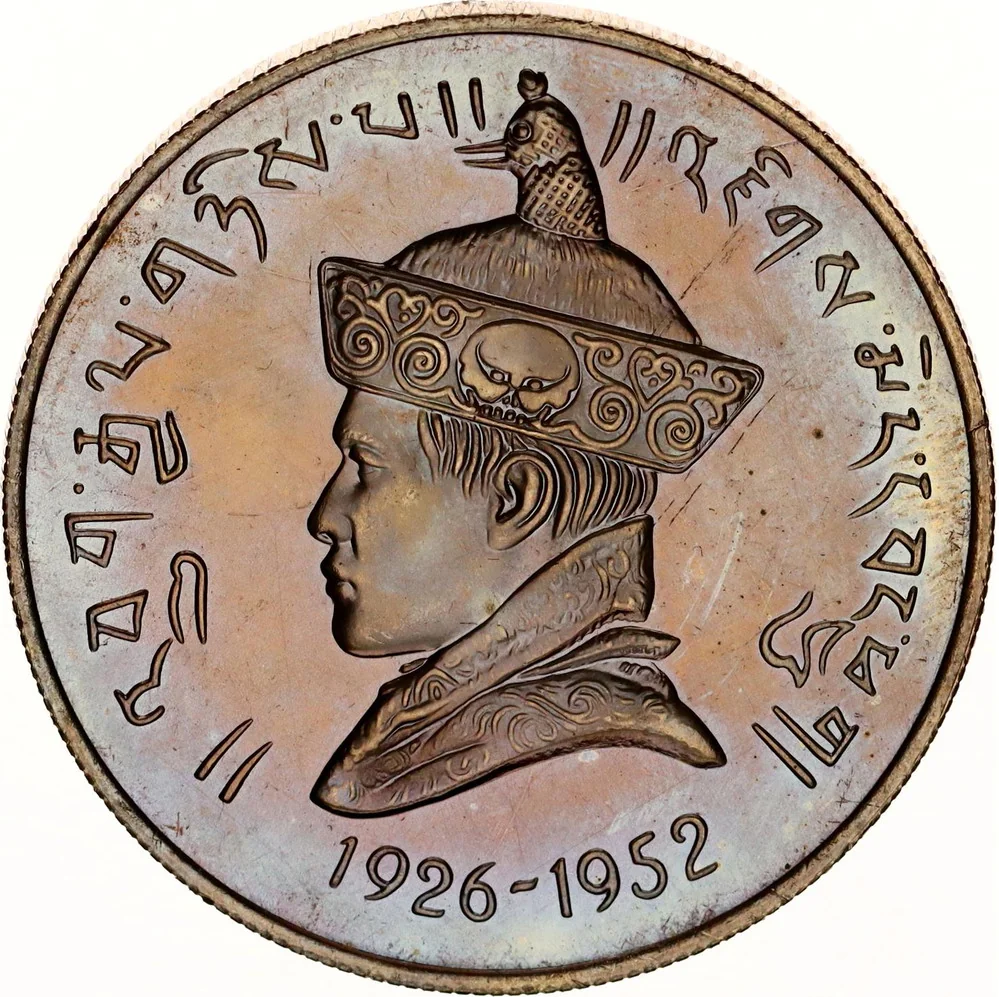
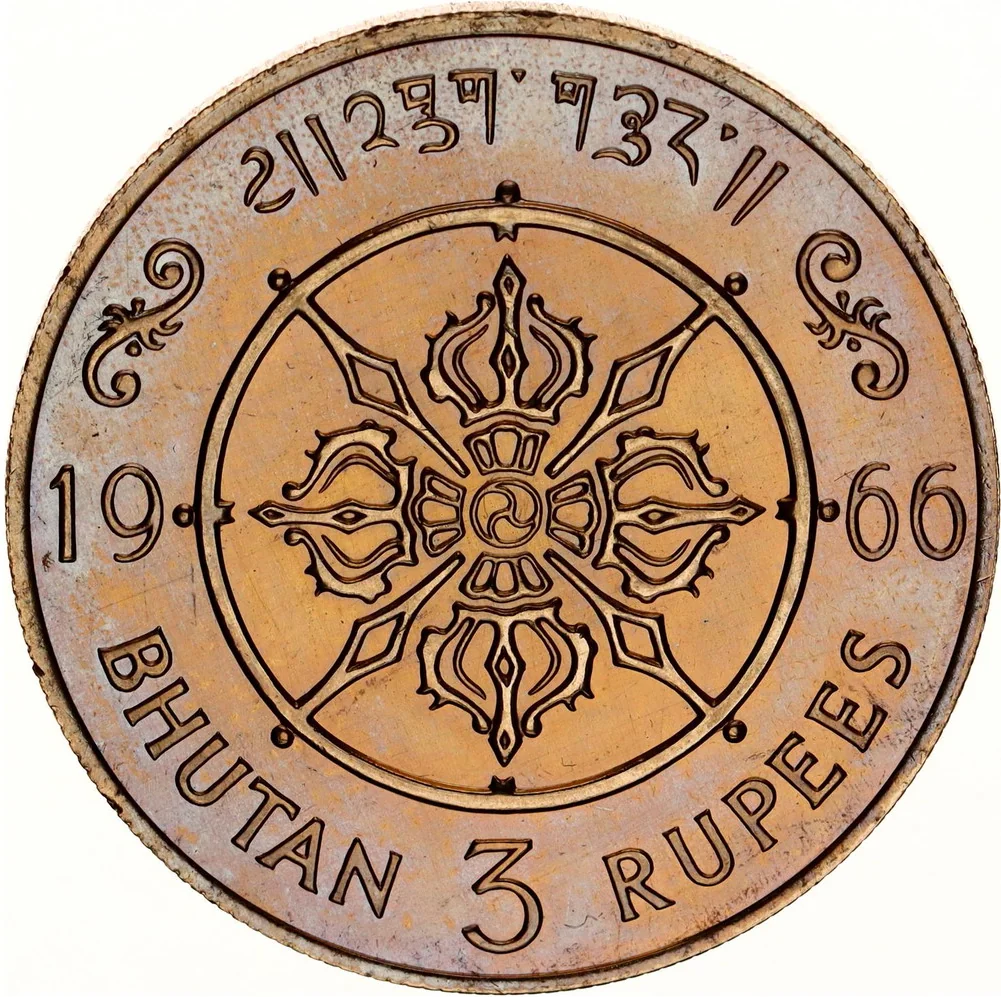
3 rupees (Jigme Wangchuk) – Bhutan
Add to wishlist
Circulating commemorative coins
Commemoration: 40th Anniversary - Accession of Jigme Wangchuk
Bhutan
Context
Year: 1966
Issuer: Bhutan
Ruler: Jigme Dorji
Currency:
(1957—1974)
Demonetized: Yes
Total mintage: 11,826
Material
References
KM: #
Numista: #26731
Obverse
Edge
Mints
| Name | Mark |
|---|---|
| Royal Mint (Tower Hill) | — |
Mintings
| Year | Mint Mark | Mintage | Quality | Collection |
|---|---|---|---|---|
| 1966 | — | 5,826 | ||
| 1966 | — | 6,000 | Proof |
Historical background
In 1966, Bhutan’s currency situation was in a state of transition and dependency, firmly under the monetary influence of India. The country did not yet have its own independent currency; instead, the Indian rupee was the primary medium of exchange and legal tender. This arrangement was formalized under the 1949 Treaty of Friendship between India and Bhutan, which, while affirming Bhutan's sovereignty, tied its economy closely to India's, including the stipulation that Bhutan would be guided by India's advice on foreign relations.
The practical administration of currency was managed by the Bank of Bhutan, which had been established in 1968 but was still two years away in 1966. Financial operations were rudimentary, with the Royal Government operating through a small treasury. The widespread use of the Indian rupee facilitated trade with Bhutan's largest partner but also meant Bhutan had no direct control over its money supply or monetary policy, limiting its economic sovereignty. Barter and commodity exchange, particularly in rural areas, still supplemented the monetary economy.
This period set the stage for a significant monetary reform. Recognizing the symbolic and practical importance of a national currency, King Jigme Dorji Wangchuck's government was actively planning for its introduction. These plans culminated just two years later, in 1968, with the launch of the Ngultrum (Nu.), which was pegged at par with the Indian rupee. The 1966 context, therefore, is best understood as the final chapter of a pre-national currency era, with the groundwork being laid for a key instrument of modern statehood.
The practical administration of currency was managed by the Bank of Bhutan, which had been established in 1968 but was still two years away in 1966. Financial operations were rudimentary, with the Royal Government operating through a small treasury. The widespread use of the Indian rupee facilitated trade with Bhutan's largest partner but also meant Bhutan had no direct control over its money supply or monetary policy, limiting its economic sovereignty. Barter and commodity exchange, particularly in rural areas, still supplemented the monetary economy.
This period set the stage for a significant monetary reform. Recognizing the symbolic and practical importance of a national currency, King Jigme Dorji Wangchuck's government was actively planning for its introduction. These plans culminated just two years later, in 1968, with the launch of the Ngultrum (Nu.), which was pegged at par with the Indian rupee. The 1966 context, therefore, is best understood as the final chapter of a pre-national currency era, with the groundwork being laid for a key instrument of modern statehood.
🌟 Limited