

Obverse
Description:
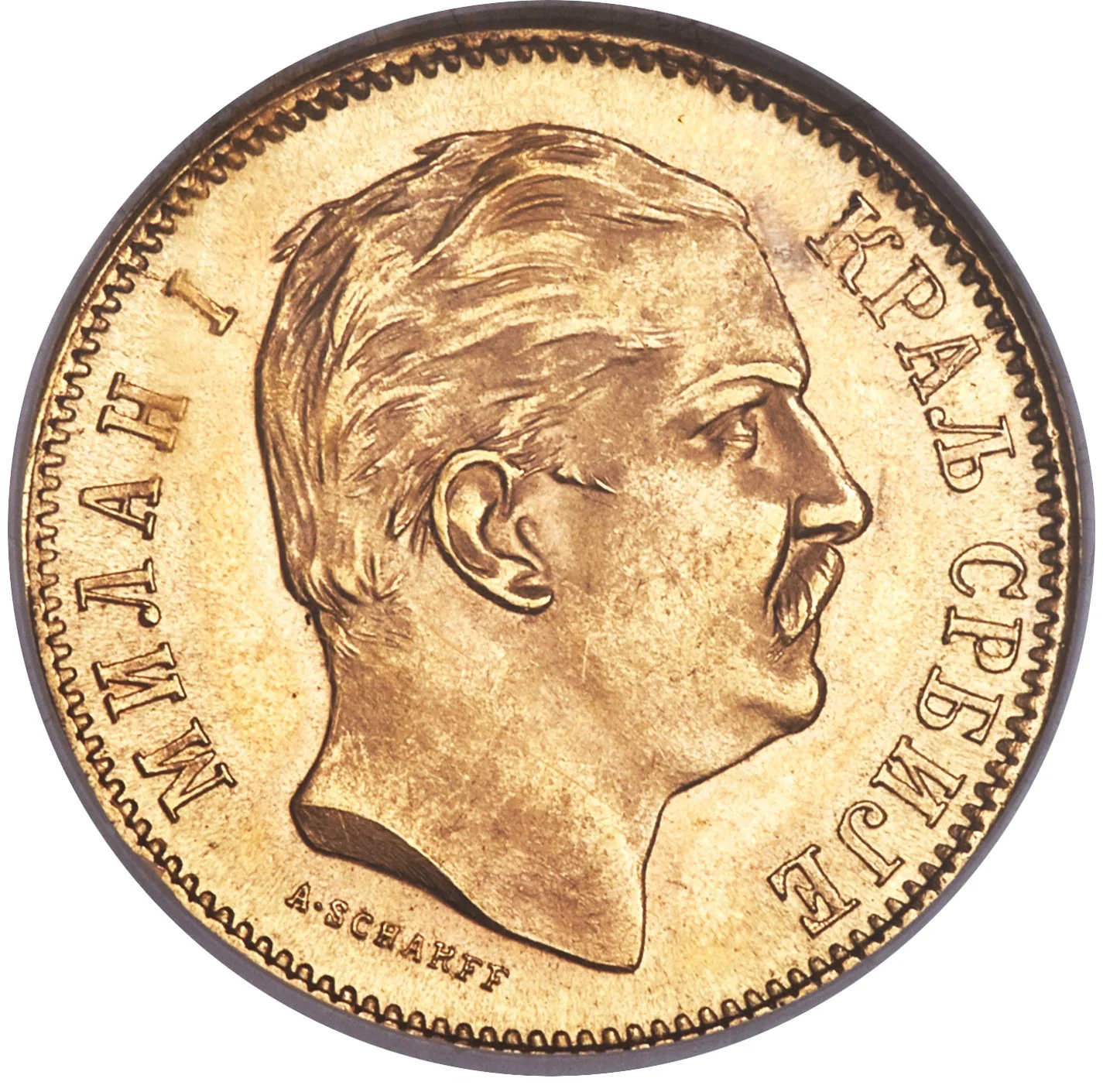
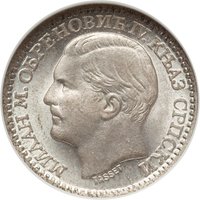
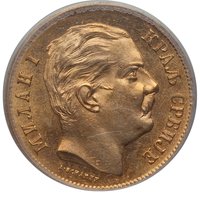
Milan facing right.
Inscription:
МИЛАН I
КРАЉ СРБИЈЕ
A•SCHARFF
КРАЉ СРБИЈЕ
A•SCHARFF
Translation:
MILAN I
KING OF SERBIA
A•SCHARFF
KING OF SERBIA
A•SCHARFF
Engraver: Anton Scharff
Reverse
Description:
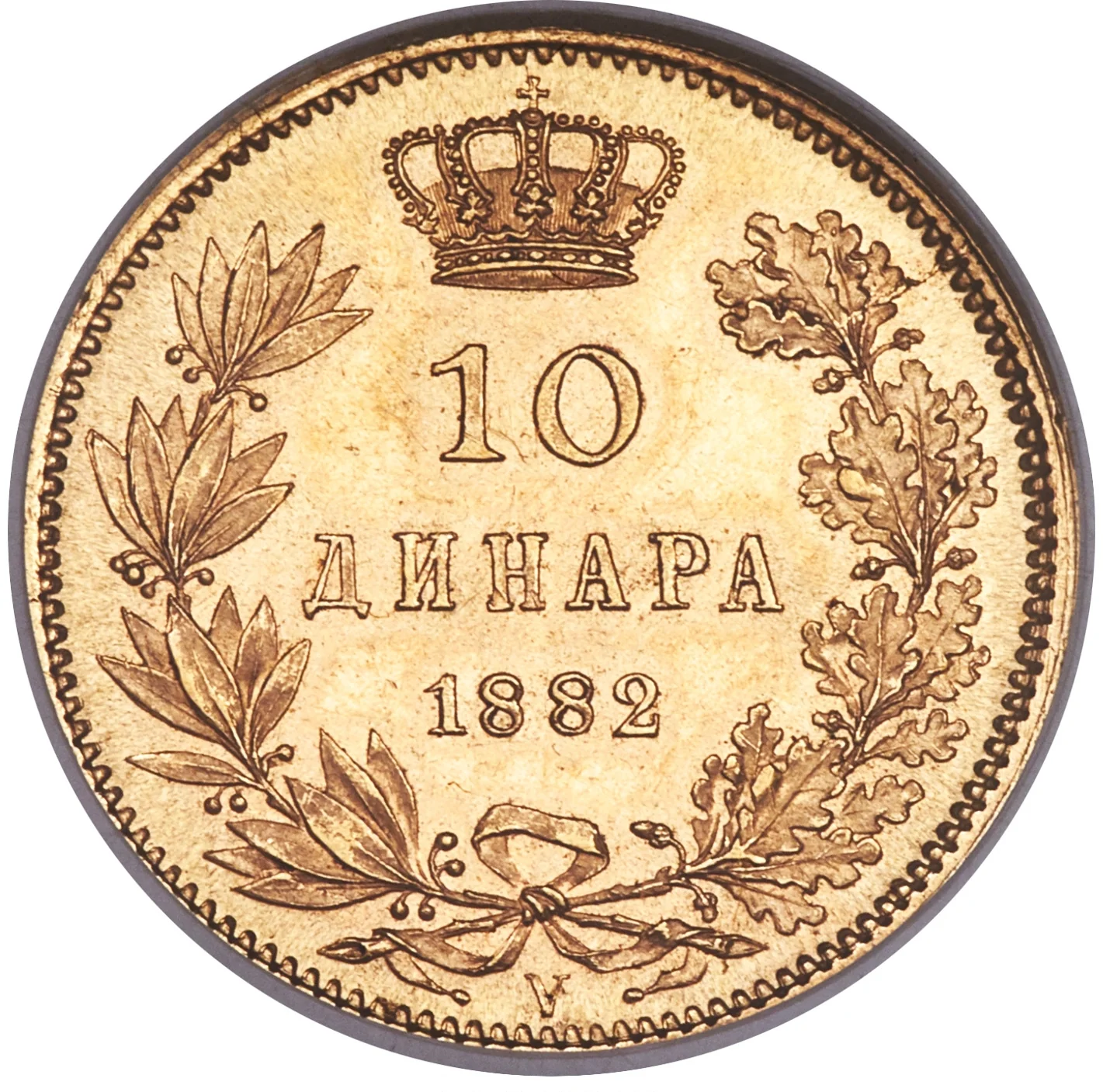
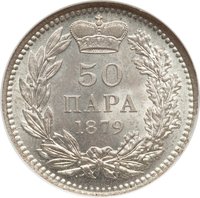
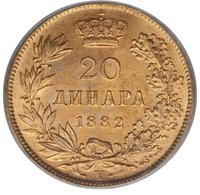
Crowned wreath enclosing denomination and date.
Inscription:
10
ДИНАРА
1882
V
ДИНАРА
1882
V
Translation:
10
DINARA
1882
V
DINARA
1882
V
Script: Cyrillic
Engraver: Anton Scharff
Edge
Reeded
Mints
| Name | Mark |
|---|---|
| Münze Österreich | V |
Mintings
| Year | Mint Mark | Mintage | Quality | Collection |
|---|---|---|---|---|
| 1882 | V | 300,000 |
Historical background
In 1882, Serbia's currency situation was characterized by a complex and transitional monetary system, reflecting its recent political elevation from a principality to a kingdom the previous year. The Ottoman para and Austrian florins (guilders) and thalers circulated widely alongside each other, a legacy of centuries of Ottoman rule and strong economic ties with the Austro-Hungarian Empire. This lack of a unified national currency created significant practical difficulties for trade and state finance, as exchange rates fluctuated and calculations were cumbersome, hindering economic modernization and the assertion of full sovereignty.
The Serbian government, under King Milan Obrenović, was actively pursuing monetary reform to address this. Plans were underway to introduce a new, decimal-based national currency—the Serbian dinar—which would be pegged to the French franc, aligning Serbia with the Latin Monetary Union. This move was strategically chosen to reduce economic dependence on Austria-Hungary and to integrate more closely with Western European financial systems. The necessary legislation was being prepared, and the first series of dinars and paras would be minted and issued the following year, in 1883.
Thus, the currency situation in 1882 was one of imminent change. While daily transactions still relied on a patchwork of foreign and obsolete coins, the state was on the cusp of implementing a critical symbol of national independence and economic policy. The successful introduction of the dinar was seen as essential for consolidating the kingdom's fiscal autonomy, stabilizing its economy, and signaling its modernizing ambitions to the European powers.
The Serbian government, under King Milan Obrenović, was actively pursuing monetary reform to address this. Plans were underway to introduce a new, decimal-based national currency—the Serbian dinar—which would be pegged to the French franc, aligning Serbia with the Latin Monetary Union. This move was strategically chosen to reduce economic dependence on Austria-Hungary and to integrate more closely with Western European financial systems. The necessary legislation was being prepared, and the first series of dinars and paras would be minted and issued the following year, in 1883.
Thus, the currency situation in 1882 was one of imminent change. While daily transactions still relied on a patchwork of foreign and obsolete coins, the state was on the cusp of implementing a critical symbol of national independence and economic policy. The successful introduction of the dinar was seen as essential for consolidating the kingdom's fiscal autonomy, stabilizing its economy, and signaling its modernizing ambitions to the European powers.
⭐ Rare