

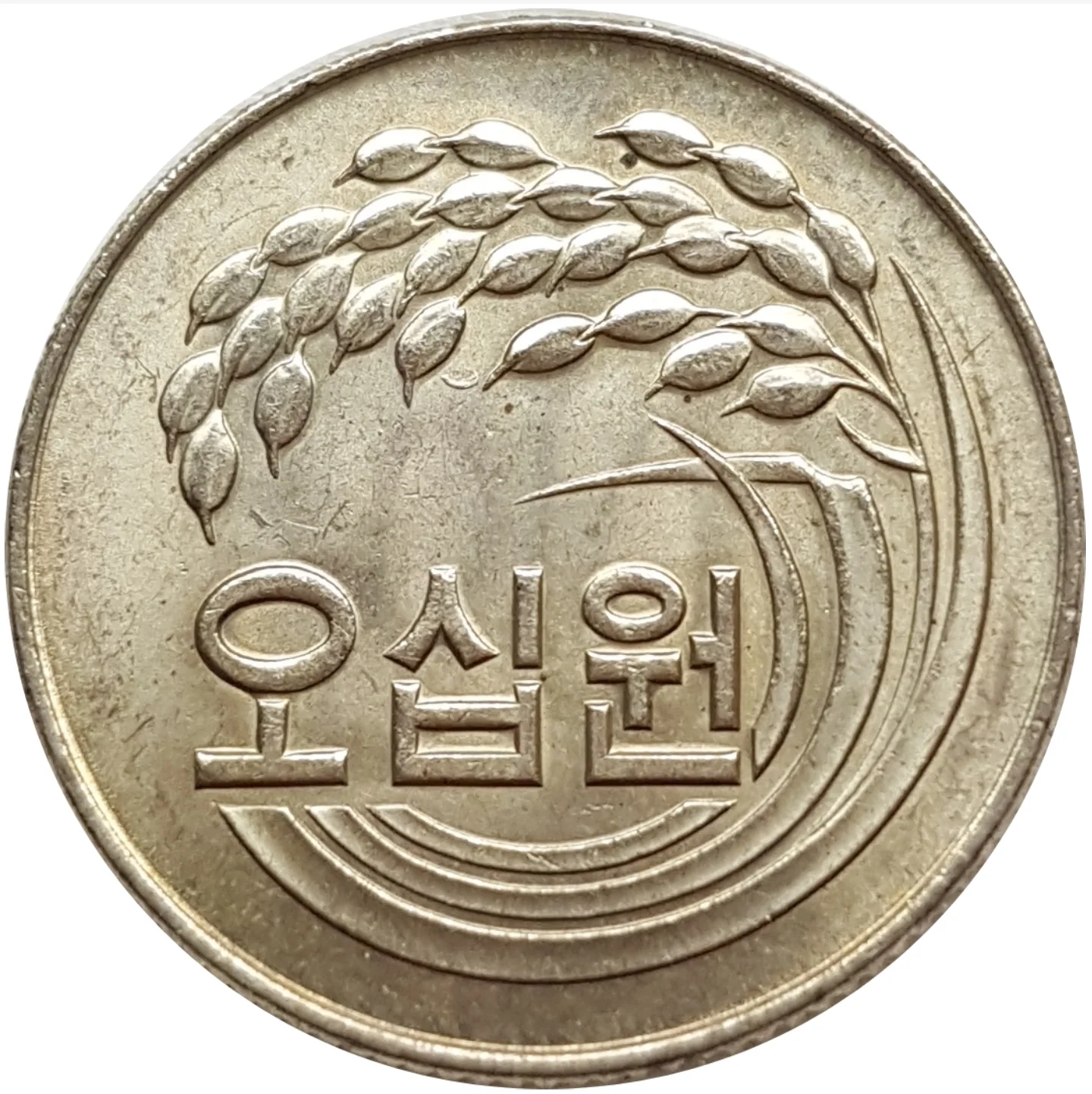
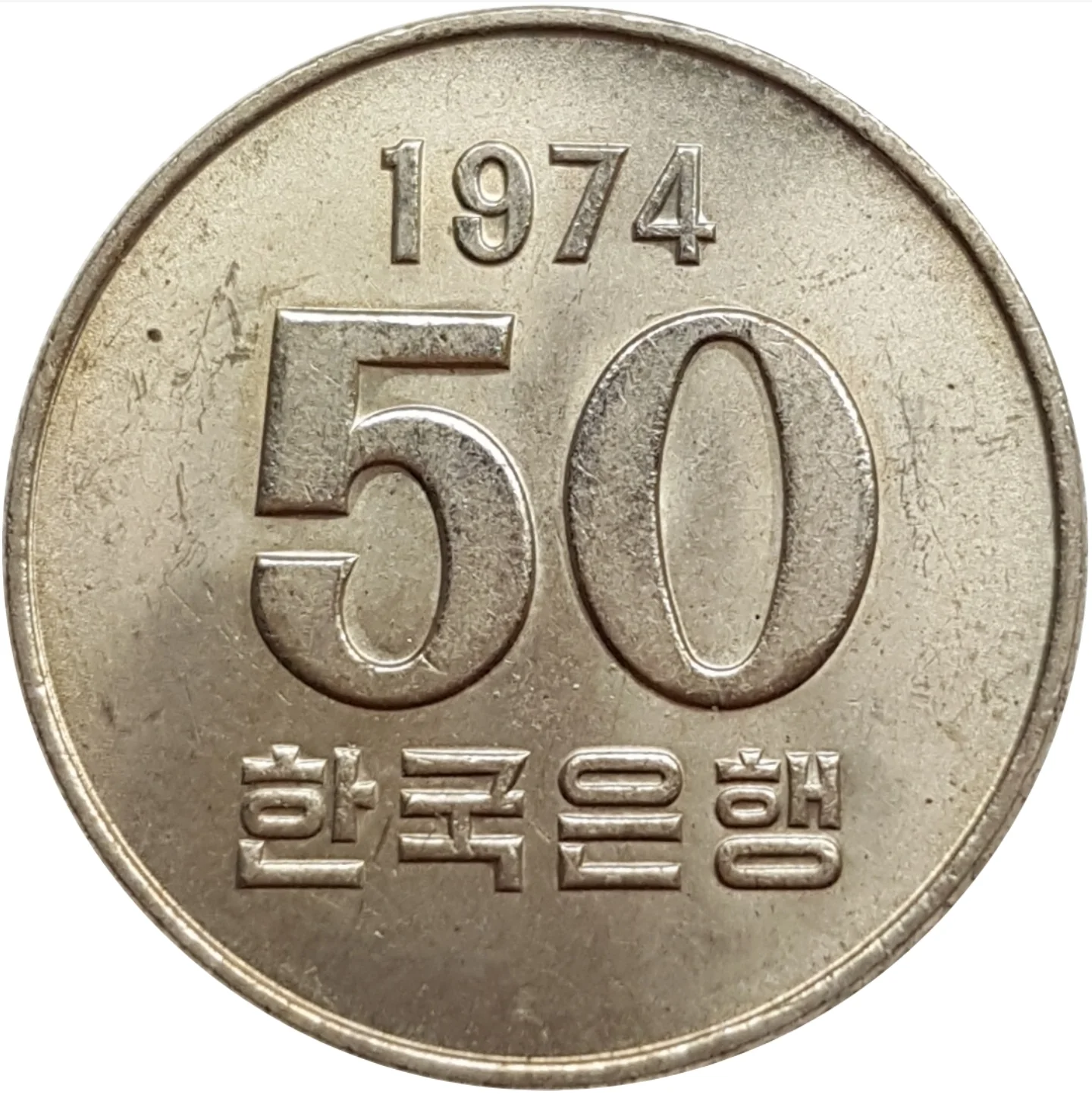
50 won – South Korea
Add to wishlist
South Korea
Context
Years: 1972–1982
Issuer: South Korea
Issuing organization: Bank of Korea
Period:
(since 1948)
Currency:
(since 1962)
Total mintage: 182,002,000
Material
References
KM: #
Numista: #2647
Value
Exchange value: 50 KRW
Inflation-adjusted value: 1097.57 KRW
Obverse
Reverse
Edge
Milled
Categories
| Organization> FAO |
Mints
| Name | Mark |
|---|---|
| Korea Minting and Security Printing Corporation | — |
Mintings
| Year | Mint Mark | Mintage | Quality | Collection |
|---|---|---|---|---|
| 1972 | — | 6,000,000 | ||
| 1973 | — | 40,000,000 | ||
| 1974 | — | 25,000,000 | ||
| 1977 | — | 1,000,000 | ||
| 1978 | — | 15,000,000 | ||
| 1979 | — | 20,000,000 | ||
| 1980 | — | 10,000,000 | ||
| 1981 | — | 25,000,000 | ||
| 1982 | — | 40,000,000 | ||
| 1982 | — | 2,000 | Proof |
Historical background
In the early 1970s, South Korea's currency situation was defined by the severe strains of its rapid, debt-fueled industrial expansion under President Park Chung-hee. The government's heavy-handed promotion of the chaebol (large family-owned conglomerates) through directed credit led to massive borrowing, both domestically and from foreign lenders. By 1972, the corporate sector was drowning in short-term, high-interest debt, with many companies facing insolvency. This created a looming systemic crisis, as a wave of bankruptcies threatened to collapse the entire financial system and undo the gains of the country's "Miracle on the Han River."
The breaking point came with the "August 3rd Emergency Decree" of 1972, a radical presidential fiat that unilaterally restructured all domestic corporate debt. The decree forced a freeze on payments to curb loan sharks, converted short-term loans into long-term, low-interest obligations, and provided emergency liquidity. This was essentially a state-mandated bailout for the chaebol at the expense of private lenders and savers. While it averted an immediate financial meltdown, it fundamentally distorted the market, reinforcing the incestuous relationship between the state, banks, and conglomerates, and moral hazard became entrenched in the economy.
Internationally, the won was pegged to the U.S. dollar at a fixed rate, but this system was under global pressure following the Nixon Shock of 1971, which ended the Bretton Woods system. South Korea maintained its peg, but the 1972 domestic debt crisis underscored the fragility of its economic model. The currency's stability was artificially maintained through strict capital controls and government fiat rather than organic economic health, setting a precedent for managed finance that would characterize South Korea's development for decades, while storing up vulnerabilities for future crises.
The breaking point came with the "August 3rd Emergency Decree" of 1972, a radical presidential fiat that unilaterally restructured all domestic corporate debt. The decree forced a freeze on payments to curb loan sharks, converted short-term loans into long-term, low-interest obligations, and provided emergency liquidity. This was essentially a state-mandated bailout for the chaebol at the expense of private lenders and savers. While it averted an immediate financial meltdown, it fundamentally distorted the market, reinforcing the incestuous relationship between the state, banks, and conglomerates, and moral hazard became entrenched in the economy.
Internationally, the won was pegged to the U.S. dollar at a fixed rate, but this system was under global pressure following the Nixon Shock of 1971, which ended the Bretton Woods system. South Korea maintained its peg, but the 1972 domestic debt crisis underscored the fragility of its economic model. The currency's stability was artificially maintained through strict capital controls and government fiat rather than organic economic health, setting a precedent for managed finance that would characterize South Korea's development for decades, while storing up vulnerabilities for future crises.
🌱 Very Common