

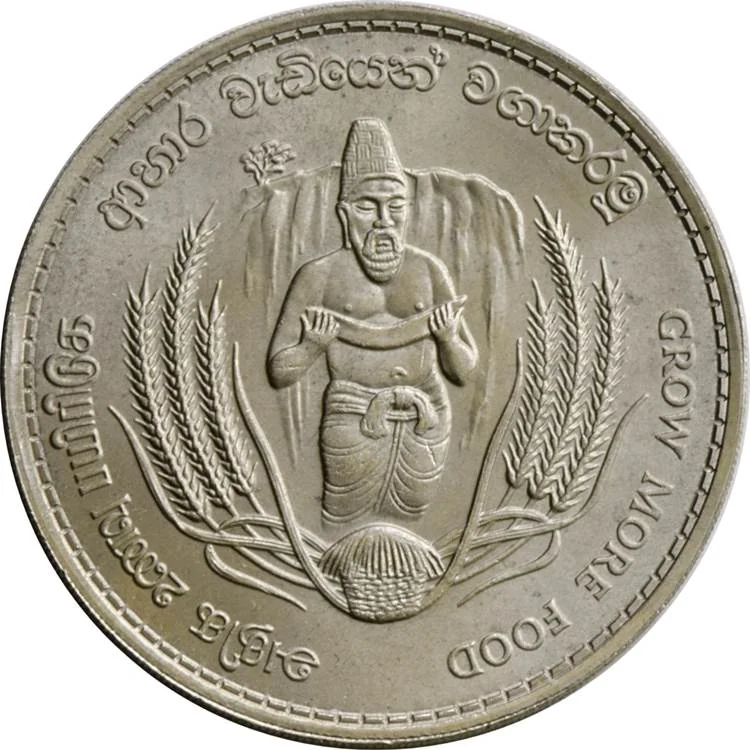
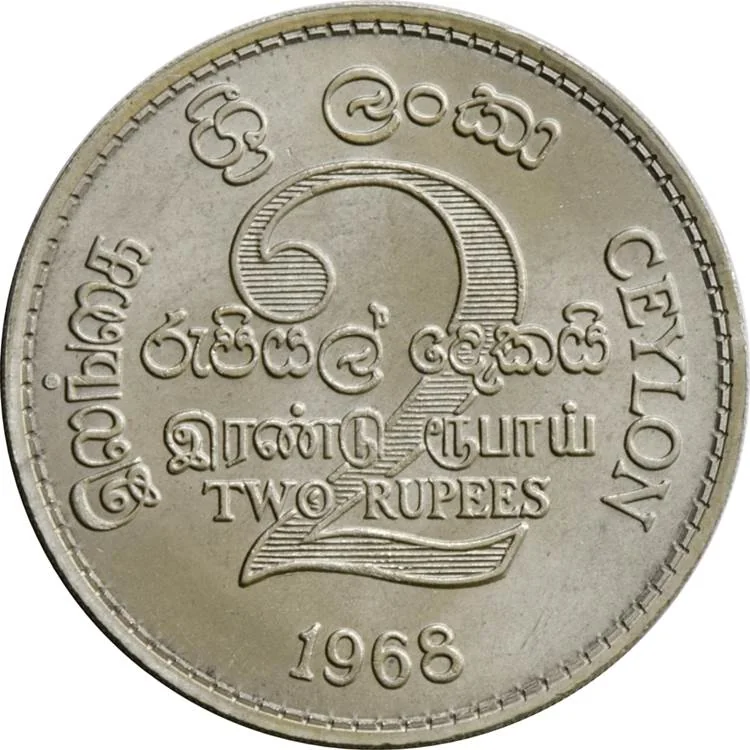
2 rupees – Ceylon
Add to wishlist
Circulating commemorative coins
Commemoration: F.A.O.
Sri Lanka
Context
Year: 1968
Country: Sri Lanka
Issuer: Ceylon
Ruler: Elizabeth II
Currency:
(1871—1972)
Demonetized: Yes
Total mintage: 500,000
Material
References
KM: #
Numista: #9957
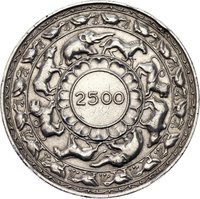
Obverse
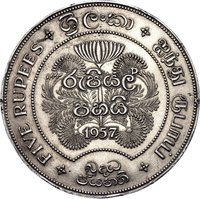
Reverse
Edge
Security edge (Indented)
Categories
| Organization> FAO |
Mints
| Name | Mark |
|---|---|
| Royal Mint (Tower Hill) | — |
Mintings
| Year | Mint Mark | Mintage | Quality | Collection |
|---|---|---|---|---|
| 1968 | — | 500,000 |
Historical background
In 1968, Ceylon (now Sri Lanka) was navigating a precarious currency situation under the fixed exchange rate system of the Bretton Woods agreement. The Ceylon Rupee was pegged to the Pound Sterling, a link that provided some stability but also tied the nation's fortunes to external economic pressures. The core challenge was a persistent and severe balance of payments deficit, driven by declining export revenues from key commodities like tea, rubber, and coconut. Meanwhile, the cost of essential imports—including food and manufactured goods—continued to rise, draining the country's foreign reserves.
This economic strain was exacerbated by the 1967 devaluation of the Pound Sterling, to which the Rupee was anchored. While the government initially maintained the Rupee's gold parity, making it effectively stronger against the Pound, this further hurt export competitiveness. Internally, expansive welfare policies and subsidised food rations placed a heavy burden on government finances, limiting its ability to adjust. The result was a reliance on strict import controls and foreign aid, particularly from the International Monetary Fund (IMF) and the World Bank, which came with conditions for economic liberalisation.
Consequently, 1968 represented a period of controlled vulnerability. The currency's value was officially stable, but this stability was artificially maintained through restrictive trade policies and external borrowing rather than robust economic fundamentals. The situation highlighted the structural weaknesses of an import-dependent, plantation-based economy and set the stage for the more profound economic difficulties and eventual floatation of the Rupee that would follow in the early 1970s.
This economic strain was exacerbated by the 1967 devaluation of the Pound Sterling, to which the Rupee was anchored. While the government initially maintained the Rupee's gold parity, making it effectively stronger against the Pound, this further hurt export competitiveness. Internally, expansive welfare policies and subsidised food rations placed a heavy burden on government finances, limiting its ability to adjust. The result was a reliance on strict import controls and foreign aid, particularly from the International Monetary Fund (IMF) and the World Bank, which came with conditions for economic liberalisation.
Consequently, 1968 represented a period of controlled vulnerability. The currency's value was officially stable, but this stability was artificially maintained through restrictive trade policies and external borrowing rather than robust economic fundamentals. The situation highlighted the structural weaknesses of an import-dependent, plantation-based economy and set the stage for the more profound economic difficulties and eventual floatation of the Rupee that would follow in the early 1970s.
🌱 Common