

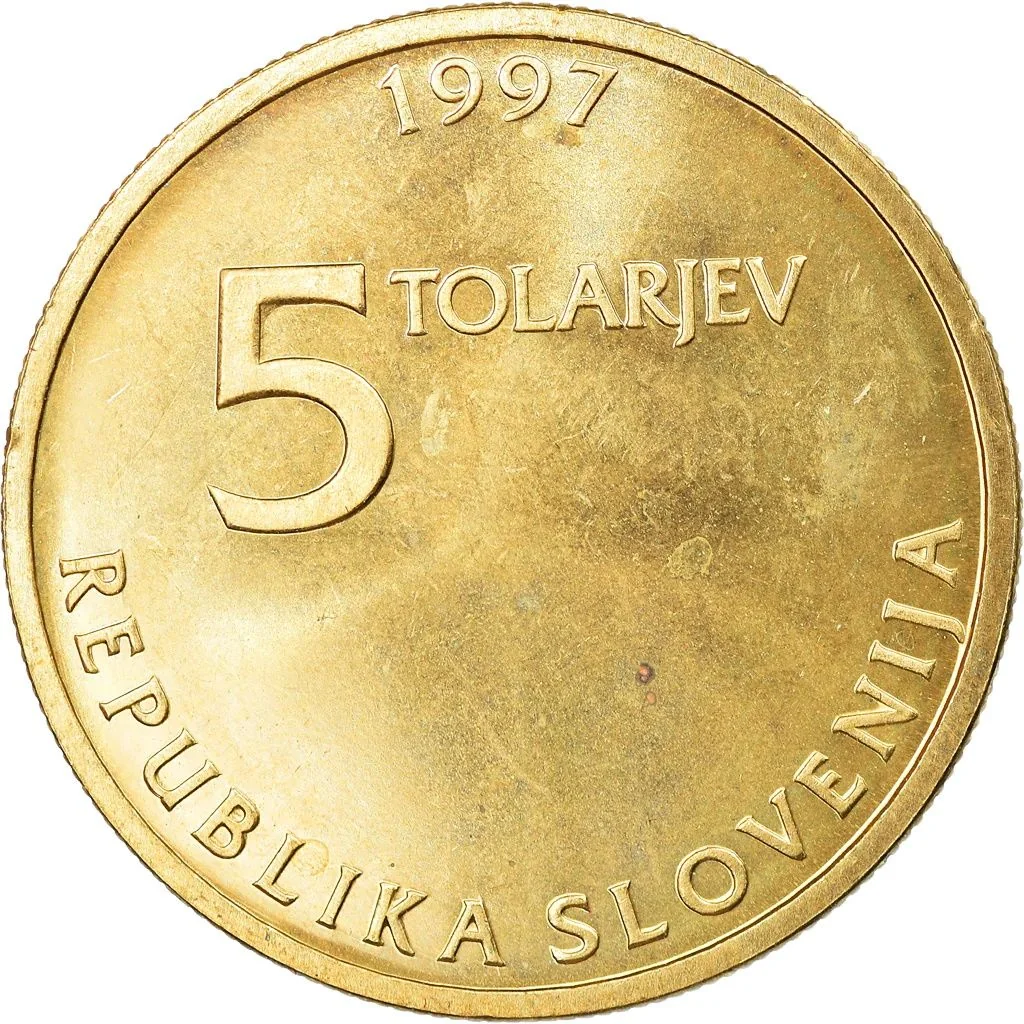
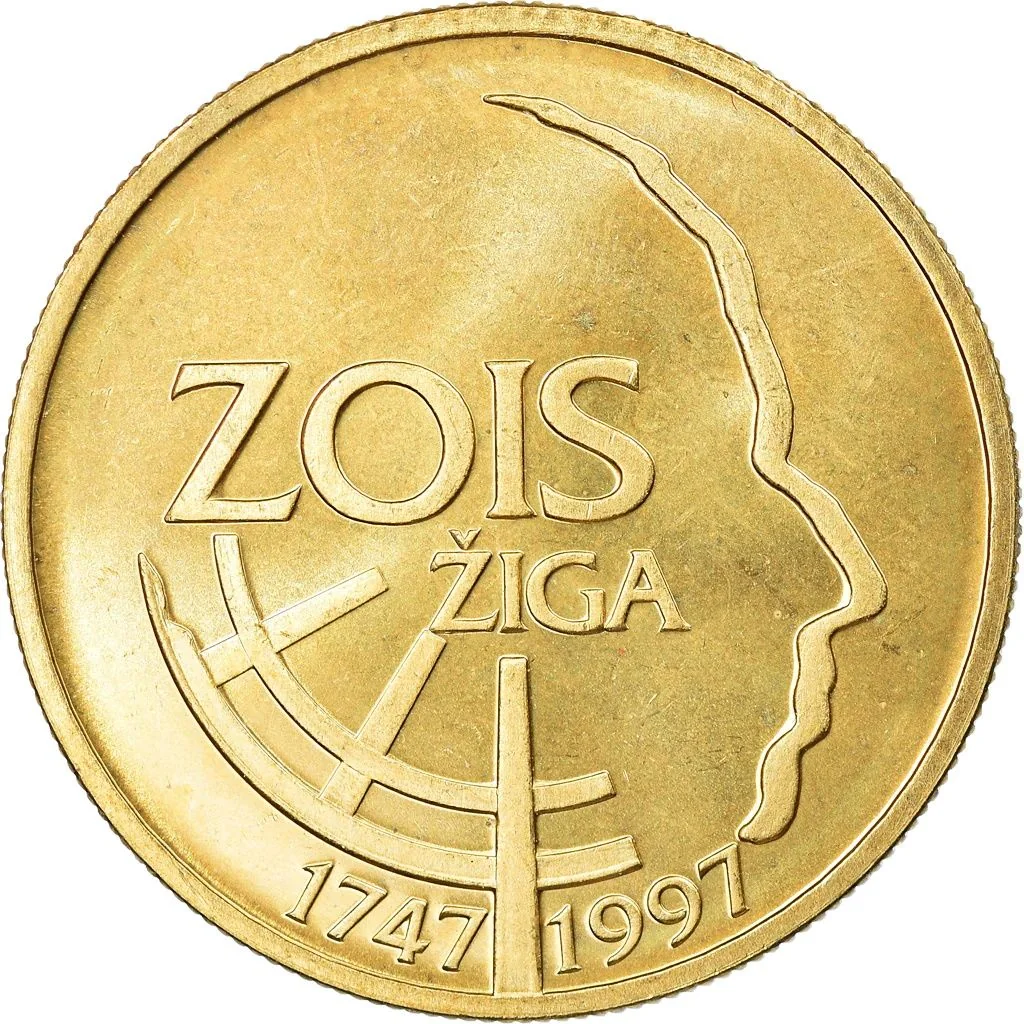
5 tolarjev (Žiga Zois) – Slovenia
Add to wishlist
Circulating commemorative coins
Commemoration: 250th Birthday of Žiga Zois
Slovenia
Context
Material
References
KM: #
Numista: #9947
Value
Exchange value: 5 SIT
Inflation-adjusted value: 14.28 SIT
Obverse
Reverse
Edge
170 reeds.
Categories
| Event> Birth anniversary |
| Person> Scientist |
Mints
| Name | Mark |
|---|---|
| Kremnica | — |
Mintings
| Year | Mint Mark | Mintage | Quality | Collection |
|---|---|---|---|---|
| 1997 | — | 500 | In sets | |
| 1997 | — | 201,000 | ||
| 1997 | — | 500 | Proof |
Historical background
In 1997, Slovenia was in a pivotal period of monetary transition, five years after gaining independence. The country had successfully navigated the initial economic shock of secession from Yugoslavia and had introduced its own temporary currency, the Slovenian tolar (SIT), in October 1991. By 1997, the tolar was a stable and fully convertible currency, a testament to the prudent fiscal and monetary policies of the Bank of Slovenia. Inflation, which had been hyperinflationary during the breakup of Yugoslavia, was brought under control and was in single digits, fostering a growing sense of economic confidence and normalcy.
The monetary policy framework during this time was explicitly focused on maintaining price stability as the primary goal, with the exchange rate allowed to float within a managed band. This approach shielded the economy from external shocks and allowed for independent interest rate decisions. Notably, 1997 was a year of significant capital account liberalization, as Slovenia removed many of the final restrictions on foreign investment and transactions. This move was crucial for deeper integration with European and global financial markets and was a direct prerequisite for the country's broader European Union accession ambitions.
Looking forward, the currency situation in 1997 was already being discussed in the context of future European integration. While the Maastricht Treaty criteria for adopting the euro were a longer-term objective, the stability of the tolar provided a solid foundation for this eventual path. Thus, 1997 can be characterized as a year of consolidation and strategic preparation, where Slovenia secured its autonomous monetary stability while deliberately opening its capital markets and aligning its policies with future EU and eurozone membership requirements.
The monetary policy framework during this time was explicitly focused on maintaining price stability as the primary goal, with the exchange rate allowed to float within a managed band. This approach shielded the economy from external shocks and allowed for independent interest rate decisions. Notably, 1997 was a year of significant capital account liberalization, as Slovenia removed many of the final restrictions on foreign investment and transactions. This move was crucial for deeper integration with European and global financial markets and was a direct prerequisite for the country's broader European Union accession ambitions.
Looking forward, the currency situation in 1997 was already being discussed in the context of future European integration. While the Maastricht Treaty criteria for adopting the euro were a longer-term objective, the stability of the tolar provided a solid foundation for this eventual path. Thus, 1997 can be characterized as a year of consolidation and strategic preparation, where Slovenia secured its autonomous monetary stability while deliberately opening its capital markets and aligning its policies with future EU and eurozone membership requirements.
🌱 Common