

20 halierov – Slovakia
Add to wishlist
Slovakia
Obverse
Description:
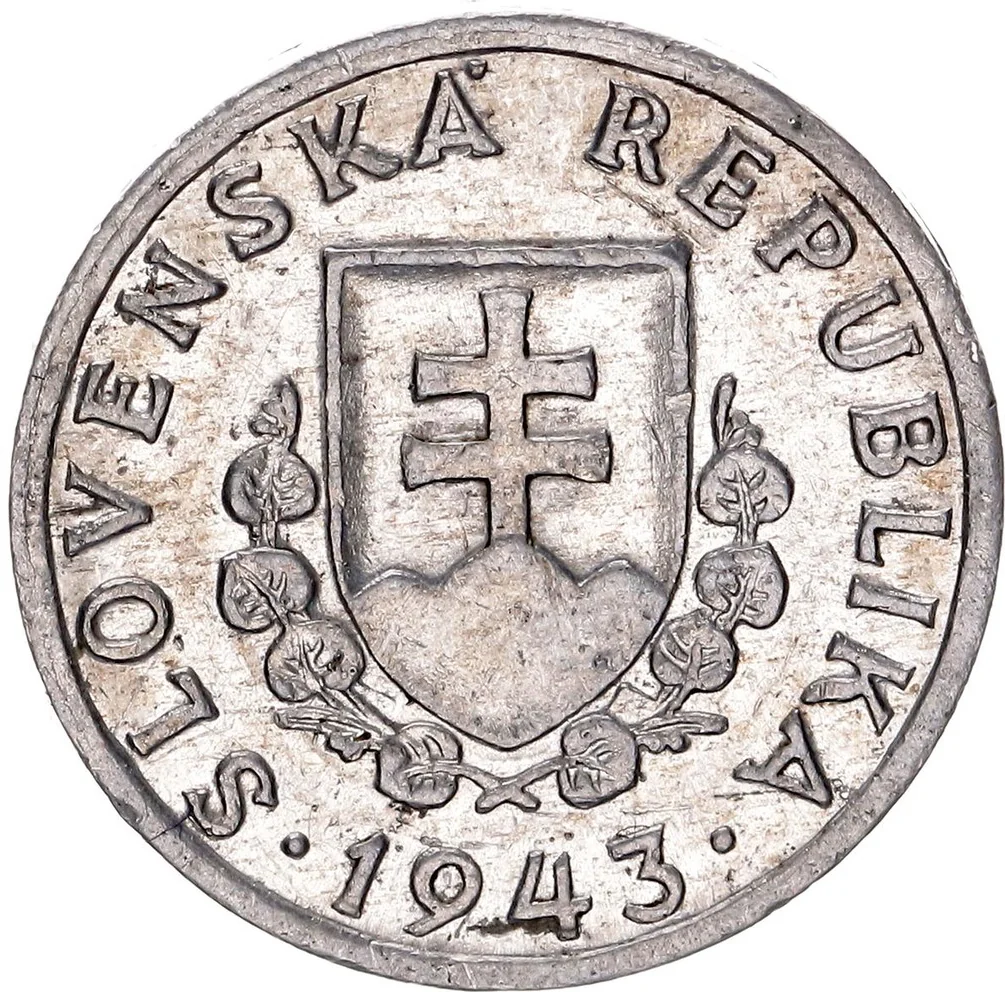
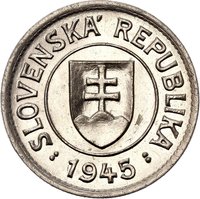
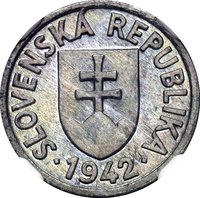
Slovak shield with date.
Inscription:
SLOVENSKÁ REPUBLIKA
1943
1943
Translation:
Slovak Republic
1943
1943
Script: Latin
Language: Slovak
Engraver: Andrej Peter
Reverse
Edge
Plain
Categories
| Symbol> Wreath |
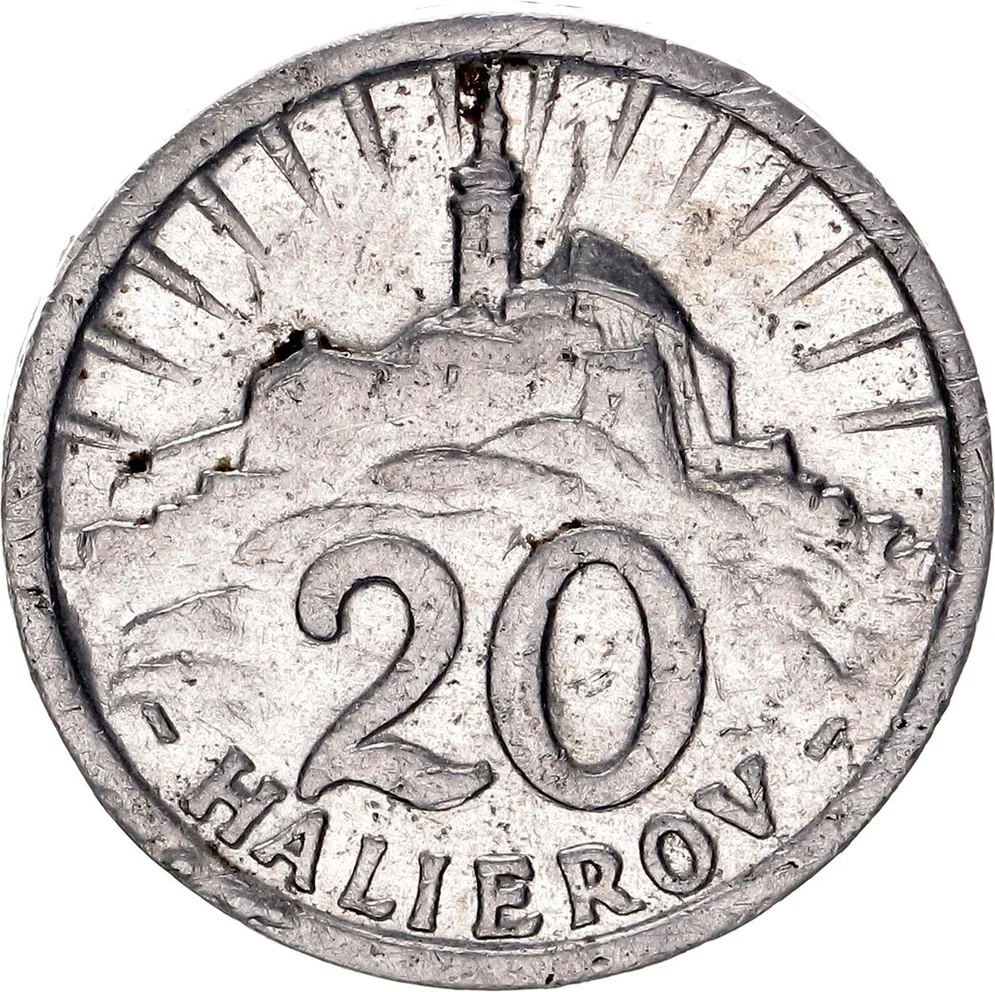
| Building> Castle or fortification |
| Symbols> Coat of Arms |
| Symbol> Cross |
Mintings
| Year | Mint Mark | Mintage | Quality | Collection |
|---|---|---|---|---|
| 1942 | — | — | ||
| 1942 | Shares mintage with KM# 4 1942 | — | ||
| 1942 | Shares mintage with KM# 4 1942 | — | ||
| 1943 | — | 15,000,000 |
Historical background
In 1942, Slovakia existed as the Slovak Republic, a nominally independent client state of Nazi Germany established in 1939 following the dissolution of Czechoslovakia. The national currency was the Slovak koruna (Sk), which had replaced the Czechoslovak koruna at par. While Slovakia maintained its own central bank (Slovenská národná banka) and issued its own banknotes and coins, its monetary policy and economic fate were tightly bound to and dictated by the demands of the German war effort. The economy was heavily oriented toward supplying the German military, leading to increasing state control, rationing, and inflationary pressures as resources were diverted.
The currency situation was fundamentally unstable, characterized by hidden inflation and a growing disconnect between official prices and black-market reality. While the official exchange rate was fixed at 1 Reichsmark = 11.62 Slovak koruna, this rate was artificial and did not reflect economic realities. Wartime shortages of consumer goods, coupled with the government's financing of deficits through money printing to fund its own military and Germany's demands, created significant monetary overhang. This meant people held increasing amounts of koruna but had fewer legitimate goods to purchase, fueling a robust black market where prices were dramatically higher.
Furthermore, Slovakia's currency was integrated into the German economic sphere through the clearing system, a mechanism that settled trade imbalances without using hard currency. This system heavily favored Germany, which ran a large deficit with Slovakia, essentially financing its imports of Slovak raw materials and goods with credit. This created a growing balance of credit claims for Slovakia that were effectively frozen and uncollectable during the war, draining the Slovak economy of real value. Thus, by 1942, the Slovak koruna was a controlled currency on a path of erosion, sustaining an economy whose primary function was to extract resources for the Nazi war machine.
The currency situation was fundamentally unstable, characterized by hidden inflation and a growing disconnect between official prices and black-market reality. While the official exchange rate was fixed at 1 Reichsmark = 11.62 Slovak koruna, this rate was artificial and did not reflect economic realities. Wartime shortages of consumer goods, coupled with the government's financing of deficits through money printing to fund its own military and Germany's demands, created significant monetary overhang. This meant people held increasing amounts of koruna but had fewer legitimate goods to purchase, fueling a robust black market where prices were dramatically higher.
Furthermore, Slovakia's currency was integrated into the German economic sphere through the clearing system, a mechanism that settled trade imbalances without using hard currency. This system heavily favored Germany, which ran a large deficit with Slovakia, essentially financing its imports of Slovak raw materials and goods with credit. This created a growing balance of credit claims for Slovakia that were effectively frozen and uncollectable during the war, draining the Slovak economy of real value. Thus, by 1942, the Slovak koruna was a controlled currency on a path of erosion, sustaining an economy whose primary function was to extract resources for the Nazi war machine.
🌱 Common