

50 Rubles – Russian Federation
Non-circulating coins
Commemoration: FIFA Confederations Cup Russia 2017
Russia
Context
Year: 2017
Country: Russia 
Issuer: Russian Federation
Period:
(since 1991)
Currency:
(since 1998)
Total mintage: 5,000
Material
Diameter: 22.6 mm
Weight: 7.78 g
Gold weight: 7.77 g
Shape: Round
Composition: 99.9% Gold
Standard: Silver quarter ounce
Magnetic: No
Technique: Milled
Alignment: Medal alignment
flip
References
Value
Exchange value: 50 RUB
Bullion value: $1296.62
Inflation-adjusted value: 98.00 RUB
Obverse
Description:
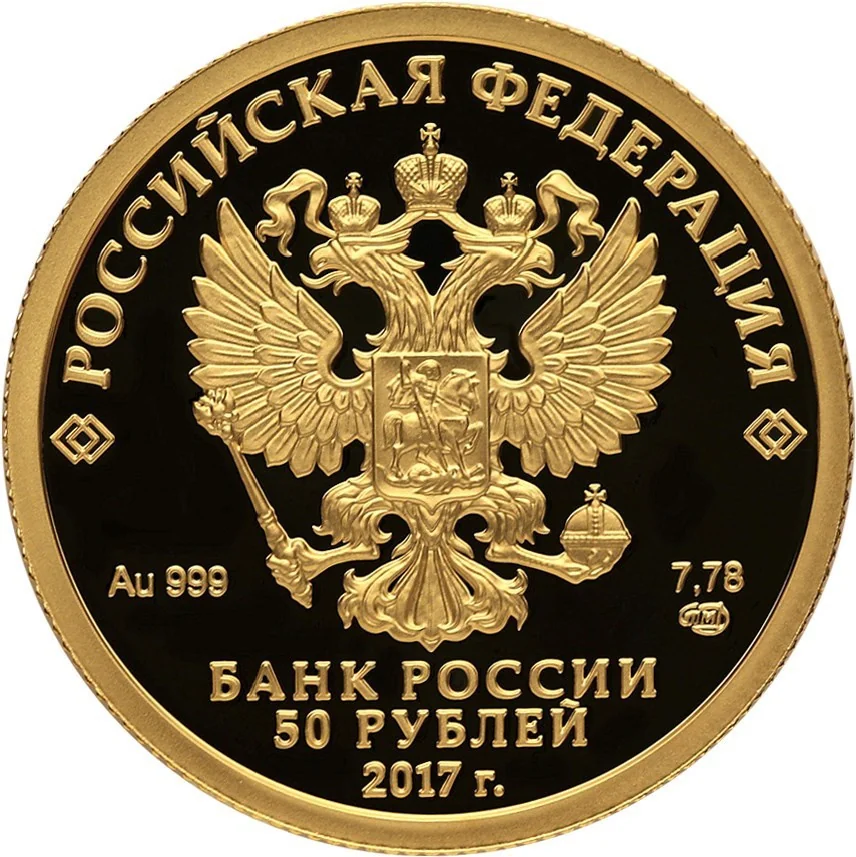
The obverse features the Russian Federation coat of arms with "РОССИЙСКАЯ ФЕДЕРАЦИЯ" above, framed by doubled rhombuses. Below are the metal specifications and mint mark, with "БАНК РОССИИ", the denomination, and the year of issue at the bottom.
Inscription:
РОССИЙСКАЯ ФЕДЕРАЦИЯ
Au 999 7,78
СПМД
БАНК РОССИИ
50 РУБЛЕЙ
2017 г.
Au 999 7,78
СПМД
БАНК РОССИИ
50 РУБЛЕЙ
2017 г.
Translation:
RUSSIAN FEDERATION
Au 999 7.78
SPMD
BANK OF RUSSIA
50 ROUBLES
2017 yr.
Au 999 7.78
SPMD
BANK OF RUSSIA
50 ROUBLES
2017 yr.
Language: Russian
Engraver: Alexandra Arsenyevna Dolgopolova
Designer: Elena Viktorovna Kramskaya
Reverse
Description:
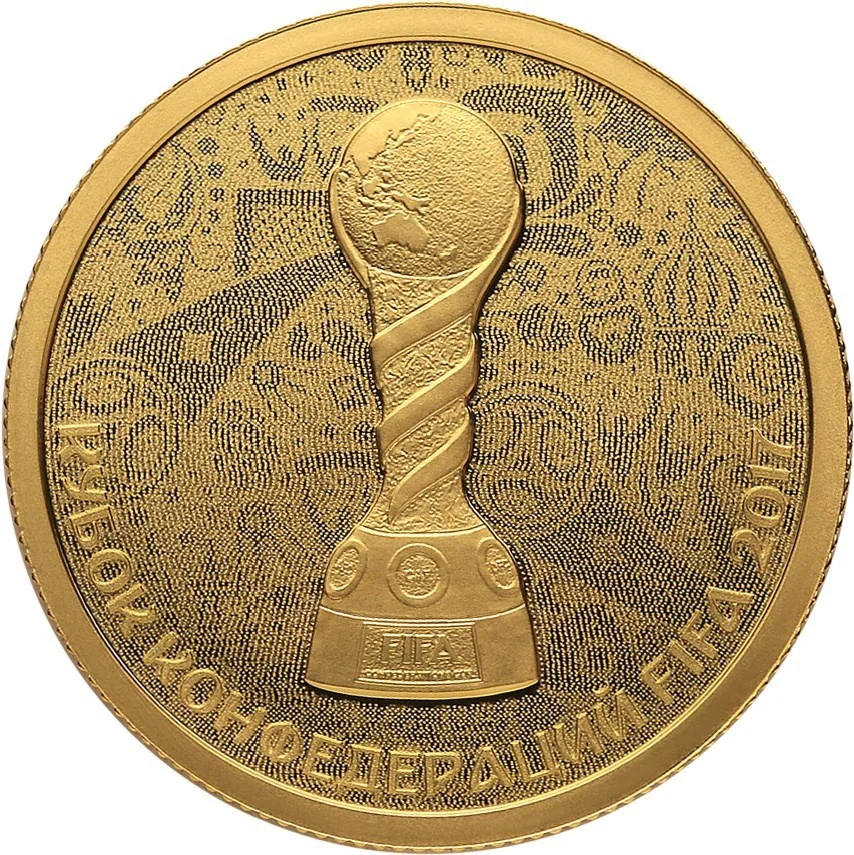
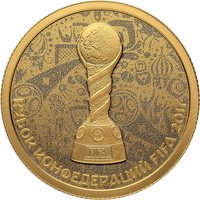
The FIFA Confederations Cup Trophy set against a blend of Russian folklore and football imagery, with "КУБОК КОНФЕДЕРАЦИЙ FIFA 2017" inscribed around the base.
Inscription:
КУБОК КОНФЕДЕРАЦИЙ FIFA 2017
Translation:
FIFA Confederations Cup 2017
Script: Cyrillic
Language: Russian
Engraver: Olga Shepel
Designer: Andrey Anatolyevich Brynza
Edge
134 corrugations
Mints
| Name | Mark |
|---|---|
| Saint Petersburg | (СПМД) |
Mintings
| Year | Mint Mark | Mintage | Quality | Collection |
|---|---|---|---|---|
| 2017 | СПМД | 5,000 | Proof |
Historical background
In 2017, the Russian economy and its currency, the ruble, were in a period of relative stabilization following the severe shocks of 2014-2015. The primary drivers of the earlier crisis—the sharp decline in global oil prices and the imposition of Western financial sanctions following the annexation of Crimea—remained in place, but their acute pressure had eased. The ruble had found a new, weaker equilibrium, trading in a range of roughly 55 to 60 rubles per US dollar for much of the year, which was significantly depreciated from pre-2014 levels but stable. This stability was underpinned by a rebound in oil prices, which averaged around $53 per barrel for Brent crude, and the economy's painful adjustment to the new normal, including a shift towards import substitution.
Monetary policy by the Central Bank of Russia (CBR) was a key factor in this stabilization. Having moved to a free-floating exchange rate in late 2014, the CBR focused decisively on inflation targeting. Throughout 2017, it pursued an aggressive cycle of interest rate cuts, reducing the key rate from 10% at the start of the year to 7.75% by December. This was possible because annual inflation had fallen dramatically to a post-Soviet low of around 3-4%, down from double-digit figures just two years prior. The rate cuts aimed to stimulate lending and economic growth, but were carefully calibrated to avoid triggering a new wave of ruble depreciation and inflation.
Overall, the financial atmosphere in 2017 was one of cautious normalization. The federal budget was adjusted to a "budget rule" that directed oil revenues above a certain threshold into reserves, shielding the ruble from direct hydrocarbon volatility. While structural weaknesses persisted and growth remained anemic at 1.5% GDP growth, the currency crisis was over. The ruble's value in 2017 was largely dictated by the dual anchors of global oil prices and the CBR's credible inflation-focused policy, allowing the government and businesses to operate with greater predictability despite the ongoing geopolitical tensions.
Monetary policy by the Central Bank of Russia (CBR) was a key factor in this stabilization. Having moved to a free-floating exchange rate in late 2014, the CBR focused decisively on inflation targeting. Throughout 2017, it pursued an aggressive cycle of interest rate cuts, reducing the key rate from 10% at the start of the year to 7.75% by December. This was possible because annual inflation had fallen dramatically to a post-Soviet low of around 3-4%, down from double-digit figures just two years prior. The rate cuts aimed to stimulate lending and economic growth, but were carefully calibrated to avoid triggering a new wave of ruble depreciation and inflation.
Overall, the financial atmosphere in 2017 was one of cautious normalization. The federal budget was adjusted to a "budget rule" that directed oil revenues above a certain threshold into reserves, shielding the ruble from direct hydrocarbon volatility. While structural weaknesses persisted and growth remained anemic at 1.5% GDP growth, the currency crisis was over. The ruble's value in 2017 was largely dictated by the dual anchors of global oil prices and the CBR's credible inflation-focused policy, allowing the government and businesses to operate with greater predictability despite the ongoing geopolitical tensions.
✨ Legendary