

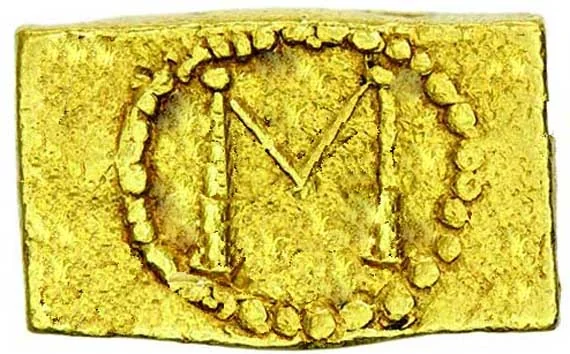
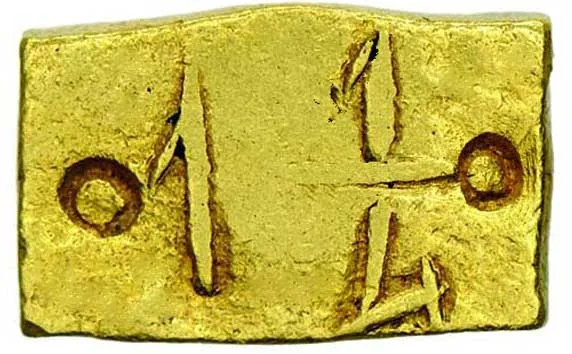
1¼ meticais – Mozambique
Add to wishlist
Mozambique
Context
Year: 1835
Issuer: Mozambique
Ruler: Mary II
Currency:
(1706—1910)
Subdivision: 1¼ meticais = 3250 Réis
Demonetization: 1915
Material
Weight: 7.2 g
Gold Weight:: 6.60 g
Thickness: 4 mm
Shape: Irregular rectangular
Composition: 91.66% Gold
Magnetic: No
References
KM: #
Numista: #99013
Value
Bullion value: $1027.46
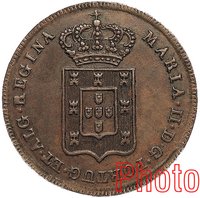
Obverse
Edge
Mintings
| Year | Mint Mark | Mintage | Quality | Collection |
|---|---|---|---|---|
| 1835 | — | — |
Historical background
In 1835, the currency situation in Mozambique was complex and fragmented, reflecting its position as a Portuguese colony deeply integrated into regional and global trade networks. The official Portuguese currency, the real, circulated but was often scarce, particularly outside of key coastal settlements like the Island of Mozambique, the colonial capital. The economy was fundamentally driven by the slave and ivory trades, and transactions were frequently conducted through barter or commodity money. Cloth, beads, and brass manillas (bracelets) served as widely accepted mediums of exchange, their values carefully calibrated and controlled by both Portuguese authorities and local African rulers.
Crucially, the most dominant and reliable currency in circulation was foreign coinage. Spanish and Mexican silver dollars (pesos or patacas), along with other European coins, were the preferred hard currency for larger commercial transactions, especially those linked to Indian Ocean trade routes. This reliance on foreign silver highlights that Mozambique's economy was more attuned to the liquidity of international commerce than to Lisbon's fiscal control. Furthermore, the powerful prazo holders (Portuguese estate holders who operated with semi-independent authority) and Swahili or Yao traders often dictated the terms of exchange, creating a multi-layered monetary environment.
Therefore, the currency landscape was not unified but a pragmatic mosaic. A merchant in 1835 might pay taxes in Portuguese réis, purchase supplies with pieces of cloth, buy ivory from the interior using bundles of beads, and settle a major slave-trade contract with stacked silver Spanish dollars. This system functioned on mutual acceptance rather than a single sovereign decree, exposing the limited reach of Portuguese colonial administration and the region's primary role as a supplier of human and natural resources for global markets.
Crucially, the most dominant and reliable currency in circulation was foreign coinage. Spanish and Mexican silver dollars (pesos or patacas), along with other European coins, were the preferred hard currency for larger commercial transactions, especially those linked to Indian Ocean trade routes. This reliance on foreign silver highlights that Mozambique's economy was more attuned to the liquidity of international commerce than to Lisbon's fiscal control. Furthermore, the powerful prazo holders (Portuguese estate holders who operated with semi-independent authority) and Swahili or Yao traders often dictated the terms of exchange, creating a multi-layered monetary environment.
Therefore, the currency landscape was not unified but a pragmatic mosaic. A merchant in 1835 might pay taxes in Portuguese réis, purchase supplies with pieces of cloth, buy ivory from the interior using bundles of beads, and settle a major slave-trade contract with stacked silver Spanish dollars. This system functioned on mutual acceptance rather than a single sovereign decree, exposing the limited reach of Portuguese colonial administration and the region's primary role as a supplier of human and natural resources for global markets.
✨ Legendary