

1000 dobras – São Tomé and Príncipe
Add to wishlist
Non-circulating coins
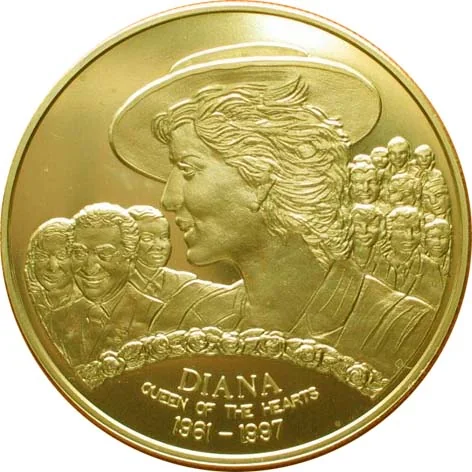
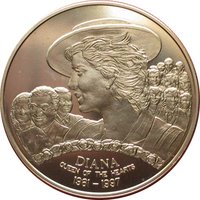
Commemoration: Diana - Queen of the Hearts
Sao Tome and Principe
Context
Year: 1997
Country: Sao Tome and Principe
Issuer: São Tomé and Príncipe
Period:
(since 1975)
Currency:
(1977—2017)
Total mintage: 3,000
Material
References
KM: #
Numista: #98320
Value
Exchange value: 1000 STD
Bullion value: $194.41
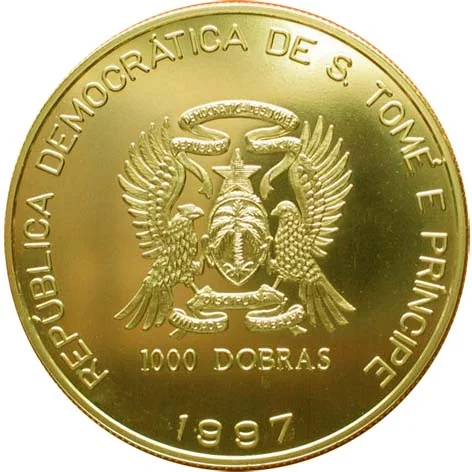
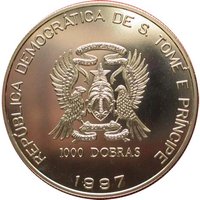
Obverse
Inscription:
REPÚBLICA DEMOCRÁTICA DE S. TOMÉ E PRÍNCIPE
1000 DOBRAS
1997
1000 DOBRAS
1997
Translation:
Democratic Republic of S. Tomé and Príncipe
1000 Dobras
1997
1000 Dobras
1997
Script: Latin
Language: Portuguese
Reverse
Inscription:
DIANA
QUEEN OF THE HEARTS
1961-1997
QUEEN OF THE HEARTS
1961-1997
Script: Latin
Edge
Reeded
Mintings
| Year | Mint Mark | Mintage | Quality | Collection |
|---|---|---|---|---|
| 1997 | — | 3,000 | Proof |
Historical background
In 1997, São Tomé and Príncipe's currency situation was defined by its long-standing and profound dependency on the Portuguese escudo and, following 1999, its planned transition to the euro. The country's own currency, the dobra (STD), introduced in 1977, suffered from chronic instability and hyperinflation, often exceeding 40% annually in the mid-1990s. This rendered it unusable for major transactions, leading to widespread de facto dollarization within the economy, particularly for real estate, foreign trade, and high-value purchases.
The nation's economic fragility was the root cause. Heavily reliant on cocoa exports and foreign aid, São Tomé and Príncipe faced persistent trade deficits, limited foreign reserves, and a large public sector. In this context, the dobra lacked credibility. To anchor its monetary system, the government maintained a formal peg to a basket of currencies, but its most critical financial relationship was with Portugal. A 1996 cooperation agreement solidified this link, ensuring the escudo circulated freely and was used for all significant financial and banking activities, effectively making it the preferred store of value.
Therefore, the 1997 currency landscape was one of a dual-system in crisis, with a weak domestic dobra used for everyday salaries and small transactions, while the real economy relied on foreign hard currencies. This arrangement underscored the country's extreme vulnerability to external shocks and set the stage for its future monetary path. The impending launch of the euro in 1999 was closely watched in São Tomé, as it would directly impact the stable anchor upon which its financial system informally depended.
The nation's economic fragility was the root cause. Heavily reliant on cocoa exports and foreign aid, São Tomé and Príncipe faced persistent trade deficits, limited foreign reserves, and a large public sector. In this context, the dobra lacked credibility. To anchor its monetary system, the government maintained a formal peg to a basket of currencies, but its most critical financial relationship was with Portugal. A 1996 cooperation agreement solidified this link, ensuring the escudo circulated freely and was used for all significant financial and banking activities, effectively making it the preferred store of value.
Therefore, the 1997 currency landscape was one of a dual-system in crisis, with a weak domestic dobra used for everyday salaries and small transactions, while the real economy relied on foreign hard currencies. This arrangement underscored the country's extreme vulnerability to external shocks and set the stage for its future monetary path. The impending launch of the euro in 1999 was closely watched in São Tomé, as it would directly impact the stable anchor upon which its financial system informally depended.
✨ Legendary