

1000 dobras – São Tomé and Príncipe
Add to wishlist
Non-circulating coins
Commemoration: 15th Aniv. Nacional Independence
Sao Tome and Principe
Context
Year: 1990
Country: Sao Tome and Principe
Issuer: São Tomé and Príncipe
Period:
(since 1975)
Currency:
(1977—2017)
Demonetized: Yes
Material
References
KM: #
Numista: #98253
Value
Exchange value: 1000 STD
Bullion value: $46.44
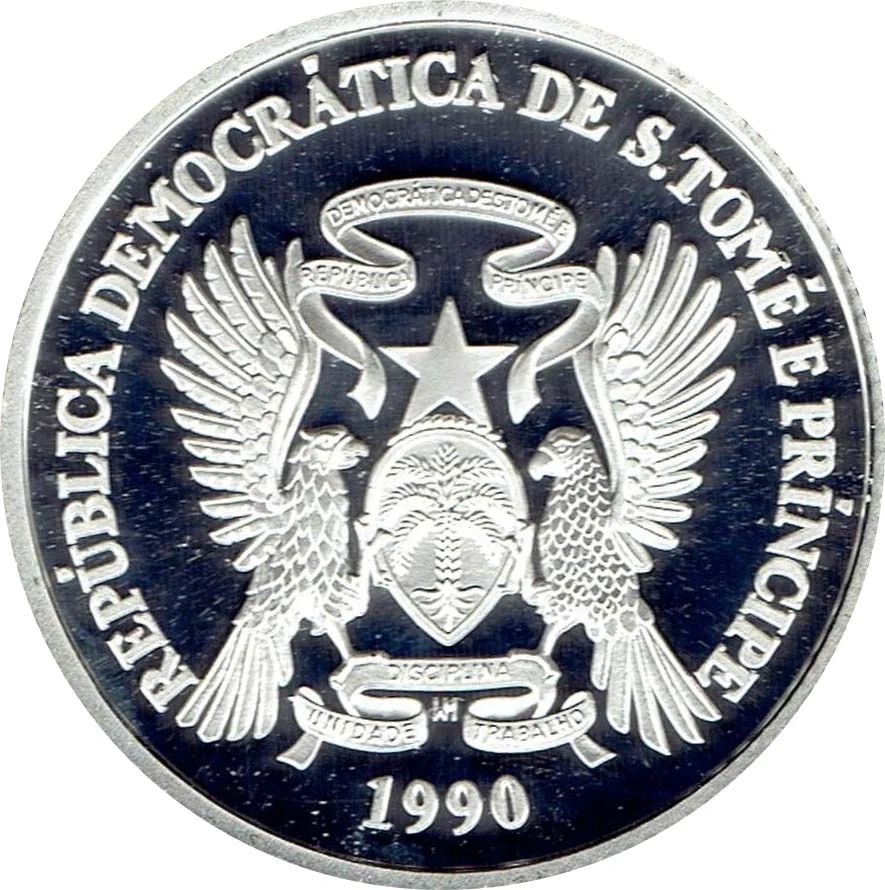
Obverse
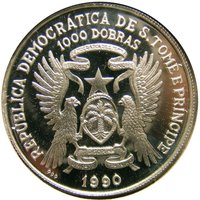
Inscription:
REPÚBLICA DEMOCRÁTICA DE S.TOMÉ E PRÍNCIPE
1000 DOBRAS
1990
999
1000 DOBRAS
1990
999
Translation:
DEMOCRATIC REPUBLIC OF S.TOME AND PRINCIPE
1000 DOBRAS
1990
999
1000 DOBRAS
1990
999
Script: Latin
Language: Portuguese
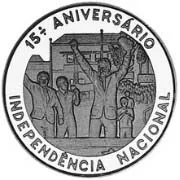
Reverse
Inscription:
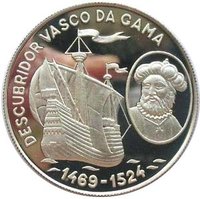
15º ANIVERSÁRIO
INDEPENDĘNCIA NACIONAL
INDEPENDĘNCIA NACIONAL
Translation:
Fifteenth Anniversary
National Independence
National Independence
Script: Latin
Language: Portuguese
Edge
Mintings
| Year | Mint Mark | Mintage | Quality | Collection |
|---|---|---|---|---|
| 1990 | — | — | Proof |
Historical background
In 1990, São Tomé and Príncipe (STP) was in the midst of a profound economic crisis, heavily reliant on a single export crop—cocoa—and struggling under the weight of a centralized socialist system established after independence from Portugal in 1975. The country's currency, the first dobra (STD), introduced in 1977, was chronically overvalued and not convertible. This created a severe foreign exchange shortage, crippling the ability to import essential goods like food, medicine, and fuel. The economy was characterized by acute shortages, a large and inefficient state sector, and a thriving parallel black market where foreign currencies, especially the US dollar and Portuguese escudo, commanded a significant premium over the official exchange rate.
The situation reached a critical point in 1987 when the government, under President Manuel Pinto da Costa, initiated a structural adjustment program with the International Monetary Fund (IMF) and the World Bank. By 1990, these reforms were intensifying, marking a decisive shift from a centrally planned to a market-oriented economy. A key pillar of this transition was a move towards currency liberalization. The government began a process of gradual but significant devaluations of the official dobra rate throughout the late 1980s and into 1990 to align it with the black-market rate, aiming to curb the parallel market and unify the exchange system.
Therefore, the currency situation in 1990 was one of active transition and instability. The dobra was losing value through controlled devaluations as part of the IMF-prescribed reforms, which also included price liberalization and privatization of state assets. This painful adjustment period set the stage for the more formal currency reforms that would follow in the subsequent years, including the eventual introduction of a new, convertible dobra in 1997. The year 1990 thus represents a pivotal moment where the foundational policies for a liberalized foreign exchange regime were being implemented to address the deep-rooted imbalances of the past.
The situation reached a critical point in 1987 when the government, under President Manuel Pinto da Costa, initiated a structural adjustment program with the International Monetary Fund (IMF) and the World Bank. By 1990, these reforms were intensifying, marking a decisive shift from a centrally planned to a market-oriented economy. A key pillar of this transition was a move towards currency liberalization. The government began a process of gradual but significant devaluations of the official dobra rate throughout the late 1980s and into 1990 to align it with the black-market rate, aiming to curb the parallel market and unify the exchange system.
Therefore, the currency situation in 1990 was one of active transition and instability. The dobra was losing value through controlled devaluations as part of the IMF-prescribed reforms, which also included price liberalization and privatization of state assets. This painful adjustment period set the stage for the more formal currency reforms that would follow in the subsequent years, including the eventual introduction of a new, convertible dobra in 1997. The year 1990 thus represents a pivotal moment where the foundational policies for a liberalized foreign exchange regime were being implemented to address the deep-rooted imbalances of the past.
💎 Extremely Rare