

10 zlotys (Battle of Upper Silesia) – Poland
Add to wishlist
Circulating commemorative coins
Commemoration: 50th Anniversary - Battle of Upper Silesia
Poland
Context
Year: 1971
Issuer: Poland
Period:
(1952—1989)
Currency:
(1949—1994)
Demonetization: 1 January 1978
Total mintage: 2,000,000
Material
Diameter: 28 mm
Weight: 9.5 g
Thickness: 2 mm
Shape: Round
Composition: Copper-nickel
Technique: Milled
Alignment: Medal alignment
flip
References
Y: #
Numista: #9817
Value
Exchange value: 10 PLZ
Inflation-adjusted value: 79945.73 PLZ
Obverse
Description:
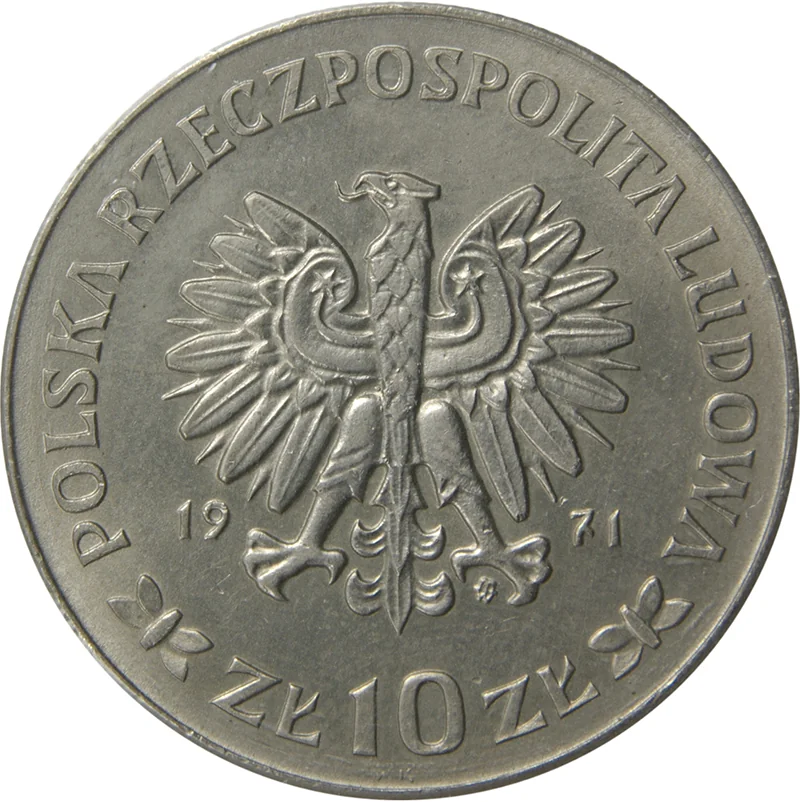
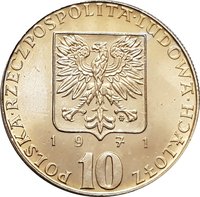
The Polish national coat of arms.
Inscription:
POLSKA RZECZPOSPOLITA LUDOWA
19 71
mw
ZŁ 10 ZŁ
WK
19 71
mw
ZŁ 10 ZŁ
WK
Translation:
Polish People's Republic
19 71
mw
10 ZŁ ZŁ
WK
19 71
mw
10 ZŁ ZŁ
WK
Script: Latin
Language: Polish
Engraver: Wacław Kowalik
Reverse
Description:
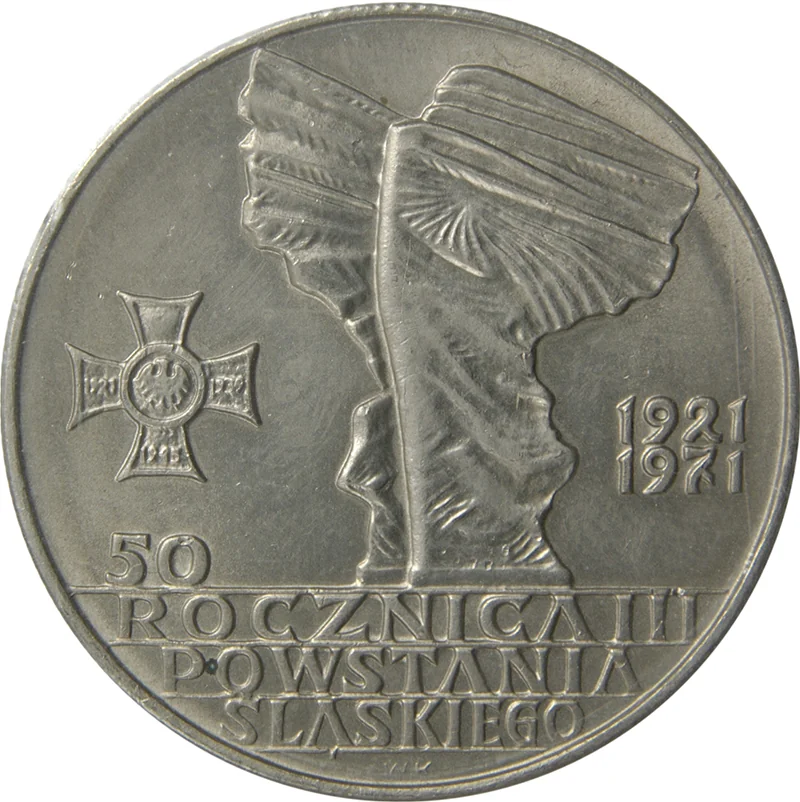
Silesian Uprising monument and cross in Katowice.
Inscription:
1921
1971
50
ROCZNICA III
POWSTANIA
ŚLĄSKIEGO
WK
1971
50
ROCZNICA III
POWSTANIA
ŚLĄSKIEGO
WK
Translation:
1921
1971
50
ANNIVERSARY OF THE THIRD
SILESIAN
UPRISING
WK
1971
50
ANNIVERSARY OF THE THIRD
SILESIAN
UPRISING
WK
Script: Latin
Language: Polish
Engraver: Wacław Kowalik
Edge
Milled
Mints
| Name | Mark |
|---|---|
| Mint of Poland | (MW) |
Mintings
| Year | Mint Mark | Mintage | Quality | Collection |
|---|---|---|---|---|
| 1971 | MW | 2,000,000 |
Historical background
In 1971, Poland's currency situation was a reflection of the deepening structural crisis of its centrally planned economy under the Polish People's Republic. The złoty was a non-convertible currency, its value artificially set by the state and divorced from market realities. While officially pegged to the US dollar, this rate was meaningless for ordinary citizens and the domestic economy, as access to hard currency was severely restricted through a complex system of different exchange rates for various transactions. The economy suffered from chronic shortages, suppressed inflation, and a growing black market where US dollars and other Western currencies commanded a premium many times higher than the official rate.
The immediate backdrop was the political and economic shock of December 1970, when worker protests over sudden price hikes for essential goods were violently suppressed, leading to the ousting of Władysław Gomułka. His successor, Edward Gierek, came to power with a populist promise to raise living standards and modernize the economy through massive borrowing from the West. In the short term, this influx of capital temporarily eased consumer pressure and allowed for a wage increase and a price freeze on basic goods, creating an illusion of stability. However, this policy did not address the fundamental inefficiencies of the system and instead dramatically increased Poland's hard currency debt, storing up severe future problems for the złoty.
Consequently, 1971 represented a precarious calm before a gathering storm. The currency's stability was entirely administrative, maintained by state controls, subsidies, and the new foreign loans. The underlying weakness of the złoty was evident in the thriving black market for dollars and the economy's inability to generate meaningful exports to the West to service its new debts. Gierek's strategy ultimately set the stage for the severe economic crises of the later 1970s and 1980s, when the unsustainable debt burden and failed reforms would lead to hyperinflation, the legalization of a private hard currency market, and the eventual collapse of the communist economic model.
The immediate backdrop was the political and economic shock of December 1970, when worker protests over sudden price hikes for essential goods were violently suppressed, leading to the ousting of Władysław Gomułka. His successor, Edward Gierek, came to power with a populist promise to raise living standards and modernize the economy through massive borrowing from the West. In the short term, this influx of capital temporarily eased consumer pressure and allowed for a wage increase and a price freeze on basic goods, creating an illusion of stability. However, this policy did not address the fundamental inefficiencies of the system and instead dramatically increased Poland's hard currency debt, storing up severe future problems for the złoty.
Consequently, 1971 represented a precarious calm before a gathering storm. The currency's stability was entirely administrative, maintained by state controls, subsidies, and the new foreign loans. The underlying weakness of the złoty was evident in the thriving black market for dollars and the economy's inability to generate meaningful exports to the West to service its new debts. Gierek's strategy ultimately set the stage for the severe economic crises of the later 1970s and 1980s, when the unsustainable debt burden and failed reforms would lead to hyperinflation, the legalization of a private hard currency market, and the eventual collapse of the communist economic model.
🌱 Common