

5 Dollars (Royal Flying Doctor Service) – Australia
Non-circulating coins
Commemoration: 70 Years of the Royal Flying Doctor Service
Australia
Context

Material
References
KM: #Click to copy to clipboard386
Numista: #98049
Value
Exchange value: 5 AUD = $3.56
Inflation-adjusted value: 10.40 AUD
Obverse
Description:
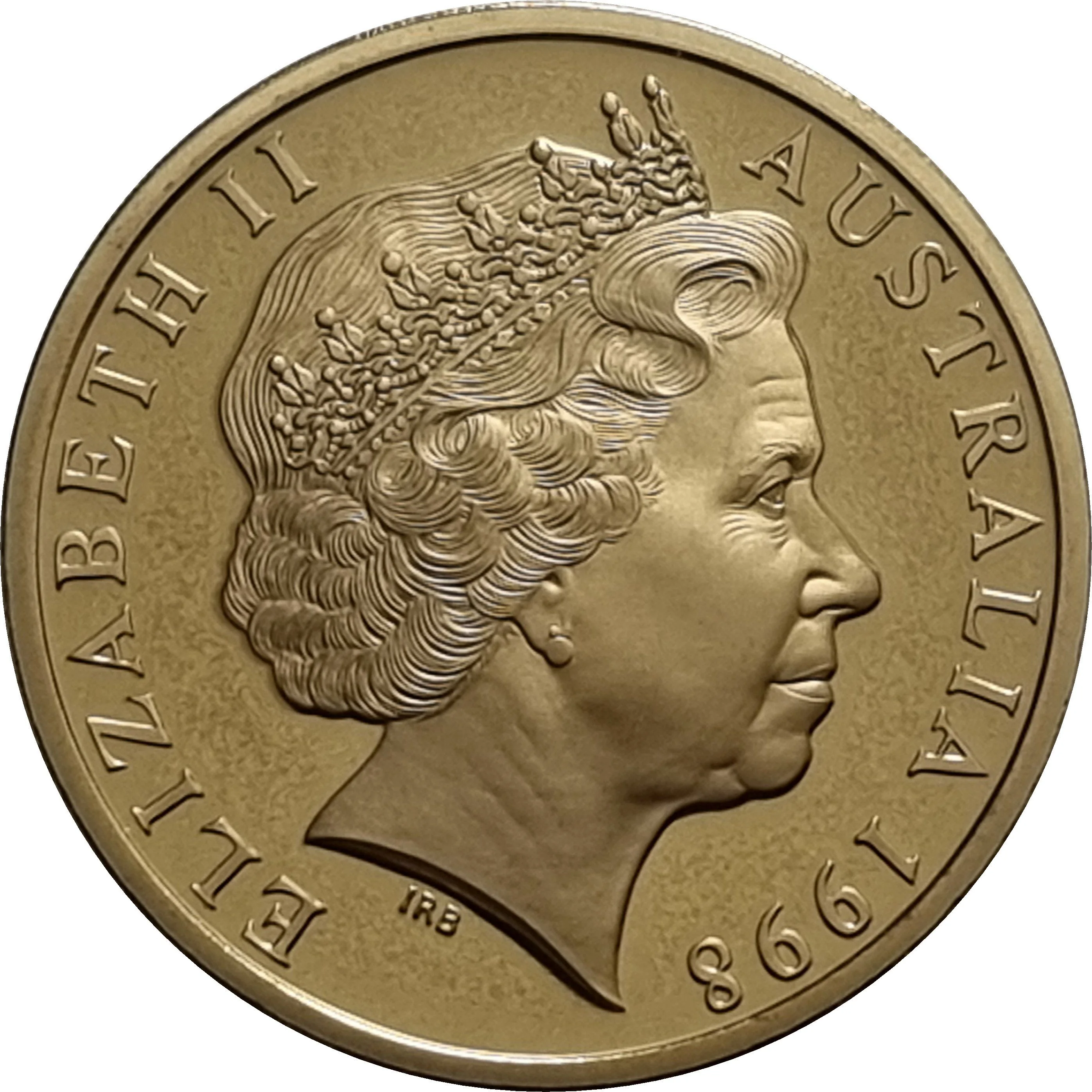
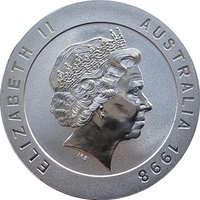
Queen Elizabeth IV, facing right, wearing the Girls of Great Britain and Ireland Tiara.
Inscription:
ELIZABETH II
AUSTRALIA 1998
IRB
AUSTRALIA 1998
IRB
Script: Latin
Designer: Ian Rank-Broadley
Reverse
Description:
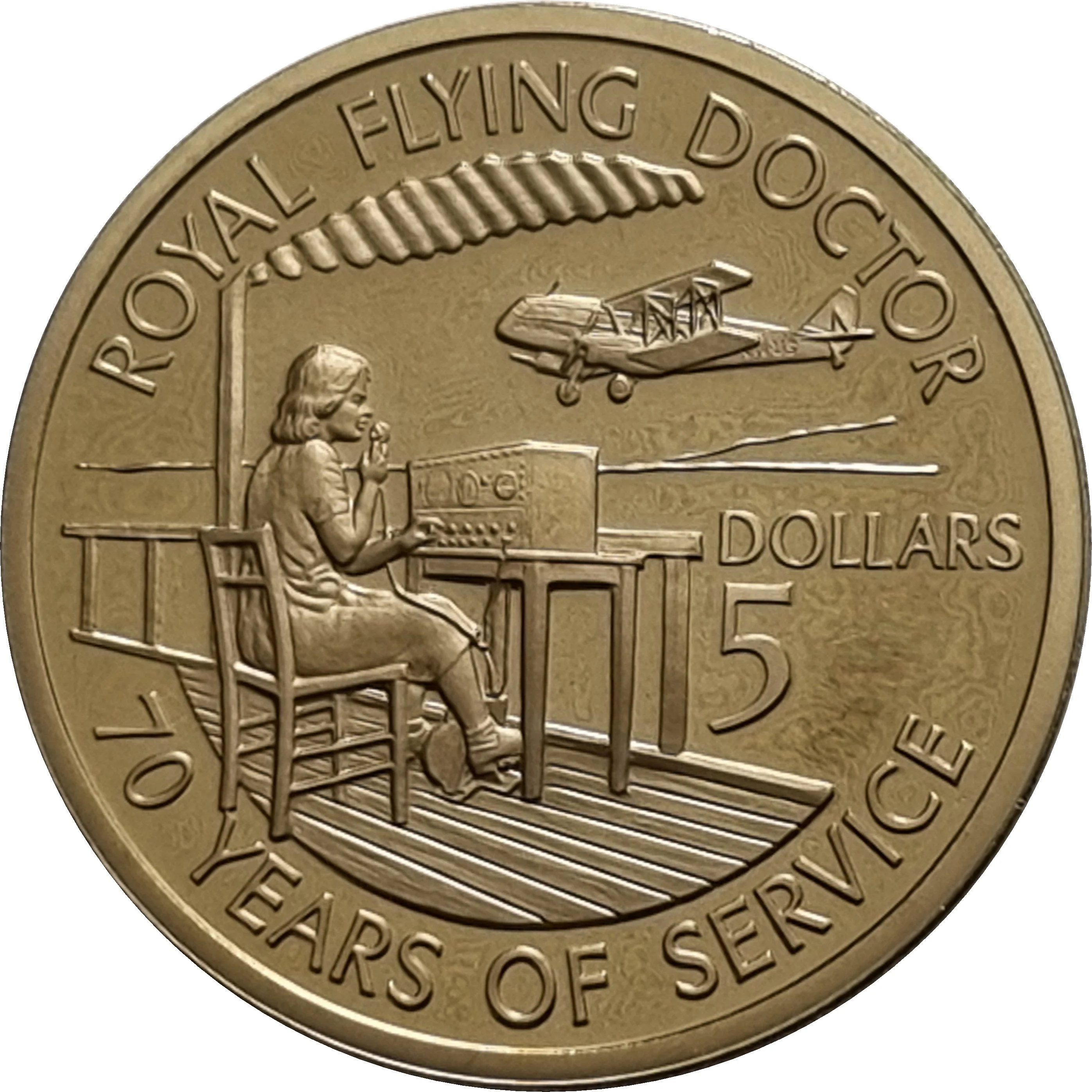
Female radio operator contacting a Royal Flying Doctor pilot in a passing plane.
Inscription:
ROYAL FLYING DOCTOR
DOLLARS
5
70 YEARS OF SERVICE
DOLLARS
5
70 YEARS OF SERVICE
Script: Latin
Designer: Wojciech Pietranik
Edge
Reeded
Categories
| Health |
| Transportation> Aircraft |
Mints
| Name | Mark |
|---|---|
| Royal Australian Mint | — |
Mintings
| Year | Mint Mark | Mintage | Quality | Collection |
|---|---|---|---|---|
| 1998 | — | 15,158 | Proof |
Historical background
In 1998, Australia's currency situation was dominated by the strategic decision to introduce a new series of banknotes, specifically the landmark release of the first polymer $10 note on November 1st. This was part of a multi-year program to fully convert the nation's currency from paper to the world-leading polymer substrate developed by the CSIRO and the Reserve Bank of Australia (RBA). The new notes, starting with the $5 in 1992, were celebrated for their enhanced security features, durability, and cleanliness, positioning Australia at the forefront of anti-counterfeiting technology globally.
Economically, the Australian dollar (AUD) in 1998 operated under a free-floating exchange rate regime, a system established in 1983. The year was one of significant turbulence, as the currency felt the severe pressures of the 1997-1998 Asian Financial Crisis. As a major trading partner with Asia, Australia saw its dollar depreciate sharply, falling to historic lows around US$0.55 in the second half of 1998. This was driven by risk aversion in global markets, falling commodity prices, and concerns over regional economic contagion impacting Australian exports.
The Reserve Bank of Australia's approach in this period was largely one of non-intervention in the foreign exchange market, allowing the currency to absorb the external shock. The low dollar, while a symptom of regional distress, also provided a natural economic stimulus by making Australian exports more competitive. Consequently, the currency narrative of 1998 was dual-faceted: one of innovative domestic currency design and resilience, and another of navigating a severe external valuation challenge that tested the flexibility of the floating exchange rate system.
Economically, the Australian dollar (AUD) in 1998 operated under a free-floating exchange rate regime, a system established in 1983. The year was one of significant turbulence, as the currency felt the severe pressures of the 1997-1998 Asian Financial Crisis. As a major trading partner with Asia, Australia saw its dollar depreciate sharply, falling to historic lows around US$0.55 in the second half of 1998. This was driven by risk aversion in global markets, falling commodity prices, and concerns over regional economic contagion impacting Australian exports.
The Reserve Bank of Australia's approach in this period was largely one of non-intervention in the foreign exchange market, allowing the currency to absorb the external shock. The low dollar, while a symptom of regional distress, also provided a natural economic stimulus by making Australian exports more competitive. Consequently, the currency narrative of 1998 was dual-faceted: one of innovative domestic currency design and resilience, and another of navigating a severe external valuation challenge that tested the flexibility of the floating exchange rate system.

💎 Very Rare