

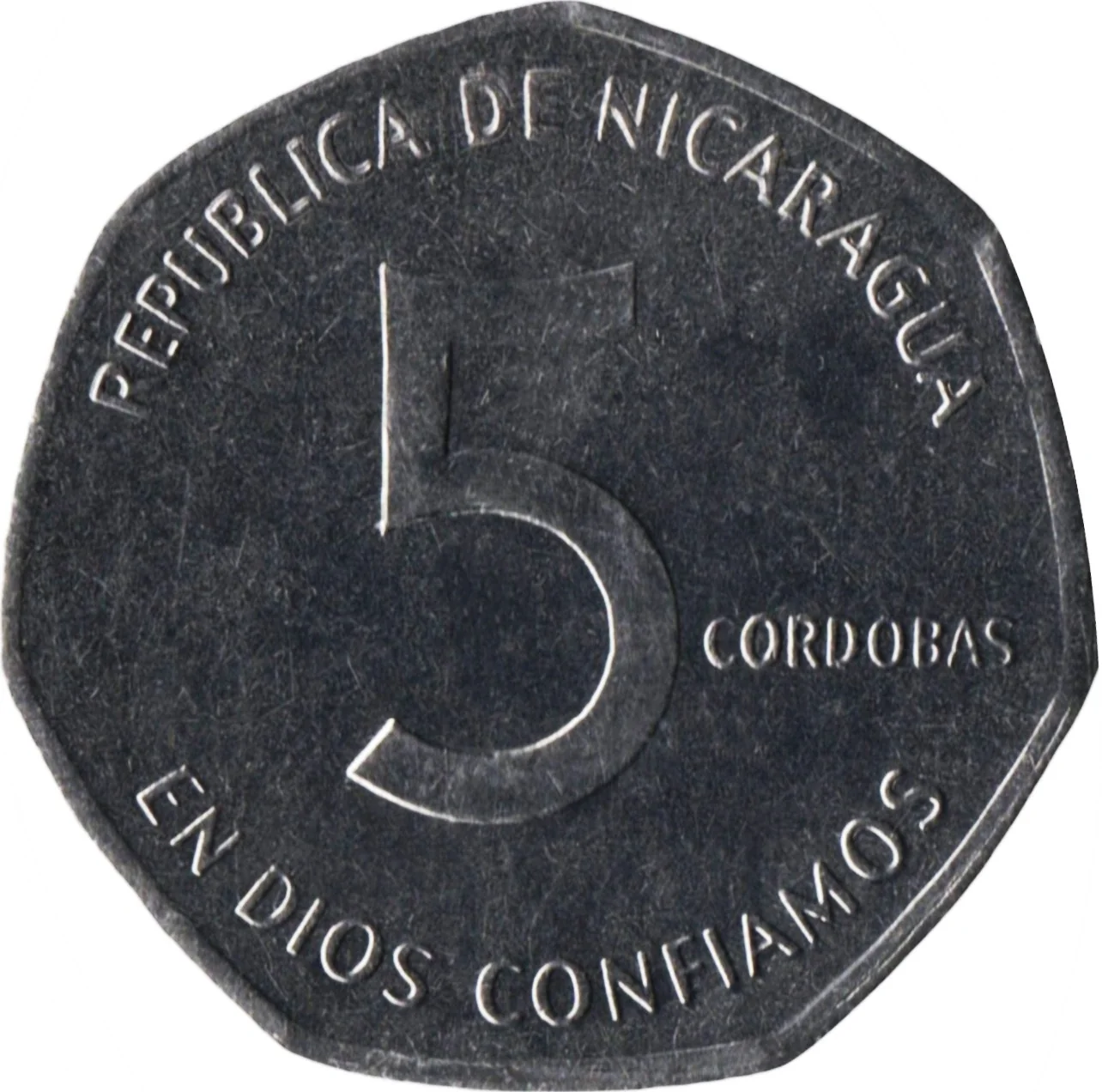
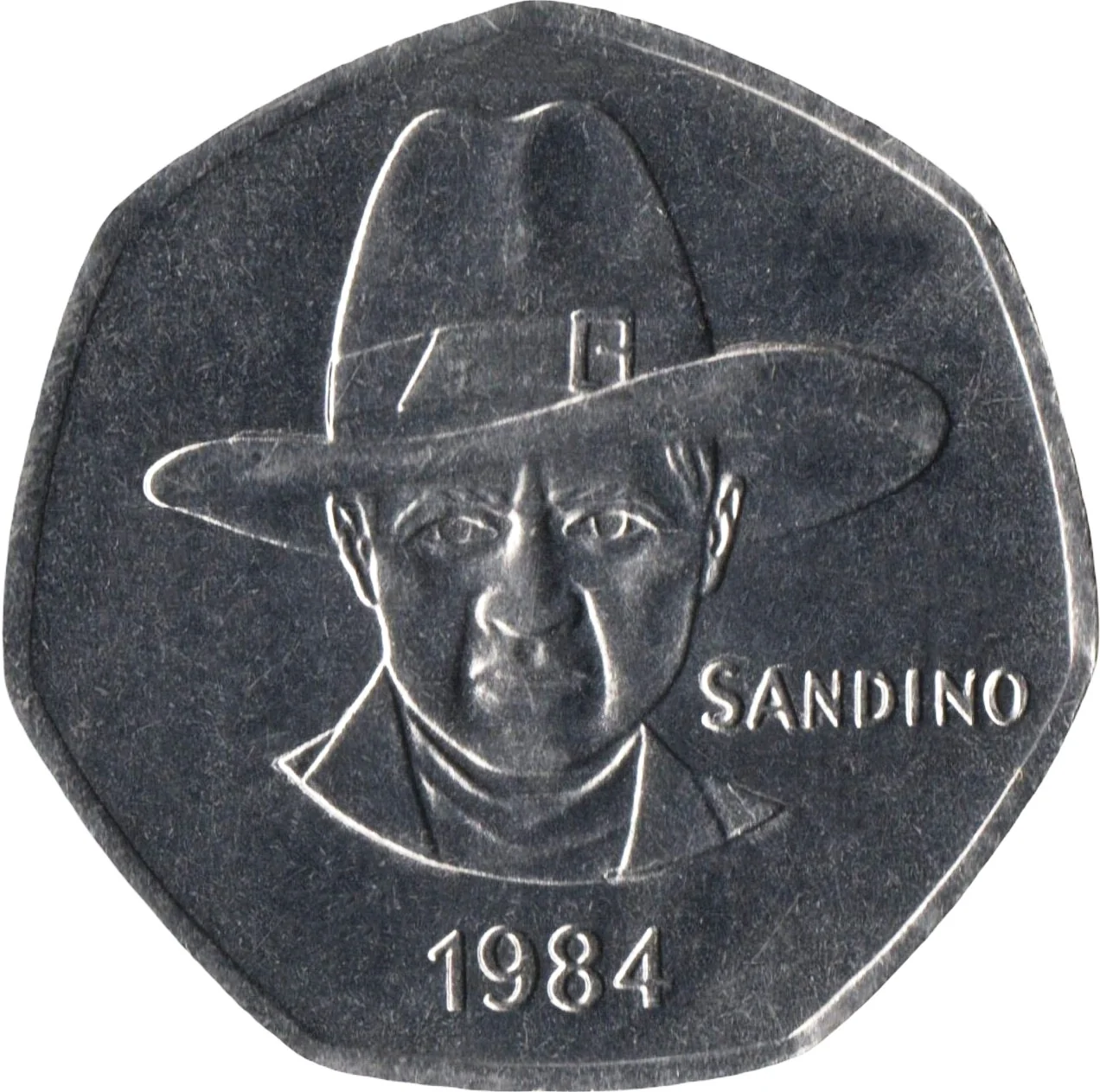
5 córdobas – Nicaragua
Add to wishlist
Nicaragua
Context
Year: 1984
Issuer: Nicaragua
Issuing organization: Central Bank of Nicaragua
Period:
(since 1854)
Currency:
(1912—1987)
Demonetization: 15 February 1988
Total mintage: 8,000,000
Material
Diameter: 27.2 mm
Weight: 7 g
Thickness: 1 mm
Shape: Heptagonal
Technique: Milled
Alignment: Medal alignment
flip
References
KM: #
Numista: #9768
Obverse
Reverse
Edge
Plain
Categories
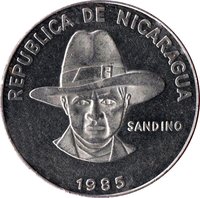
| Person> Military leader |
| Object> Hat |
Mints
| Name | Mark |
|---|---|
| Staatliche Münze Baden-Württemberg | — |
Mintings
| Year | Mint Mark | Mintage | Quality | Collection |
|---|---|---|---|---|
| 1984 | — | 8,000,000 |
Historical background
In 1984, Nicaragua's currency situation was deeply strained by the combined pressures of civil war, a U.S.-led economic embargo, and the Sandinista government's economic policies. The Contra war, funded by the United States, devastated infrastructure and agricultural production, while the Reagan administration's comprehensive trade embargo in May 1985 (formally declared then but with mounting pressure throughout 1984) severely restricted access to foreign exchange and credit. The government, pursuing a mixed economy with a large state sector, financed the war effort and social programs through significant monetary expansion, leading to rampant inflation and a growing black market for U.S. dollars.
Officially, the national currency was the córdoba, but a complex multi-tier exchange rate system was in place, creating severe distortions. The strongest official rate was reserved for essential imports and state transactions, while a much weaker rate applied to other sectors. This disparity, alongside soaring inflation—which reached over 50% in 1984 and was accelerating—fueled a vast parallel market where the U.S. dollar traded at a premium many times higher than the official rates. This duality crippled legitimate business, encouraged capital flight, and created widespread shortages of basic goods.
Consequently, 1984 represented a pivotal year where the foundations for hyperinflation and a profound currency crisis in the late 1980s were firmly laid. The economic strategy of financing the war through money creation, combined with external aggression and internal controls, rendered the córdoba increasingly unstable. The population's loss of confidence in the national currency became palpable, as saving in córdobas became irrational, and the dollarization of the economy began to take root as a practical response to the failing monetary system.
Officially, the national currency was the córdoba, but a complex multi-tier exchange rate system was in place, creating severe distortions. The strongest official rate was reserved for essential imports and state transactions, while a much weaker rate applied to other sectors. This disparity, alongside soaring inflation—which reached over 50% in 1984 and was accelerating—fueled a vast parallel market where the U.S. dollar traded at a premium many times higher than the official rates. This duality crippled legitimate business, encouraged capital flight, and created widespread shortages of basic goods.
Consequently, 1984 represented a pivotal year where the foundations for hyperinflation and a profound currency crisis in the late 1980s were firmly laid. The economic strategy of financing the war through money creation, combined with external aggression and internal controls, rendered the córdoba increasingly unstable. The population's loss of confidence in the national currency became palpable, as saving in córdobas became irrational, and the dollarization of the economy began to take root as a practical response to the failing monetary system.
🌱 Fairly Common