

1 dollar (Royal Australian Air Force) – Australia
Add to wishlist
Non-circulating coins
Commemoration: Centenary of the Royal Australian Air Force
Australia
Context
Material
References
Numista: #262212
Value
Exchange value: 1 AUD
Bullion value: $29.04
Inflation-adjusted value: 1.20 AUD
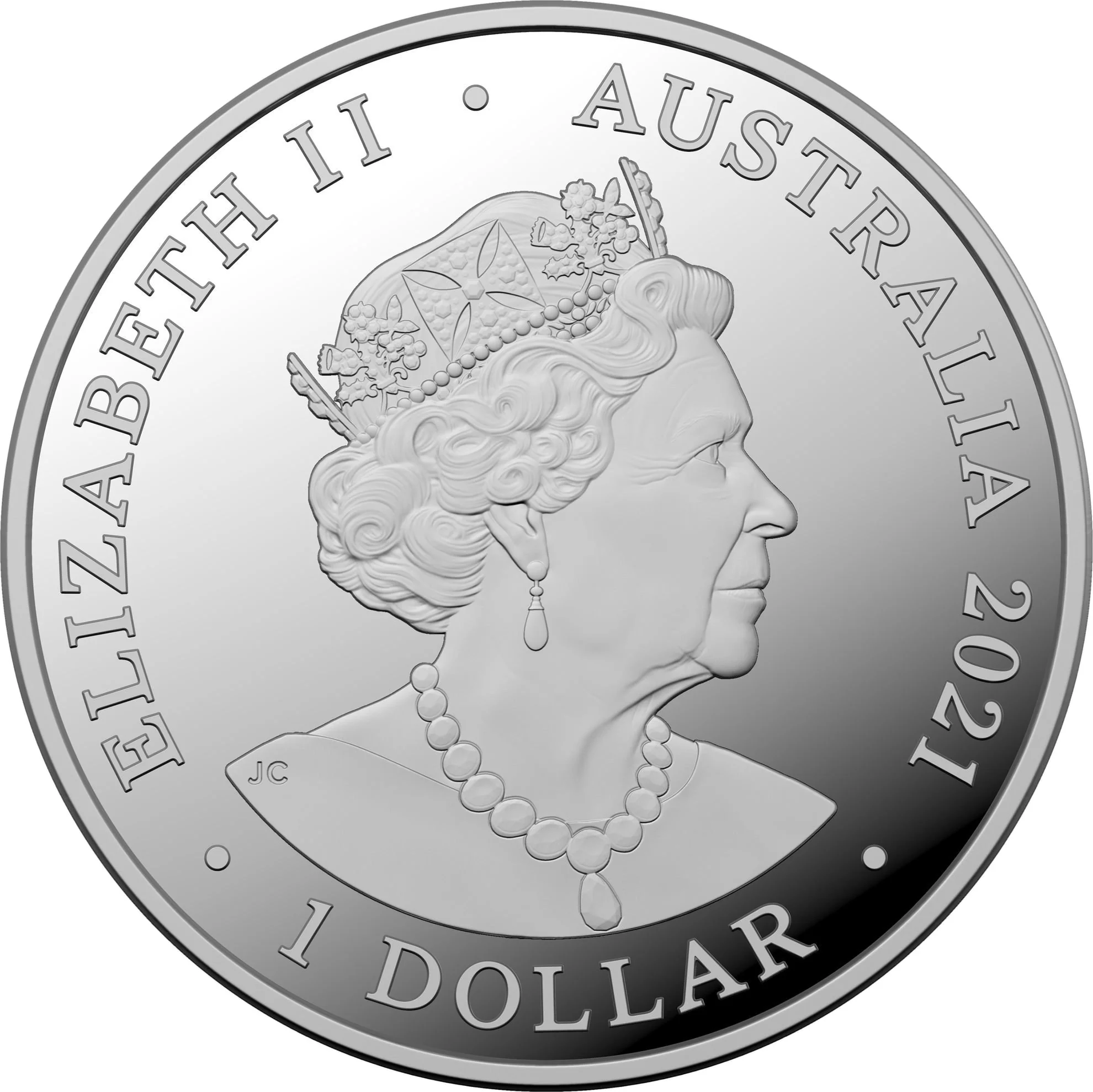
Obverse
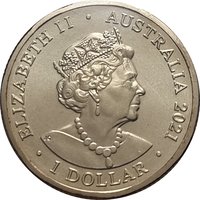
Description:
Queen Elizabeth VI facing right, wearing the King George IV State Diadem and Victorian Coronation Necklace.
Inscription:
ELIZABETH II
AUSTRALIA 2021
1 DOLLAR
JC
AUSTRALIA 2021
1 DOLLAR
JC
Script: Latin
Designer: Jody Clark
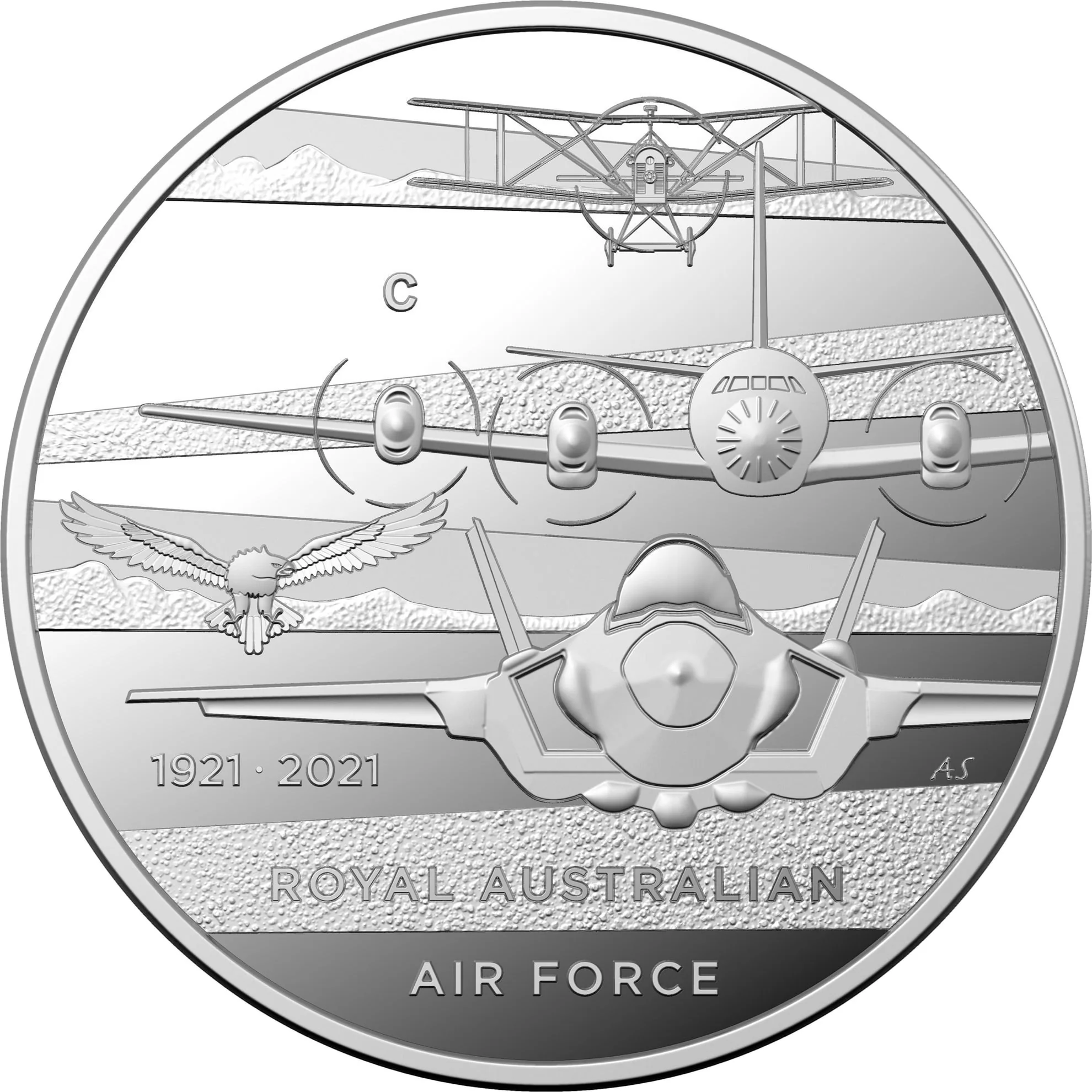
Reverse
Description:
RAAF aircraft evolution: an early SE5A biplane, a P-3 Orion, and the latest F-35A Lightning II, with the badge's Wedge-tailed Eagle to the left.
Inscription:
C
1921 • 2021 AS
ROYAL AUSTRALIAN
AIR FORCE
1921 • 2021 AS
ROYAL AUSTRALIAN
AIR FORCE
Script: Latin
Designer: Aleksandra Stokic
Edge
7 shorter smooth segments between 7 reeded segments (11 grooves each)
Categories
| Animal> Bird> Eagle |
| Transportation> Aircraft |
Mints
| Name | Mark |
|---|---|
| Royal Australian Mint | C |
Mintings
| Year | Mint Mark | Mintage | Quality | Collection |
|---|---|---|---|---|
| 2021 | C | 5,000 | Proof |
Historical background
In 2021, Australia's currency situation was primarily defined by the ongoing global response to the COVID-19 pandemic and its significant domestic economic repercussions. The Reserve Bank of Australia (RBA) maintained a historically accommodative monetary policy, holding the official cash rate at a record low of 0.1% throughout the year. This was complemented by a substantial quantitative easing program, with the RBA committing to purchase government bonds to suppress yields and support the flow of credit. These measures aimed to stimulate economic recovery, boost employment, and ensure inflation—which remained stubbornly below the RBA's 2-3% target band for much of the year—would return to desired levels.
The Australian dollar (AUD) exhibited notable volatility, largely driven by shifting global risk sentiment and commodity prices. Early in the year, the AUD surged towards US$0.80, buoyed by a robust recovery in iron ore prices, Australia's largest export. However, this strength proved temporary. As China—Australia's major trading partner—imposed trade restrictions and signaled a slowdown in its construction sector, iron ore prices collapsed in the second half of the year. Concurrently, a resurgent US dollar, fueled by expectations of faster Federal Reserve tapering, applied further downward pressure. The AUD subsequently retreated, ending the year around US$0.73.
Domestically, the currency's depreciation was seen as a mixed blessing. While it increased the cost of imports and overseas travel for Australians, it provided a welcome boost to export-oriented sectors like education, tourism, and other commodities beyond iron ore. Overall, the 2021 currency landscape reflected a nation navigating the tailwinds of strong early commodity prices against the headwinds of a complex geopolitical trade relationship and the global transition towards post-pandemic monetary policy normalization.
The Australian dollar (AUD) exhibited notable volatility, largely driven by shifting global risk sentiment and commodity prices. Early in the year, the AUD surged towards US$0.80, buoyed by a robust recovery in iron ore prices, Australia's largest export. However, this strength proved temporary. As China—Australia's major trading partner—imposed trade restrictions and signaled a slowdown in its construction sector, iron ore prices collapsed in the second half of the year. Concurrently, a resurgent US dollar, fueled by expectations of faster Federal Reserve tapering, applied further downward pressure. The AUD subsequently retreated, ending the year around US$0.73.
Domestically, the currency's depreciation was seen as a mixed blessing. While it increased the cost of imports and overseas travel for Australians, it provided a welcome boost to export-oriented sectors like education, tourism, and other commodities beyond iron ore. Overall, the 2021 currency landscape reflected a nation navigating the tailwinds of strong early commodity prices against the headwinds of a complex geopolitical trade relationship and the global transition towards post-pandemic monetary policy normalization.

💎 Extremely Rare