


Obverse
Description:
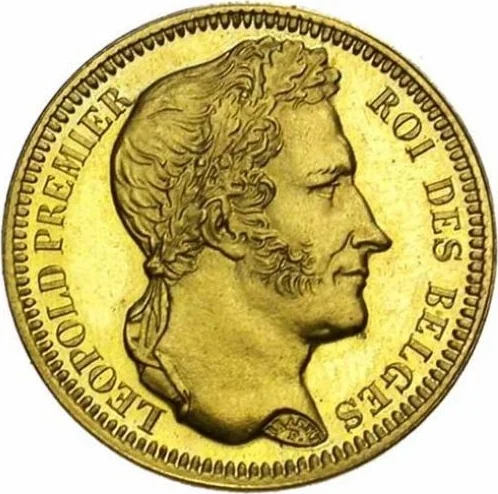
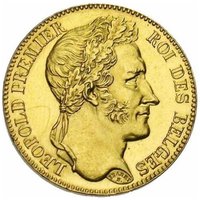
King Leopold I facing right, designer at lower right, French text surrounding.
Inscription:
LEOPOLD PREMIER ROI DES BELGES
BRAEMT F.
BRAEMT F.
Translation:
Leopold the First King of the Belgians
Braemt F.
Braemt F.
Script: Latin
Language: French
Engraver: Joseph-Pierre Braemt
Reverse
Description:
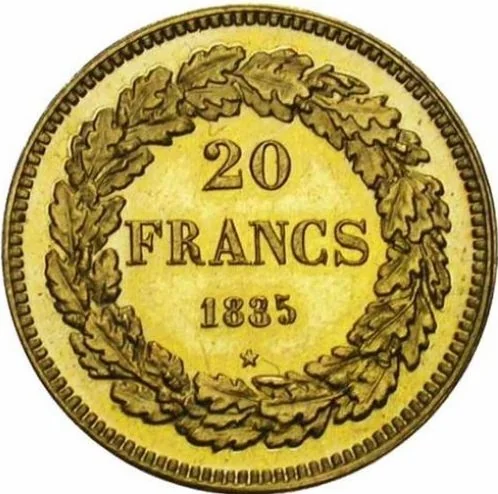
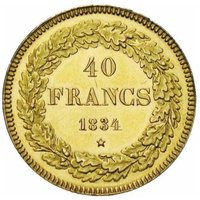
Value, year, and star in oak wreath.
Inscription:
20
FRANCS
1835
★
FRANCS
1835
★
Script: Latin
Engraver: Joseph-Pierre Braemt
Edge
Plain with incused lettering.
Legend:
DIEU PROTÈGE LA BELGIQUE
Translation:
God protects Belgium.
Language: French
Mints
| Name | Mark |
|---|---|
| Royal Mint of Belgium | — |
Mintings
| Year | Mint Mark | Mintage | Quality | Collection |
|---|---|---|---|---|
| 1834 | — | — | ||
| 1835 | — | — | ||
| 1838 | — | 1 | ||
| 1841 | — | — |
Historical background
In 1834, Belgium was navigating the complex monetary aftermath of its recent independence. The new nation inherited a chaotic currency landscape from the period of Dutch rule (1815-1830) and the subsequent revolution. Multiple currencies circulated simultaneously: Dutch guilders, French francs, and a variety of older regional coins, all with fluctuating values. This lack of a unified monetary system hampered commerce, state finances, and economic confidence, creating an urgent need for standardization to solidify national sovereignty and foster economic growth.
The Belgian government had already taken a decisive step in 1832 by passing a law adopting a bimetallic standard based on the French franc. This established the Belgian franc as the national unit of account, divisible into 100 centimes and with its silver content pegged identically to its French counterpart. However, the implementation in 1834 was still in a transitional phase. The practical task of minting and distributing enough new Belgian coinage to replace the old mixed circulation was a massive logistical and financial undertaking that would take years.
Consequently, while the legal framework was set, the currency situation in 1834 remained one of de jure unity but de facto plurality. The new Belgian coins—silver 5-franc pieces and smaller denominations—began to enter circulation alongside the older foreign coins, which remained legal tender for a time. This period was characterized by the gradual displacement of the Dutch guilder, as the state worked to assert its monetary authority and fully unify the national economy under a single, stable currency inspired by the Latin Monetary Union forming with France.
The Belgian government had already taken a decisive step in 1832 by passing a law adopting a bimetallic standard based on the French franc. This established the Belgian franc as the national unit of account, divisible into 100 centimes and with its silver content pegged identically to its French counterpart. However, the implementation in 1834 was still in a transitional phase. The practical task of minting and distributing enough new Belgian coinage to replace the old mixed circulation was a massive logistical and financial undertaking that would take years.
Consequently, while the legal framework was set, the currency situation in 1834 remained one of de jure unity but de facto plurality. The new Belgian coins—silver 5-franc pieces and smaller denominations—began to enter circulation alongside the older foreign coins, which remained legal tender for a time. This period was characterized by the gradual displacement of the Dutch guilder, as the state worked to assert its monetary authority and fully unify the national economy under a single, stable currency inspired by the Latin Monetary Union forming with France.
✨ Legendary