

Obverse
Description:
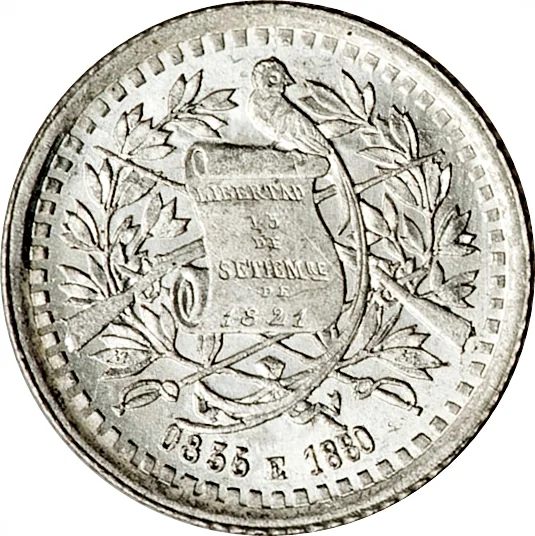
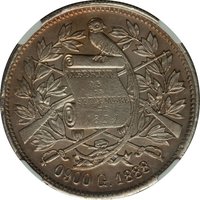
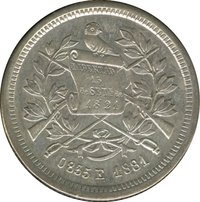
Coat of arms with fineness and date below.
Inscription:
LIBERTAD 15 DE SETIEMre DE 1821
0835 E 1880
0835 E 1880
Translation:
LIBERTY 15 SEPTEMBER 1821
0835 AND 1880
0835 AND 1880
Script: Latin
Language: Spanish
Engraver: Johann-Baptist Frener
Reverse
Description:
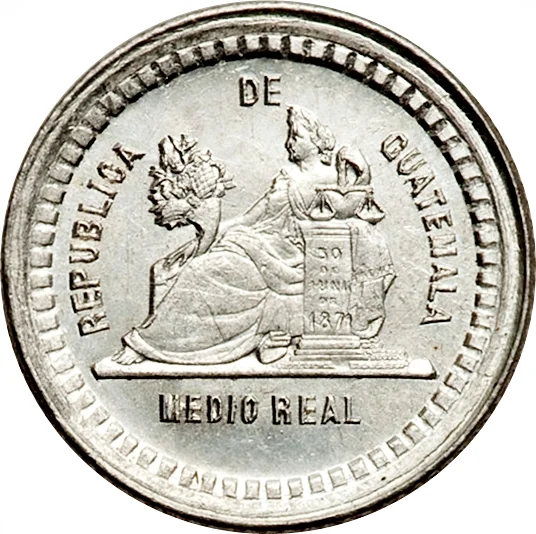
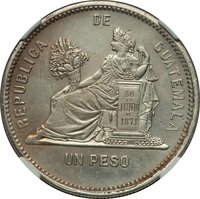
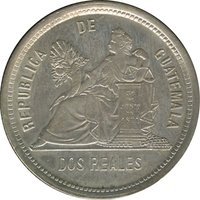
Justice seated with Constitution, legend around, value below.
Inscription:
REPUBLICA DE GUATEMALA
30 DE JUNIO DE 1871
MEDIO REAL
30 DE JUNIO DE 1871
MEDIO REAL
Translation:
REPUBLIC OF GUATEMALA
JUNE 30, 1871
HALF REAL
JUNE 30, 1871
HALF REAL
Script: Latin
Language: Spanish
Engraver: Johann-Baptist Frener
Edge
Milled
Categories
| Symbol> Allegory |
| Symbols> Coat of Arms |
Mints
| Name | Mark |
|---|---|
| Casa de Moneda de Guatemala | — |
Mintings
| Year | Mint Mark | Mintage | Quality | Collection |
|---|---|---|---|---|
| 1880 | — | — | ||
| 1881 | — | — | ||
| 1883 | — | 46,237 | ||
| 1889 | — | 481,424 | ||
| 1890 | — | — | ||
| 1892 | — | 17,600 |
Historical background
In 1880, Guatemala’s currency system was in a state of transition and disarray, caught between the colonial past and the demands of a modernizing coffee-export economy. The official currency was the Guatemalan Peso, theoretically on a silver standard, but the reality was far more complex. The circulation was dominated by a chaotic mix of foreign coins, primarily Spanish, Mexican, and Peruvian silver pesos and reales, alongside British sovereigns and French francs. This proliferation of foreign specie, each with varying metallic content and value, created significant challenges for commerce and state finance, leading to confusion and frequent disputes over exchange rates.
The root of this instability lay in the chronic shortage of official Guatemalan minted coin. While the Casa de Moneda de Guatemala (the national mint) had been established centuries prior, its output was insufficient. Furthermore, the government's fiscal weakness, exacerbated by the costs of infrastructure projects and the consolidation of the liberal state under President Justo Rufino Barrios, led to the issuance of fiat paper money. This paper currency, not fully backed by silver reserves, circulated at a discount to specie and was widely distrusted, particularly in rural areas and among the indigenous population, who preferred tangible silver coins for transactions.
This monetary fragmentation directly hampered economic development. Coffee planters, who were the engine of the export boom, needed a reliable and uniform currency to pay laborers, settle international debts, and finance investments. The situation prompted increasing calls from the powerful coffee-growing elite and foreign merchants for a fundamental monetary reform. Consequently, the year 1880 fell within a period of intense debate that would culminate in the Monetary Law of 1881, which formally decimalized the currency, introduced the Quetzal as a unit of account (pegged to the US Dollar), and sought to replace the chaotic mix of coins with a unified, modern system, laying the groundwork for future financial stability.
The root of this instability lay in the chronic shortage of official Guatemalan minted coin. While the Casa de Moneda de Guatemala (the national mint) had been established centuries prior, its output was insufficient. Furthermore, the government's fiscal weakness, exacerbated by the costs of infrastructure projects and the consolidation of the liberal state under President Justo Rufino Barrios, led to the issuance of fiat paper money. This paper currency, not fully backed by silver reserves, circulated at a discount to specie and was widely distrusted, particularly in rural areas and among the indigenous population, who preferred tangible silver coins for transactions.
This monetary fragmentation directly hampered economic development. Coffee planters, who were the engine of the export boom, needed a reliable and uniform currency to pay laborers, settle international debts, and finance investments. The situation prompted increasing calls from the powerful coffee-growing elite and foreign merchants for a fundamental monetary reform. Consequently, the year 1880 fell within a period of intense debate that would culminate in the Monetary Law of 1881, which formally decimalized the currency, introduced the Quetzal as a unit of account (pegged to the US Dollar), and sought to replace the chaotic mix of coins with a unified, modern system, laying the groundwork for future financial stability.
🌟 Limited