

10 Francs – Burundi
Burundi
Context
Year: 2011
Issuer: Burundi 
Issuing organization: Bank of the Republic of Burundi
Period:
(since 1966)
Currency:
(since 1962)
Material
References
KM: #Click to copy to clipboard21
Numista: #26140
Value
Exchange value: 10 BIF
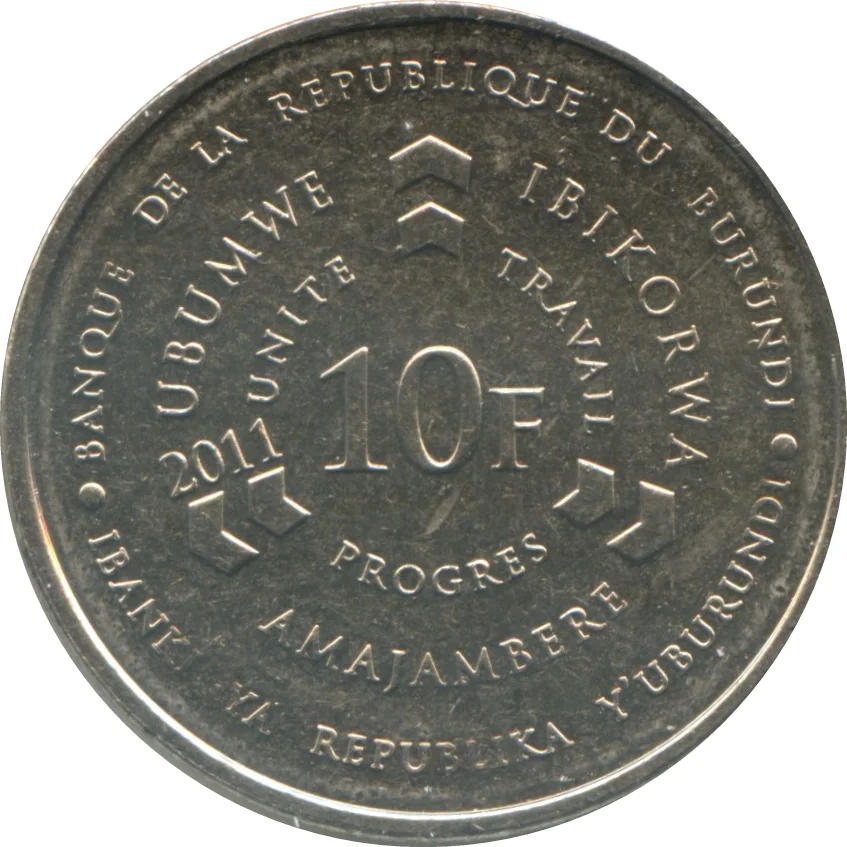
Obverse
Description:
Denomination encircled by text.
Inscription:
BANQUE DE LA REPUBLIQUE DU BURUNDI
IBANKI YA REPUBLIKA Y'UBURUNDI
UNITE TRAVAIL PROGRES
UBUMWE IBIKORWA AMAJAMBERE
10F 2011
IBANKI YA REPUBLIKA Y'UBURUNDI
UNITE TRAVAIL PROGRES
UBUMWE IBIKORWA AMAJAMBERE
10F 2011
Translation:
BANK OF THE REPUBLIC OF BURUNDI
BANK OF THE REPUBLIC OF BURUNDI
UNITY WORK PROGRESS
UNITY WORK PROGRESS
10F 2011
BANK OF THE REPUBLIC OF BURUNDI
UNITY WORK PROGRESS
UNITY WORK PROGRESS
10F 2011
Script: Latin
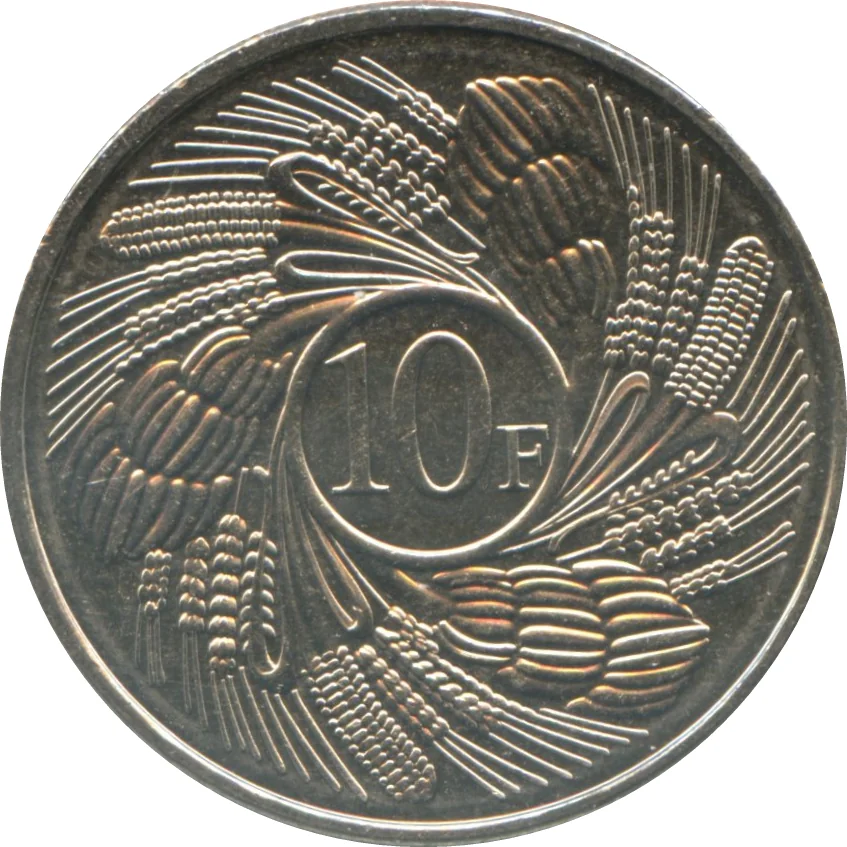
Reverse
Description:
Agricultural products encircling a central denomination.
Inscription:
10F
Script: Latin
Edge
Reeded
Mintings
| Year | Mint Mark | Mintage | Quality | Collection |
|---|---|---|---|---|
| 2011 | — | — |
Historical background
In 2011, Burundi's currency, the Burundian franc (BIF), was characterized by severe instability and significant depreciation, a situation rooted in a profound political and economic crisis. Following a contentious and violence-marred election in 2010, international donors, led by the European Union, suspended direct budget support. This suspension created a critical foreign exchange shortage, as aid had previously financed up to 50% of the national budget and supplied the bulk of the country's hard currency. Consequently, the central bank's reserves were depleted, severely limiting its ability to defend the franc's value.
The scarcity of US dollars and euros on the formal market led to the proliferation of a thriving black market where the franc traded at a steep discount. Officially, the exchange rate was maintained around 1,230 BIF to the US dollar, but on the parallel market, rates could exceed 1,600 BIF. This gap created major distortions, hurting businesses that relied on imports and contributing to soaring inflation, which reached approximately 15% by the end of the year. The government's attempts to curb the black market, including police crackdowns on unauthorized forex traders, proved ineffective and further discouraged the inflow of remittances and foreign currency through formal channels.
The currency crisis had a direct and painful impact on the population, exacerbating poverty in one of the world's least developed nations. The high inflation eroded purchasing power, making essential imported goods like fuel, medicine, and food increasingly unaffordable. This economic distress unfolded against a backdrop of political fragility, creating a vicious cycle where the lack of foreign currency stifled economic activity, and political uncertainty deterred the investment and donor engagement needed to stabilize the franc. Thus, the currency situation in 2011 was both a symptom and a cause of Burundi's broader socio-economic turmoil.
The scarcity of US dollars and euros on the formal market led to the proliferation of a thriving black market where the franc traded at a steep discount. Officially, the exchange rate was maintained around 1,230 BIF to the US dollar, but on the parallel market, rates could exceed 1,600 BIF. This gap created major distortions, hurting businesses that relied on imports and contributing to soaring inflation, which reached approximately 15% by the end of the year. The government's attempts to curb the black market, including police crackdowns on unauthorized forex traders, proved ineffective and further discouraged the inflow of remittances and foreign currency through formal channels.
The currency crisis had a direct and painful impact on the population, exacerbating poverty in one of the world's least developed nations. The high inflation eroded purchasing power, making essential imported goods like fuel, medicine, and food increasingly unaffordable. This economic distress unfolded against a backdrop of political fragility, creating a vicious cycle where the lack of foreign currency stifled economic activity, and political uncertainty deterred the investment and donor engagement needed to stabilize the franc. Thus, the currency situation in 2011 was both a symptom and a cause of Burundi's broader socio-economic turmoil.
🌱 Very Common