

1 Dollar – Eastern Caribbean States
Context
Material
Diameter: 27.5 mm
Weight: 8 g
Thickness: 1.7 mm
Shape: Decagonal
Composition: Copper-nickel
Technique: Milled
Alignment: Medal alignment
flip
References
KM: #Click to copy to clipboard20
Numista: #2602
Value
Exchange value: 1 XCD
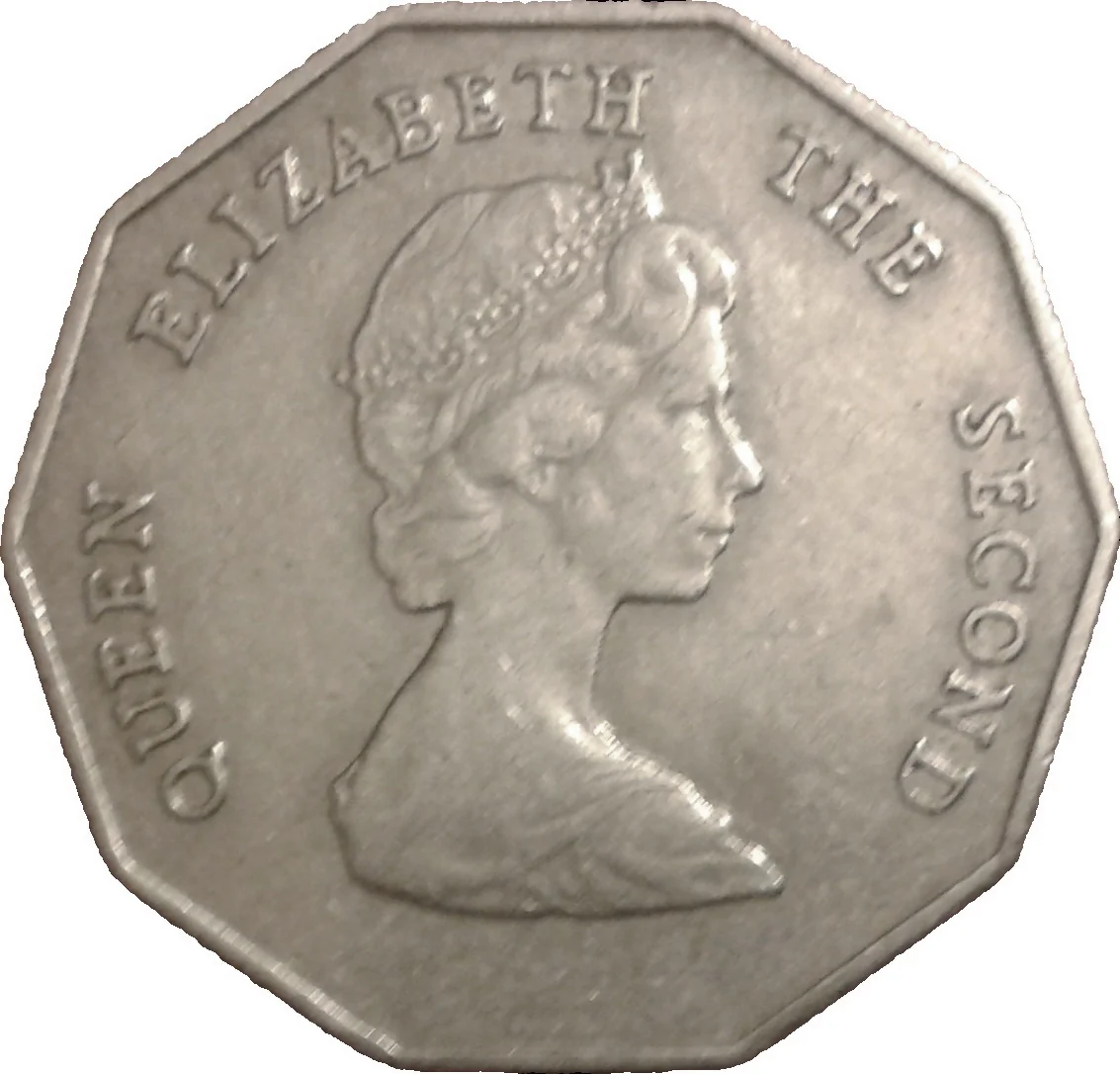
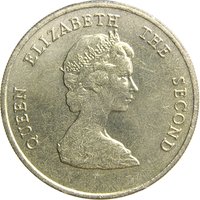
Obverse
Description:
Portrait of Queen Elizabeth II in profile.
Inscription:
QUEEN ELIZABETH THE SECOND
Script: Latin
Engraver: Arnold Machin
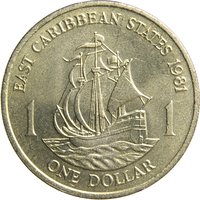
Reverse
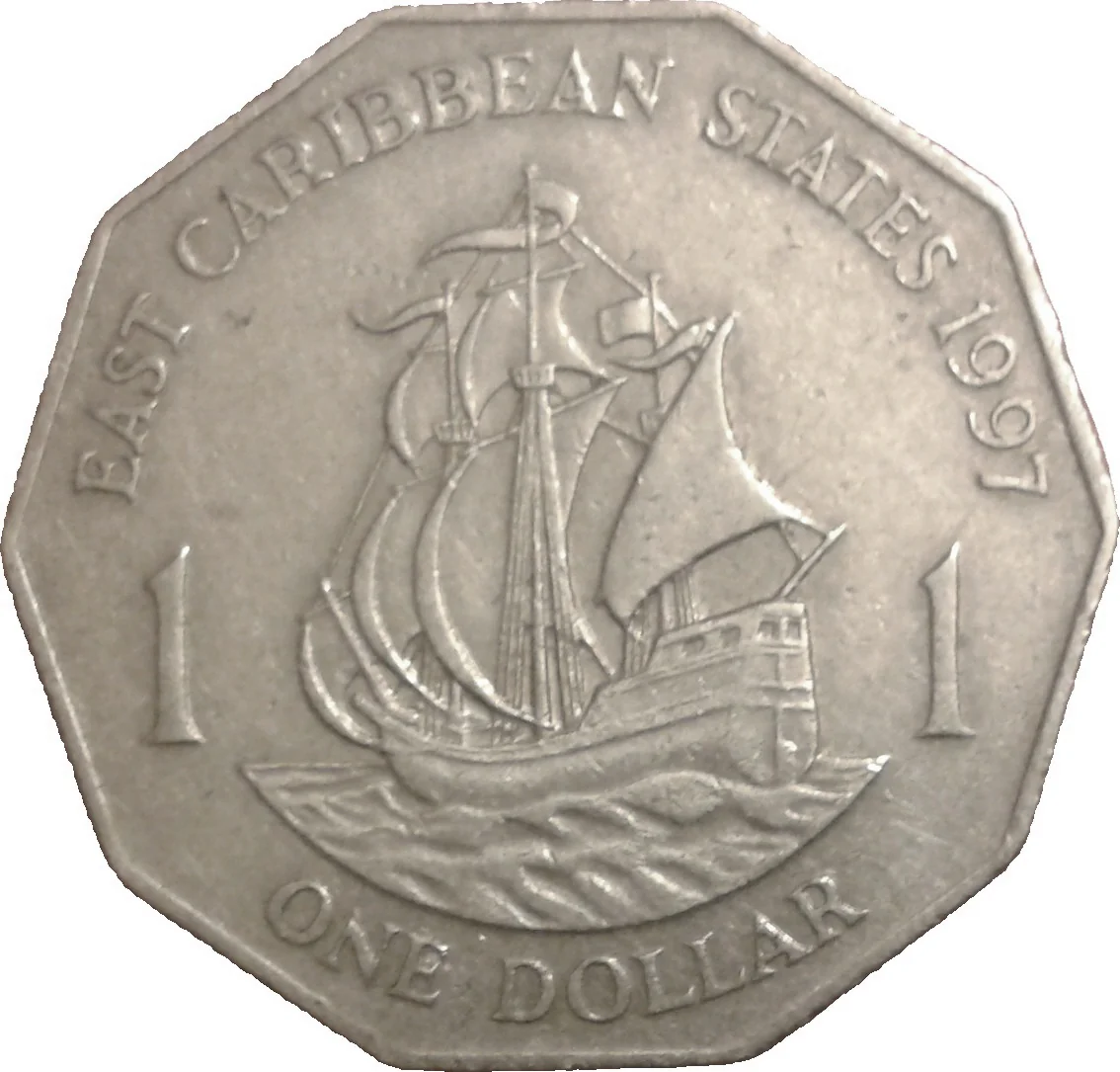
Description:
Sir Francis Drake's ship, the *Golden Hind*.
Inscription:
EAST CARIBBEAN STATES 1997
1 1
ONE DOLLAR
1 1
ONE DOLLAR
Script: Latin
Engraver: Thomas Humphrey Paget
Edge
5 smooth and 5 reeded sides (19 dents each)
Categories
| Transportation> Watercraft |
Mints
| Name | Mark |
|---|---|
| Royal Mint | — |
Mintings
| Year | Mint Mark | Mintage | Quality | Collection |
|---|---|---|---|---|
| 1989 | — | — | ||
| 1991 | — | — | ||
| 1992 | — | — | ||
| 1993 | — | — | ||
| 1994 | — | — | ||
| 1995 | — | — | ||
| 1996 | — | — | ||
| 1997 | — | — | ||
| 1998 | — | — | ||
| 1999 | — | — | ||
| 2000 | — | — |
Historical background
In 1989, the currency situation in the Eastern Caribbean States was defined by stability and regional integration under the long-established Eastern Caribbean Currency Authority (ECCA). The ECCA, founded in 1965, issued the Eastern Caribbean dollar (EC$), which was pegged at a fixed rate of EC$2.70 to US$1. This peg, in place since 1976, provided a crucial anchor for the small, open economies of the region, shielding them from volatile exchange rate fluctuations and fostering confidence for trade and investment. The member countries, including Antigua and Barbuda, Dominica, Grenada, Montserrat, St. Kitts and Nevis, St. Lucia, and St. Vincent and the Grenadines, collectively maintained a common pool of foreign reserves in London to back the currency, adhering to a colonial-era sterling reserve system.
The year 1989, however, fell within a period of significant transition for the monetary arrangement. Discussions had been ongoing for years to modernize the ECCA into a more robust central bank with enhanced regulatory and supervisory powers. The existing Authority was seen as somewhat limited in its capacity to actively manage monetary policy and oversee a growing financial sector. Consequently, 1989 served as a final preparatory year before a major institutional change: the Eastern Caribbean Central Bank (ECCB) was formally established on July 1, 1983, but by 1989, it was consolidating its role, having fully taken over currency issuance and monetary management from the ECCA.
Therefore, the background for 1989 is one of continuity in practice but evolution in structure. The currency itself remained stable and fully convertible, backed by the foreign reserves and the fixed peg to the US dollar. Economically, the region was navigating the aftermath of global turbulence in the 1980s, with tourism and agriculture as key sectors. The shift from the ECCA to the ECCB represented a move toward greater monetary sovereignty and modernized financial governance, setting the foundation for the currency union that persists today as one of the world's longest-standing.
The year 1989, however, fell within a period of significant transition for the monetary arrangement. Discussions had been ongoing for years to modernize the ECCA into a more robust central bank with enhanced regulatory and supervisory powers. The existing Authority was seen as somewhat limited in its capacity to actively manage monetary policy and oversee a growing financial sector. Consequently, 1989 served as a final preparatory year before a major institutional change: the Eastern Caribbean Central Bank (ECCB) was formally established on July 1, 1983, but by 1989, it was consolidating its role, having fully taken over currency issuance and monetary management from the ECCA.
Therefore, the background for 1989 is one of continuity in practice but evolution in structure. The currency itself remained stable and fully convertible, backed by the foreign reserves and the fixed peg to the US dollar. Economically, the region was navigating the aftermath of global turbulence in the 1980s, with tourism and agriculture as key sectors. The shift from the ECCA to the ECCB represented a move toward greater monetary sovereignty and modernized financial governance, setting the foundation for the currency union that persists today as one of the world's longest-standing.
🌱 Very Common