

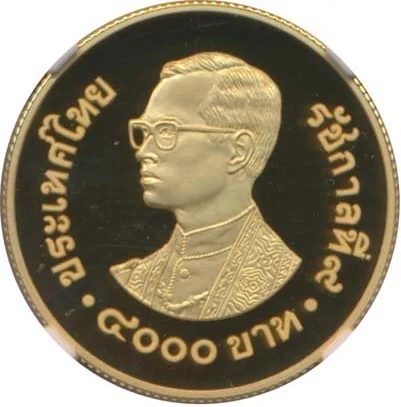

4000 Bahts – Thailand
Non-circulating coins
Commemoration: International Year of the Child
Thailand
Context

Material
References
Y: #Click to copy to clipboard153
Numista: #26007
Value
Exchange value: 4000 THB = $128.78
Bullion value: $2574.25
Obverse
Reverse
Description:
Children playing. International Year of the Child, Thailand 1981.
Inscription:
INTERNATIONAL YEAR OF THE CHILD
THAILAND
CHI
1981
THAILAND
CHI
1981
Script: Latin
Engraver: Philip Nathan
Edge
Milled
Categories
| Organization> UNICEF |
Mints
| Name | Mark |
|---|---|
| Valcambi | CHI |
Mintings
| Year | Mint Mark | Mintage | Quality | Collection |
|---|---|---|---|---|
| 1981 | CHI | 4,892 | Proof |
Historical background
In 1981, Thailand's economy faced significant external pressures that severely tested its currency, the baht. The country was grappling with the aftermath of the second oil shock, which had widened its current account deficit and fueled inflation. Furthermore, a period of high global interest rates, driven by U.S. Federal Reserve policy, triggered massive capital outflows from emerging markets like Thailand, putting intense downward pressure on the baht, which was then pegged to a basket of currencies dominated by the U.S. dollar.
The Bank of Thailand (BOT) responded with a decisive two-tier exchange rate system in May 1981, a major departure from the unified peg. This system created an official rate for essential imports and debt servicing, while a more depreciated "financial" or market rate applied to most other transactions, effectively devaluing the baht for capital flows and non-essential goods. This move aimed to conserve scarce foreign reserves, curb speculative attacks, and allow a controlled adjustment without abandoning the peg entirely.
This currency crisis and the policy response were a pivotal moment, exposing structural vulnerabilities in Thailand's fixed exchange rate regime and its reliance on foreign capital. While the two-tier system provided temporary relief, it was a complex and distortionary measure that highlighted underlying economic imbalances. The experience of 1981 foreshadowed the deeper financial liberalization that would follow in the latter half of the decade and, ultimately, the far more severe crisis that would engulf the baht in 1997.
The Bank of Thailand (BOT) responded with a decisive two-tier exchange rate system in May 1981, a major departure from the unified peg. This system created an official rate for essential imports and debt servicing, while a more depreciated "financial" or market rate applied to most other transactions, effectively devaluing the baht for capital flows and non-essential goods. This move aimed to conserve scarce foreign reserves, curb speculative attacks, and allow a controlled adjustment without abandoning the peg entirely.
This currency crisis and the policy response were a pivotal moment, exposing structural vulnerabilities in Thailand's fixed exchange rate regime and its reliance on foreign capital. While the two-tier system provided temporary relief, it was a complex and distortionary measure that highlighted underlying economic imbalances. The experience of 1981 foreshadowed the deeper financial liberalization that would follow in the latter half of the decade and, ultimately, the far more severe crisis that would engulf the baht in 1997.



✨ Legendary