

1⁄20 krugerrand – South Africa
Add to wishlist
South Africa
Context
Years: 2017–2025
Issuer: South Africa
Period:
(since 1961)
Currency:
(since 1967)
Total mintage: 6,449
Material
References
KM: #
Numista: #259440
Value
Bullion value: $483.97
Obverse
Description:
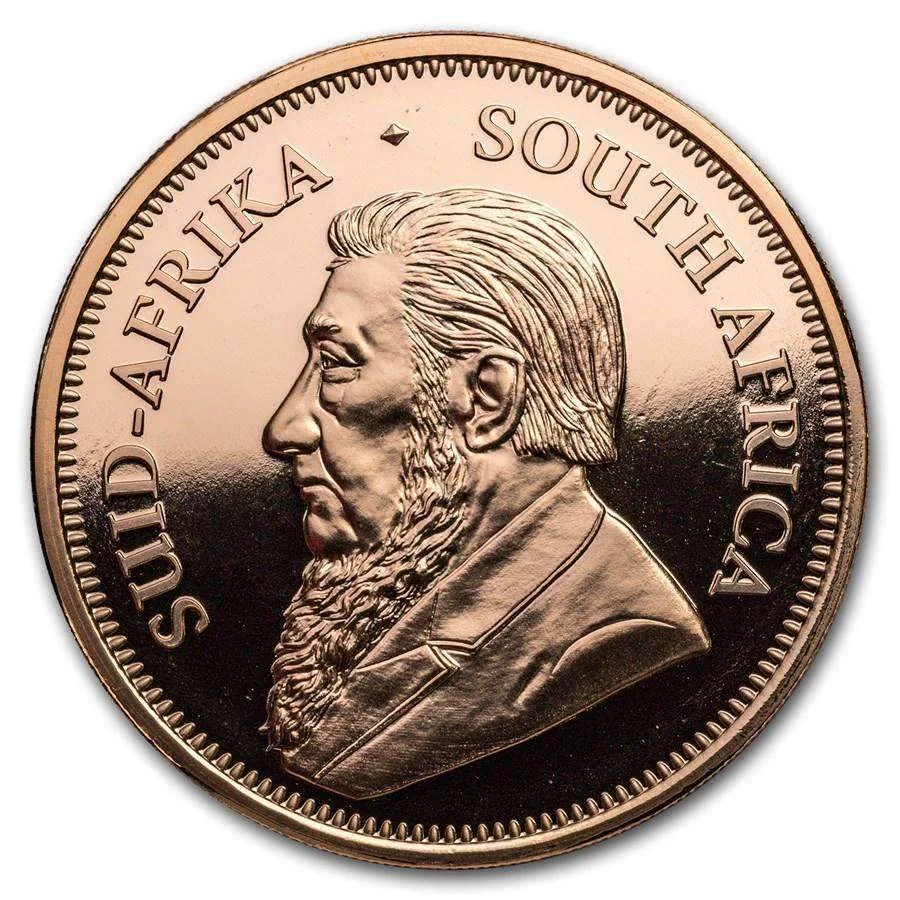
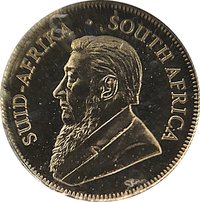
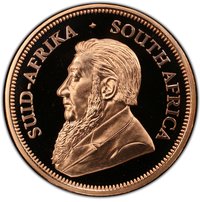
Portrait of Paul Kruger, President of the South African Republic (1883-1902).
Inscription:
SUID-AFRIKA · SOUTH AFRICA
Script: Latin
Reverse
Description:
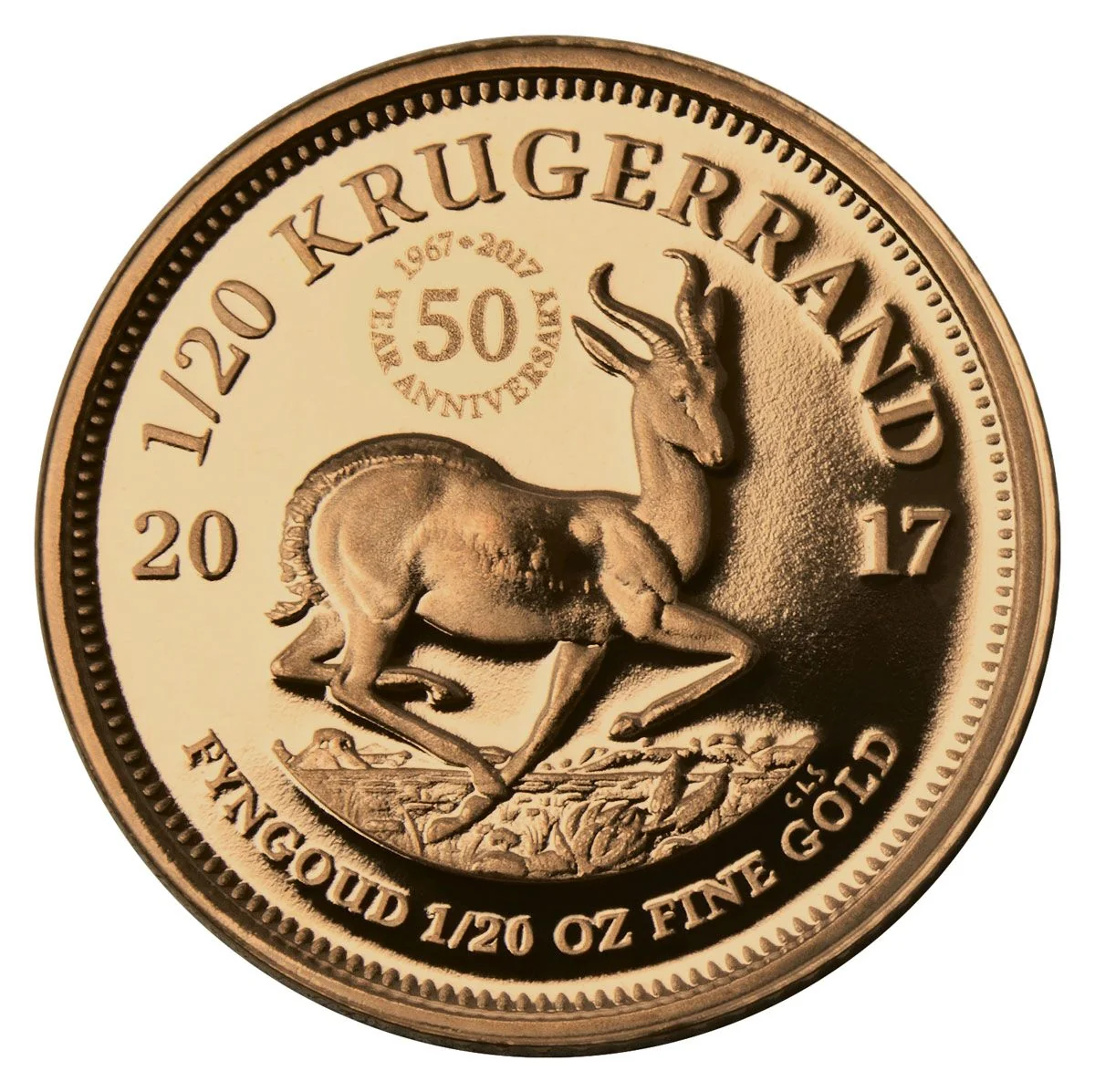
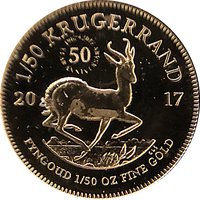
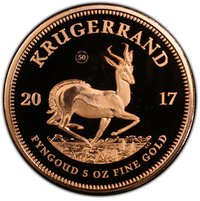
Springbok pronking date
Inscription:
1/10 KRUGERRAND
1984
FYNGOUD 1/10 OZ FINE GOLD
1984
FYNGOUD 1/10 OZ FINE GOLD
Script: Latin
Engraver: Coert Laurens Steynberg
Edge
Milled180 edge serrations for uncirculated, 220 serrations for proof
Categories
| Animal> Cow |
| Person> Politician |
Mints
| Name | Mark |
|---|---|
| South African Mint | — |
Mintings
| Year | Mint Mark | Mintage | Quality | Collection |
|---|---|---|---|---|
| 2017 | — | 3,200 | ||
| 2017 | — | 3,249 | Proof | |
| 2024 | — | — | Proof | |
| 2024 | — | — | In sets | |
| 2025 | — | — | Proof | |
| 2025 | — | — | In sets |
Historical background
In 2017, the South African Rand (ZAR) experienced a year of significant volatility and political pressure, largely decoupling from a period of relative global market calm. The currency's trajectory was dominated by domestic political turmoil, specifically the fallout from President Jacob Zuma's controversial cabinet reshuffle in late March, which saw the respected finance minister, Pravin Gordhan, removed from his post. This event, widely interpreted as a move to gain control over the national treasury, triggered an immediate crisis of confidence. Credit rating agencies Standard & Poor's and Fitch subsequently downgraded South Africa's sovereign credit rating to junk status, citing political instability and risks to fiscal policy. The Rand plummeted, breaching R13.50/USD, and investor sentiment turned deeply negative for much of the year.
Beyond the political shock, the economy grappled with structural weaknesses that constrained the Rand. Growth remained anaemic, unemployment stubbornly high, and state-owned enterprises, particularly Eskom, posed a continuous fiscal risk. These fundamentals limited the currency's ability to mount a sustained recovery even during periods of political respite. However, the Rand demonstrated notable resilience in the latter part of the year, staging a strong rally from December onwards. This recovery was fueled by a weakening US dollar, a general rally in emerging market currencies, and growing optimism surrounding the ANC's elective conference in December.
The December conference proved to be a pivotal moment for the currency's narrative. Cyril Ramaphosa's election as ANC president, defeating Jacob Zuma's preferred candidate, was met with overwhelming market approval. It sparked a "Ramaphoria" rally, with the Rand strengthening below R12.30/USD by year-end on hopes of political renewal, improved governance, and more market-friendly economic policies. Thus, 2017 closed with the ZAR on a stronger note, but the year underscored its acute sensitivity to domestic politics and the profound impact of leadership decisions on investor confidence and currency stability.
Beyond the political shock, the economy grappled with structural weaknesses that constrained the Rand. Growth remained anaemic, unemployment stubbornly high, and state-owned enterprises, particularly Eskom, posed a continuous fiscal risk. These fundamentals limited the currency's ability to mount a sustained recovery even during periods of political respite. However, the Rand demonstrated notable resilience in the latter part of the year, staging a strong rally from December onwards. This recovery was fueled by a weakening US dollar, a general rally in emerging market currencies, and growing optimism surrounding the ANC's elective conference in December.
The December conference proved to be a pivotal moment for the currency's narrative. Cyril Ramaphosa's election as ANC president, defeating Jacob Zuma's preferred candidate, was met with overwhelming market approval. It sparked a "Ramaphoria" rally, with the Rand strengthening below R12.30/USD by year-end on hopes of political renewal, improved governance, and more market-friendly economic policies. Thus, 2017 closed with the ZAR on a stronger note, but the year underscored its acute sensitivity to domestic politics and the profound impact of leadership decisions on investor confidence and currency stability.
✨ Legendary