

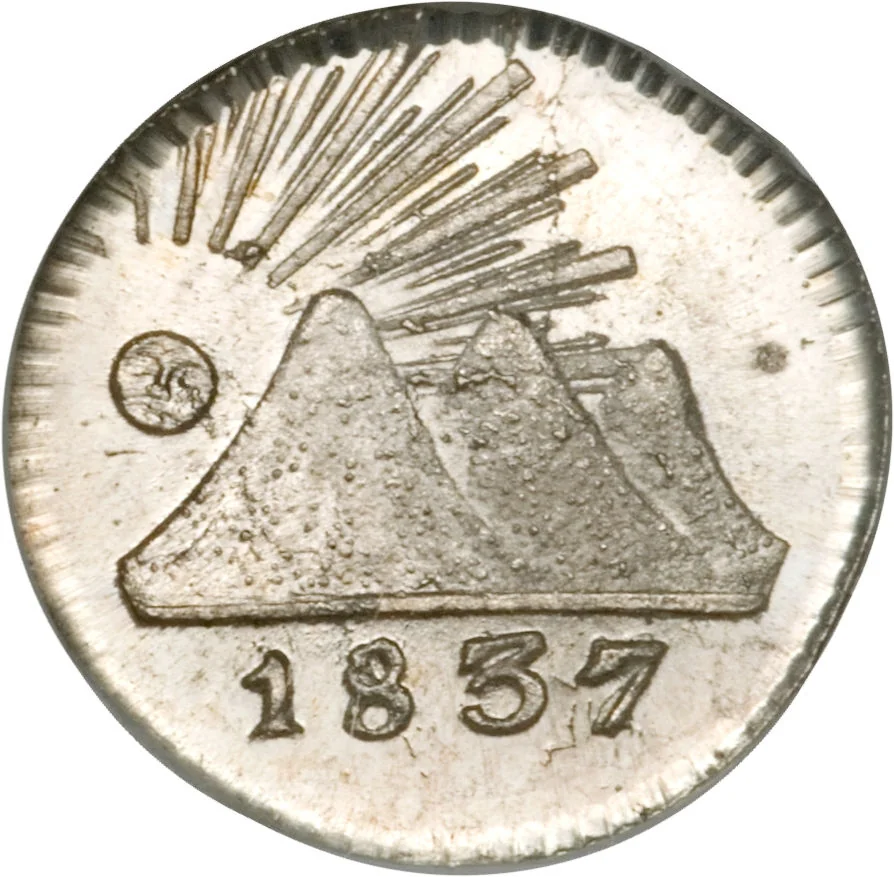
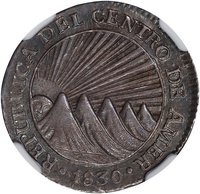
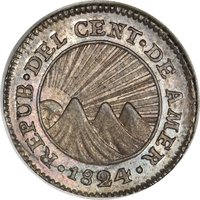
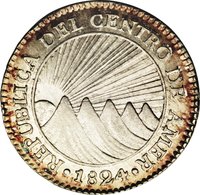
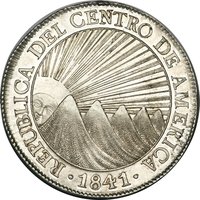
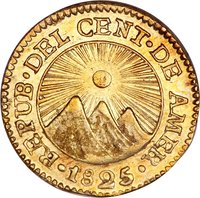
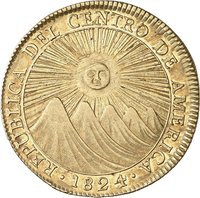
Obverse
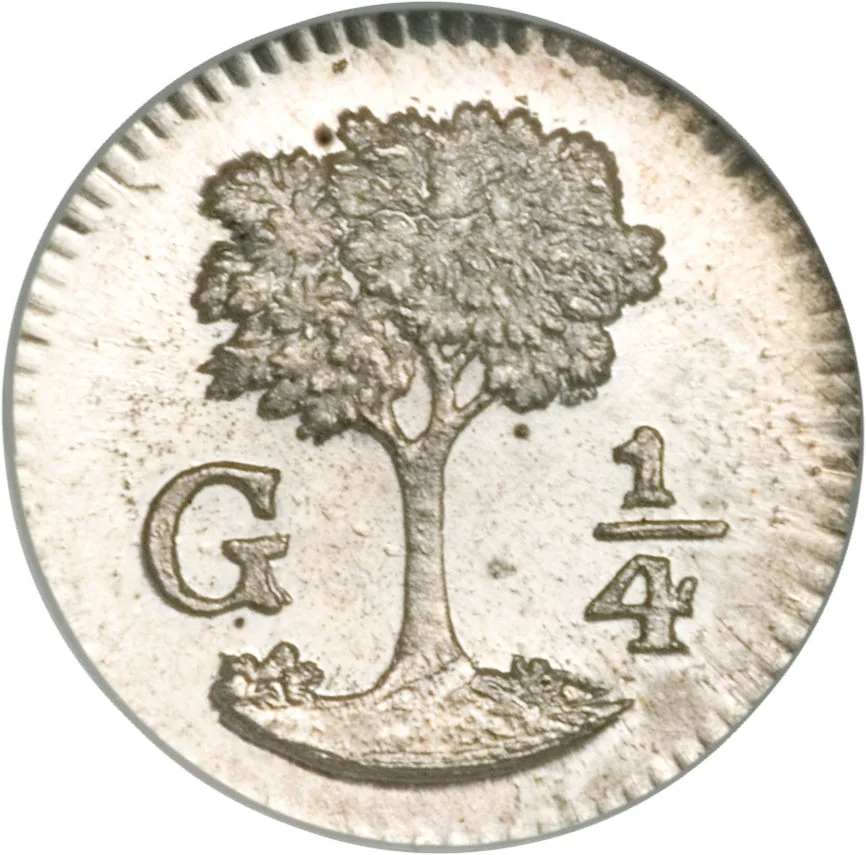
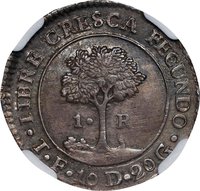
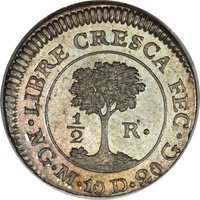
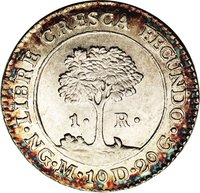
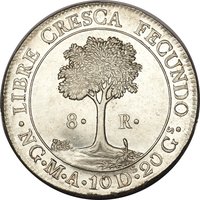
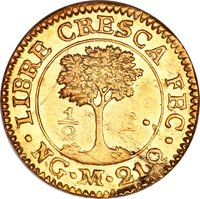
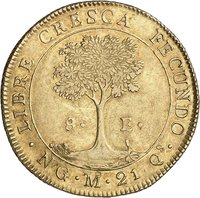
Reverse
Edge
Plain
Mints
| Name | Mark |
|---|---|
| Casa de Moneda de Guatemala | G |
Mintings
Historical background
The currency situation in the Federal Republic of Central America in 1824 was one of profound disorder and transition, inherited from the collapse of Spanish colonial rule. Upon independence in 1823, the new federation—comprising present-day Guatemala, Honduras, El Salvador, Nicaragua, and Costa Rica—faced a chaotic monetary landscape dominated by a wide variety of coins. These included Spanish colonial reales and pesos, coins from other former Spanish colonies like Mexico and Peru, and even counterfeits, all circulating simultaneously with no uniform standard or central mint. This heterogeneity severely hampered internal trade and federal administration, as the value of coins often depended on their weight, fineness, and place of origin, leading to confusion and economic friction between the states.
Recognizing this crisis, the federal government took decisive action in 1824. The Constituent Assembly passed a foundational monetary law on August 19, which established a new national currency system based on the peso. The law defined the peso as divisible into 8 reales and pegged it to the widely trusted Spanish colonial peso fuerte (strong peso), mandating that all new coins match its silver content (approximately 25.56 grams of .903 fine silver). Crucially, the legislation authorized the creation of a federal mint in Guatemala City, charged with producing the new national coinage: silver coins in denominations of 1, 2, 4, and 8 reales, as well as gold escudos.
Despite this clear legislative framework, the reality in 1824 remained one of anticipation and continued difficulty. The federal mint would not begin production until 1831, leaving a seven-year gap where the old, mixed currency continued to circulate without being systematically replaced. Consequently, while the law provided a crucial blueprint for future monetary sovereignty, its immediate impact was limited. The federation struggled with a lack of physical specie, ongoing reliance on foreign coins, and the underlying political tensions that would eventually fracture the union, all of which prevented the 1824 system from achieving true stability or uniform adoption across its constituent states.
Recognizing this crisis, the federal government took decisive action in 1824. The Constituent Assembly passed a foundational monetary law on August 19, which established a new national currency system based on the peso. The law defined the peso as divisible into 8 reales and pegged it to the widely trusted Spanish colonial peso fuerte (strong peso), mandating that all new coins match its silver content (approximately 25.56 grams of .903 fine silver). Crucially, the legislation authorized the creation of a federal mint in Guatemala City, charged with producing the new national coinage: silver coins in denominations of 1, 2, 4, and 8 reales, as well as gold escudos.
Despite this clear legislative framework, the reality in 1824 remained one of anticipation and continued difficulty. The federal mint would not begin production until 1831, leaving a seven-year gap where the old, mixed currency continued to circulate without being systematically replaced. Consequently, while the law provided a crucial blueprint for future monetary sovereignty, its immediate impact was limited. The federation struggled with a lack of physical specie, ongoing reliance on foreign coins, and the underlying political tensions that would eventually fracture the union, all of which prevented the 1824 system from achieving true stability or uniform adoption across its constituent states.
🌟 Limited