

5 Cruzeiros – Brazil
Brazil
Context
Years: 1980–1984
Issuer: Brazil 
Period:
(since 1967)
Currency:
(1967—1986)
Demonetization: 27 February 1986
Total mintage: 934,650,000
Material
Diameter: 22 mm
Weight: 4.56 g
Thickness: 1.6 mm
Shape: Round
Composition: Stainless steel
Technique: Milled
Alignment: Coin alignment
flip
References
KM: #Click to copy to clipboard591
Numista: #2576
Value
Exchange value: 5 BRB
Inflation-adjusted value: 4563368248931.49 BRB
Obverse
Description:
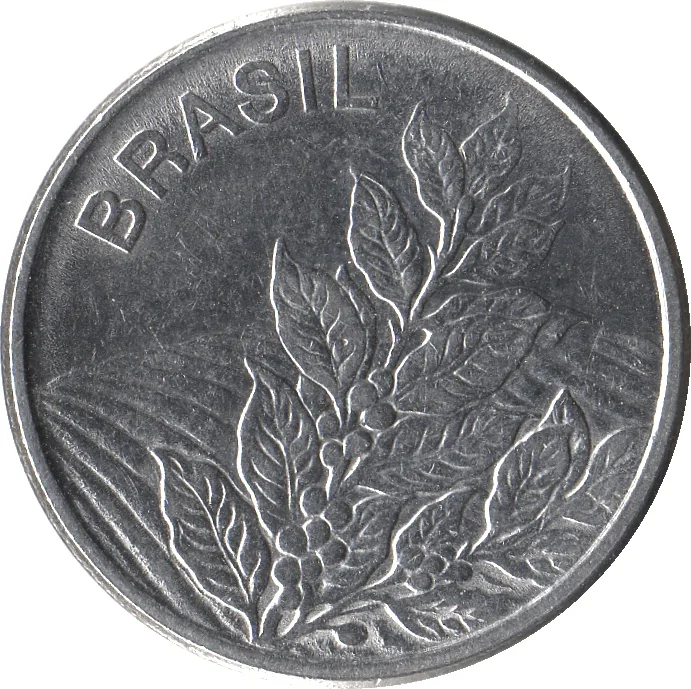
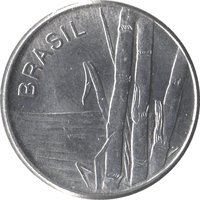
Coffee plant with plowed field, country name top-left.
Inscription:
BRASIL
Translation:
BRASIL
Script: Latin
Language: Portuguese
Reverse
Description:
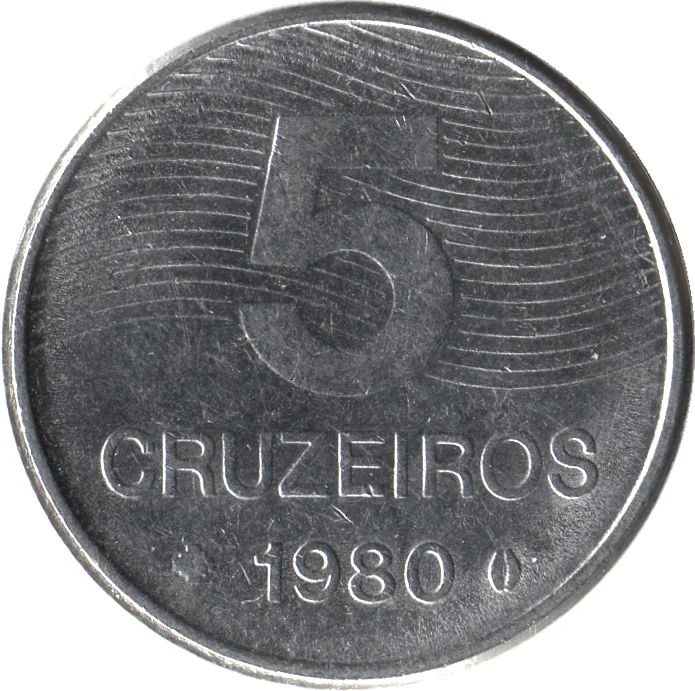
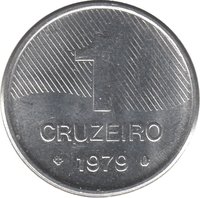
Coffee beans frame the date, with the value on a wavy-line background.
Inscription:
5
CRUZEIROS
1980
CRUZEIROS
1980
Script: Latin
Edge
Plain
Categories
| Agriculture |
| Organization> FAO |
Mints
| Name | Mark |
|---|---|
| Casa da Moeda do Brasil | — |
Mintings
| Year | Mint Mark | Mintage | Quality | Collection |
|---|---|---|---|---|
| 1980 | — | 388,250,000 | ||
| 1981 | — | 82,000,000 | ||
| 1982 | — | 108,000,000 | ||
| 1983 | — | 113,400,000 | ||
| 1984 | — | 243,000,000 |
Historical background
Brazil entered the 1980s in the throes of a profound economic crisis, marked by the exhaustion of the "Brazilian Miracle" growth model and the onset of the "Lost Decade." The currency, the cruzeiro (Cr$), was under severe pressure from rampant inflation, which soared from around 40% in 1979 to over 100% by 1980. This inflationary spiral was fueled by the second oil shock, high global interest rates, and, crucially, the massive foreign debt accumulated during the military regime's ambitious development projects. The government's reliance on printing money to finance deficits and service debt created a vicious cycle of devaluation and price increases.
In response, the economic team of President João Figueiredo implemented a series of abrupt and heterodox monetary reforms in an attempt to control inflation and signal stability. Most notably, in 1980, the government introduced the "Tabrit," a new currency index meant to be a precursor to a full currency change. This was not a physical currency but a daily indexed unit of account used for financial contracts, attempting to break inflationary inertia by de-linking from the daily devaluing cruzeiro. However, these measures were largely perceived as confusing and lacked the necessary fiscal discipline to be credible, failing to address the root causes of inflation.
Consequently, the currency situation remained chaotic and set the stage for the extreme measures of the following years. The failure of the 1980 attempts led to a pattern that would define the decade: successive, increasingly complex currency reforms and name changes (cruzado, cruzado novo, cruzeiro, cruzeiro real) in a futile struggle to halt hyperinflation. The 1980 experience underscored that without controlling the fiscal deficit and public debt, mere technical adjustments to the currency system were doomed, leaving Brazil's economy trapped in a destabilizing cycle of indexation, devaluation, and eroding purchasing power.
In response, the economic team of President João Figueiredo implemented a series of abrupt and heterodox monetary reforms in an attempt to control inflation and signal stability. Most notably, in 1980, the government introduced the "Tabrit," a new currency index meant to be a precursor to a full currency change. This was not a physical currency but a daily indexed unit of account used for financial contracts, attempting to break inflationary inertia by de-linking from the daily devaluing cruzeiro. However, these measures were largely perceived as confusing and lacked the necessary fiscal discipline to be credible, failing to address the root causes of inflation.
Consequently, the currency situation remained chaotic and set the stage for the extreme measures of the following years. The failure of the 1980 attempts led to a pattern that would define the decade: successive, increasingly complex currency reforms and name changes (cruzado, cruzado novo, cruzeiro, cruzeiro real) in a futile struggle to halt hyperinflation. The 1980 experience underscored that without controlling the fiscal deficit and public debt, mere technical adjustments to the currency system were doomed, leaving Brazil's economy trapped in a destabilizing cycle of indexation, devaluation, and eroding purchasing power.
🌱 Very Common