

5 Euro – Finland
Non-circulating coins
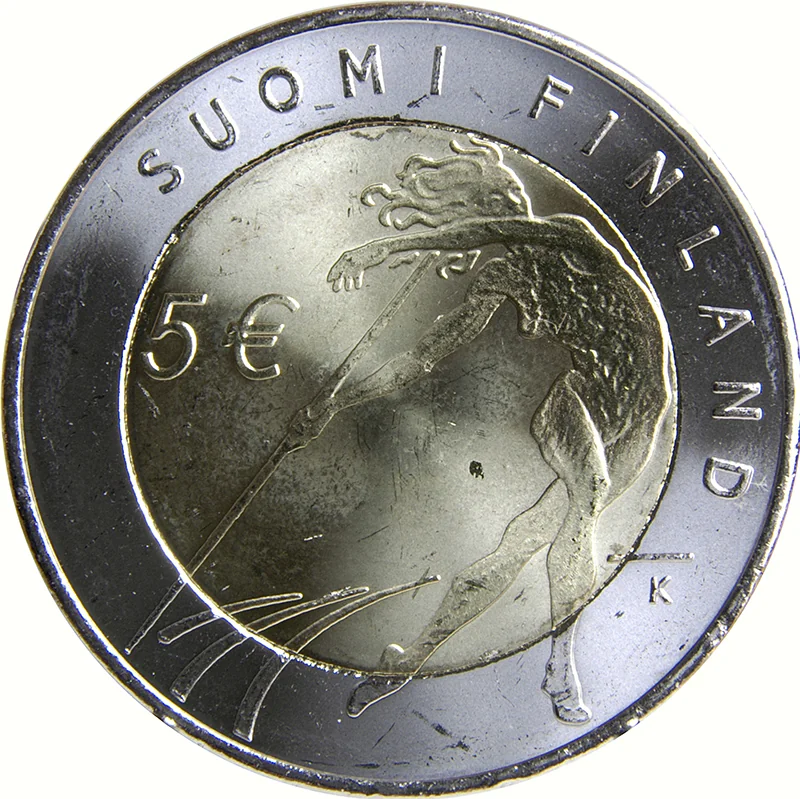
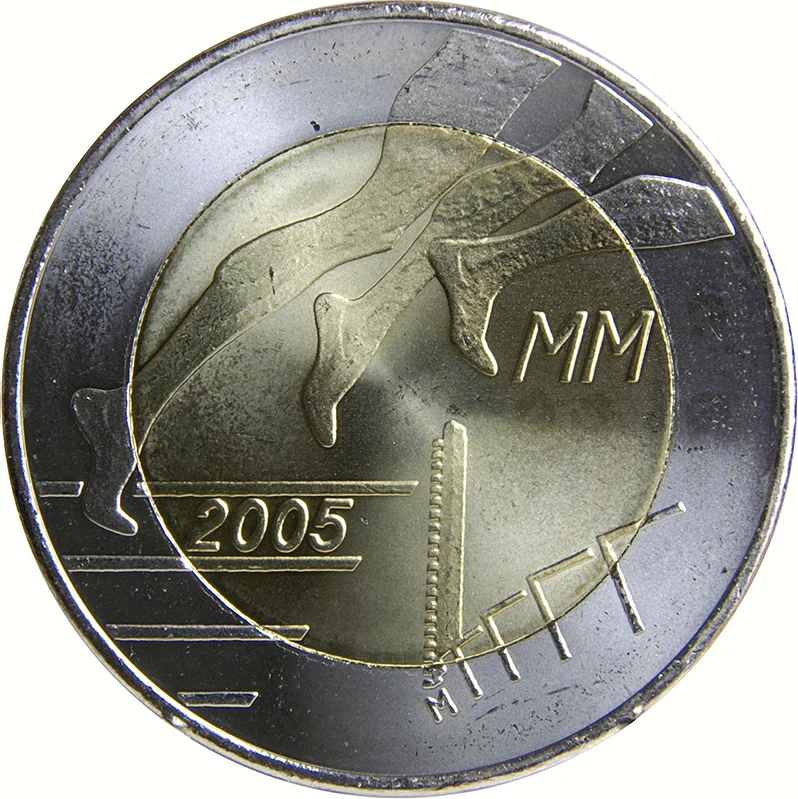
Commemoration: 10th IAAF World Championships in Athletics
Finland

Obverse
Description:
Female javelin thrower.
Inscription:
SUOMI FINLAND
5 €
K
5 €
K
Translation:
Finland
5 €
K
5 €
K
Script: Latin
Engraver: Tapio Kettunen
Reverse
Edge
Plain
Mints
| Name | Mark |
|---|---|
| Mint of Finland | — |
Mintings
| Year | Mint Mark | Mintage | Quality | Collection |
|---|---|---|---|---|
| 2005 | — | 170,000 | ||
| 2005 | — | 5,005 | Proof | |
| 2005 | — | 30,000 | BU |
Historical background
In 2005, Finland was a well-established member of the Eurozone, having adopted the euro as its sole legal tender on 1 January 2002. The transition from the Finnish markka (FIM) was considered a success, with the physical changeover completed smoothly and public acceptance growing steadily. By 2005, the euro was fully integrated into daily economic life, with price stability largely maintained and the dual circulation period a distant memory. The European Central Bank (ECB) now set Finland's monetary policy, a shift that brought the benefits of lower transaction costs and eliminated exchange rate risk within the single currency area, further integrating Finland with its primary trading partners.
However, the currency situation was not without domestic debate. Some sectors, particularly export-oriented industries like forestry and technology, began to voice concerns about the euro's exchange rate strength and the one-size-fits-all interest rate policy of the ECB. The strong euro, while curbing inflation for imports, made Finnish exports more expensive outside the Eurozone, squeezing profitability. Furthermore, there was lingering nostalgia for the markka among a segment of the population, who perceived the euro as having led to a subtle increase in prices (the "rounding-up effect") and a loss of national monetary sovereignty, especially regarding crisis management tools.
Overall, 2005 represented a period of consolidation for the euro in Finland. The technical and practical aspects of the currency union were settled, and the economy was adjusting to its new reality within the broader European framework. The focus had shifted from the mechanics of adoption to evaluating its economic impacts, with discussions centering on competitiveness and the trade-offs of a shared currency rather than any prospect of reversal. Finland's currency situation was thus characterized by stable operation but an ongoing, nuanced assessment of its costs and benefits within a globalizing economy.
However, the currency situation was not without domestic debate. Some sectors, particularly export-oriented industries like forestry and technology, began to voice concerns about the euro's exchange rate strength and the one-size-fits-all interest rate policy of the ECB. The strong euro, while curbing inflation for imports, made Finnish exports more expensive outside the Eurozone, squeezing profitability. Furthermore, there was lingering nostalgia for the markka among a segment of the population, who perceived the euro as having led to a subtle increase in prices (the "rounding-up effect") and a loss of national monetary sovereignty, especially regarding crisis management tools.
Overall, 2005 represented a period of consolidation for the euro in Finland. The technical and practical aspects of the currency union were settled, and the economy was adjusting to its new reality within the broader European framework. The focus had shifted from the mechanics of adoption to evaluating its economic impacts, with discussions centering on competitiveness and the trade-offs of a shared currency rather than any prospect of reversal. Finland's currency situation was thus characterized by stable operation but an ongoing, nuanced assessment of its costs and benefits within a globalizing economy.
🌟 Uncommon