

10 Zlotys (Warsaw Mint) – Poland
Circulating commemorative coins
Commemoration: 200th Anniversary of Warsaw Mint
Poland
Context
Year: 1966
Issuer: Poland 
Period:
(1952—1989)
Currency:
(1949—1994)
Demonetization: 1 January 1978
Total mintage: 102,000
Material
Diameter: 28 mm
Weight: 9.5 g
Thickness: 2.1 mm
Shape: Round
Composition: Copper-nickel
Technique: Milled
Alignment: Medal alignment
flip
References
Y: #Click to copy to clipboard56
Numista: #25693
Value
Exchange value: 10 PLZ
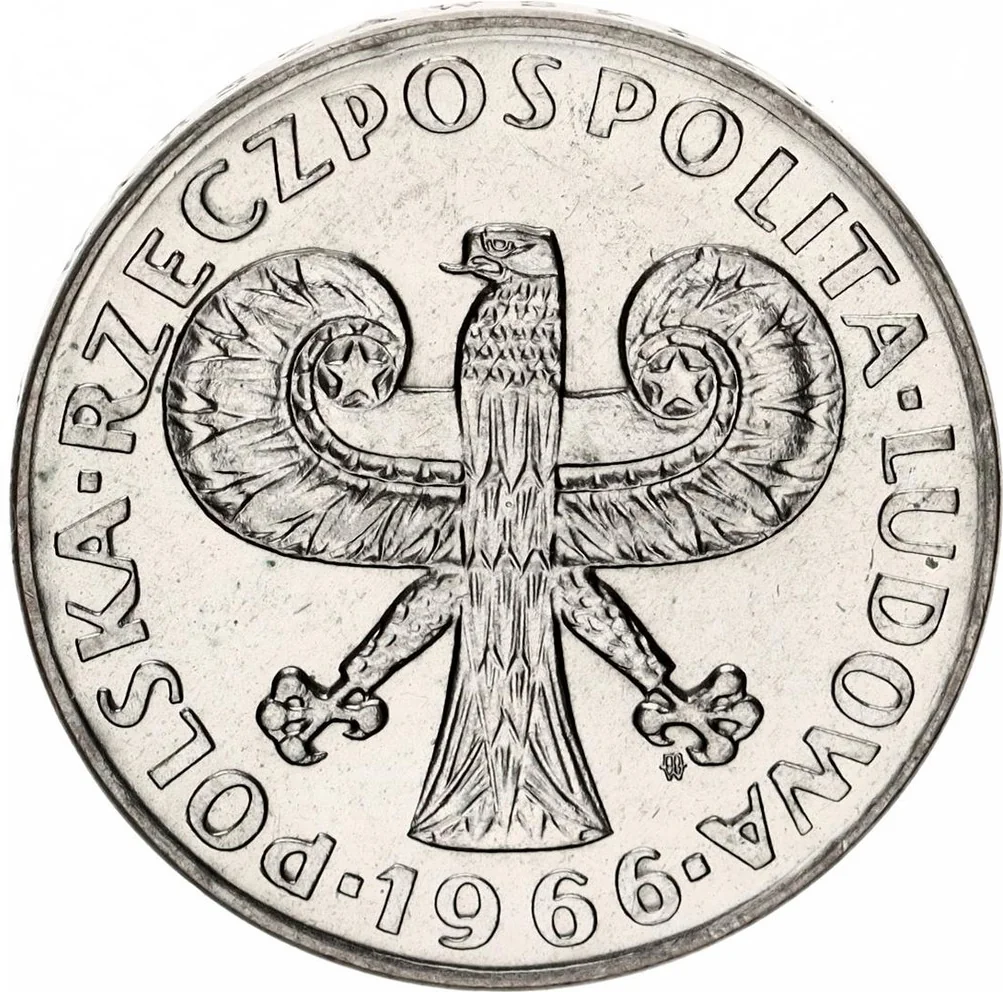
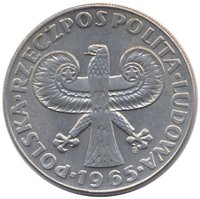
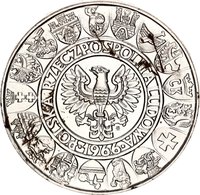
Obverse
Description:
The Polish national coat of arms.
Inscription:
POLSKA·RZECZPOSPOLITA·LUDOWA
·1966·
mw
·1966·
mw
Script: Latin
Engraver: Jerzy Jarnuszkiewicz
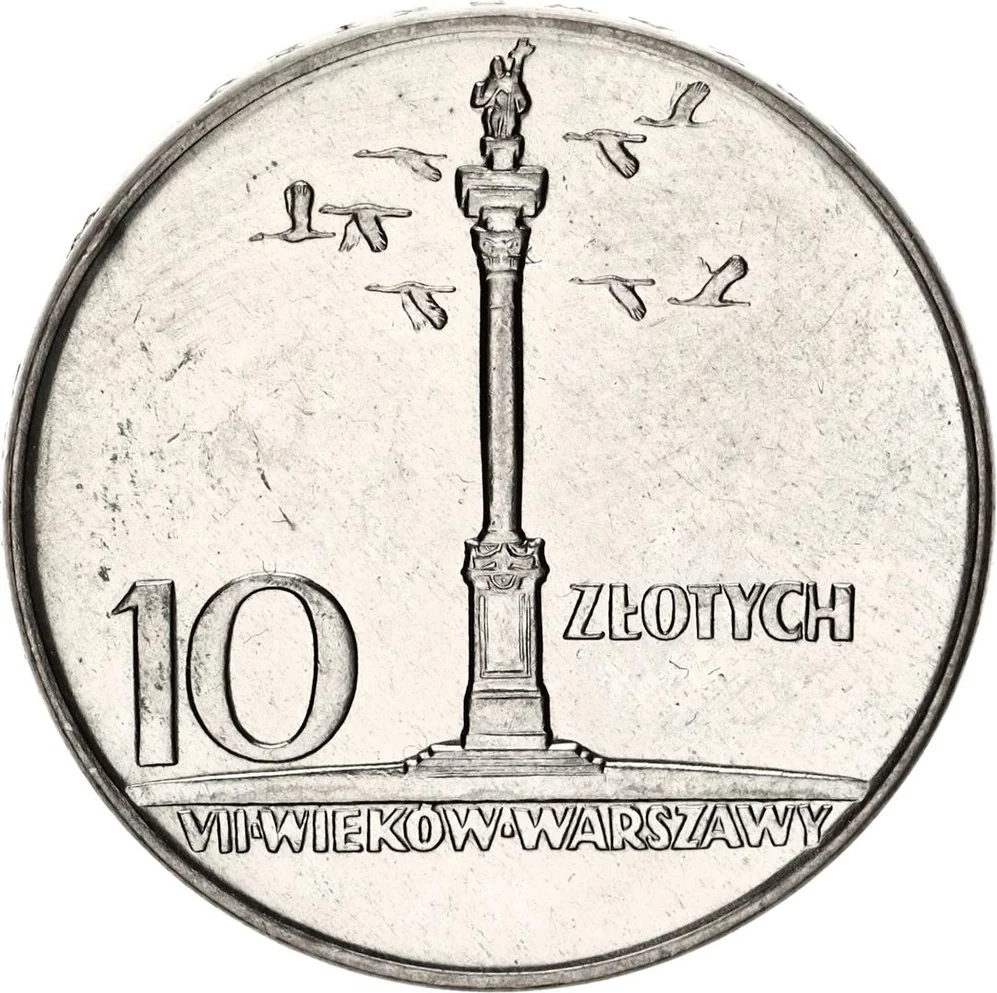
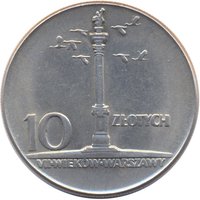
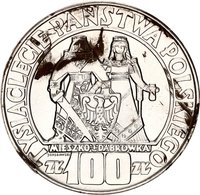
Reverse
Inscription:
10 ZŁOTYCH
VII·WIEKÓW·WARSZAWY
VII·WIEKÓW·WARSZAWY
Translation:
10 ZŁOTYCH
VII CENTURIES OF WARSAW
VII CENTURIES OF WARSAW
Script: Latin
Language: Polish
Engraver: Jerzy Jarnuszkiewicz
Edge
Plain with inscription
Legend:
W DWUSETNĄ ROCZNICĘ MENNICY WARSZAWSKIEJ
Translation:
ON THE TWO HUNDREDTH ANNIVERSARY OF THE WARSAW MINT
Language: Polish
Mints
| Name | Mark |
|---|---|
| Mint of Poland | (MW) |
Mintings
| Year | Mint Mark | Mintage | Quality | Collection |
|---|---|---|---|---|
| 1966 | MW | 102,000 |
Historical background
In 1966, Poland’s currency situation was characterized by the rigidities and contradictions of a centrally planned economy under the communist Polish United Workers' Party. The official currency was the złoty (PLN), which was non-convertible on international markets and whose exchange rate was set administratively by the state, bearing little relation to its actual purchasing power or market value. The economy operated with a fixed, multi-tiered exchange rate system, where different rates applied to different types of transactions (e.g., foreign trade accounting, tourism, and remittances), creating a complex and distorted financial environment.
Beneath this official facade, a significant black market for foreign currency, particularly US dollars and Deutsche Marks, thrived. This parallel market emerged due to chronic shortages of consumer goods, the złoty's weakness, and restrictions on hard currency possession for ordinary citizens. The black market rate for dollars was many times higher than the official rate, reflecting the true level of demand for stable foreign currency and the złoty's overvaluation. This duality meant that Poles with access to hard currency through family abroad or unofficial work had vastly greater economic freedom and access to scarce goods in state-run "Pewex" and "Baltona" stores, which sold imported items for foreign currency.
The year 1966 itself did not see a major monetary reform, but the currency situation was a persistent symptom of deeper economic stagnation under the rule of Władysław Gomułka. While the state celebrated the millennium of Poland's baptism, the economic focus remained on heavy industry, leading to imbalances, consumer neglect, and growing foreign debt. The entrenched currency distortions and reliance on the black market underscored the widening gap between the state's planned economic vision and the realities of everyday life, setting the stage for the worker protests and economic crises that would erupt later in the decade.
Beneath this official facade, a significant black market for foreign currency, particularly US dollars and Deutsche Marks, thrived. This parallel market emerged due to chronic shortages of consumer goods, the złoty's weakness, and restrictions on hard currency possession for ordinary citizens. The black market rate for dollars was many times higher than the official rate, reflecting the true level of demand for stable foreign currency and the złoty's overvaluation. This duality meant that Poles with access to hard currency through family abroad or unofficial work had vastly greater economic freedom and access to scarce goods in state-run "Pewex" and "Baltona" stores, which sold imported items for foreign currency.
The year 1966 itself did not see a major monetary reform, but the currency situation was a persistent symptom of deeper economic stagnation under the rule of Władysław Gomułka. While the state celebrated the millennium of Poland's baptism, the economic focus remained on heavy industry, leading to imbalances, consumer neglect, and growing foreign debt. The entrenched currency distortions and reliance on the black market underscored the widening gap between the state's planned economic vision and the realities of everyday life, setting the stage for the worker protests and economic crises that would erupt later in the decade.
🌟 Uncommon