

200 lire (State Council IV Section) – Italy
Add to wishlist
Circulating commemorative coins
Commemoration: 100th Anniversary of the IV Section of the State Council
Italy
Context
Material
References
KM: #
Numista: #2552
Value
Exchange value: 200 ITL
Inflation-adjusted value: 494.67 ITL
Obverse
Description:
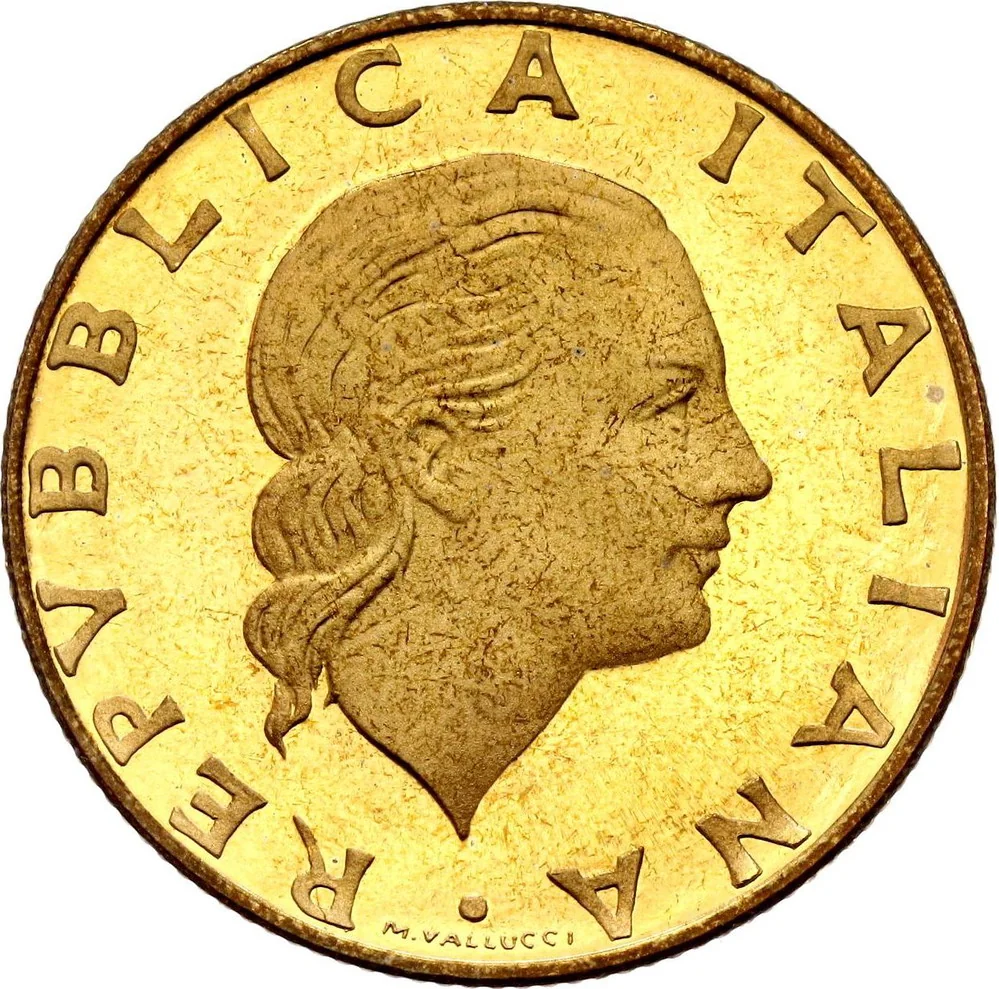
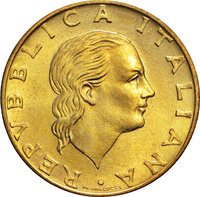
Female head with long curls facing right. Below neck, a large dot and engraver's name.
Inscription:
REPVBBLICA ITALIANA
M. VALLUCCI
M. VALLUCCI
Translation:
Italian Republic
M. Vallucci
M. Vallucci
Script: Latin
Engraver: Mario Vallucci
Reverse
Description:
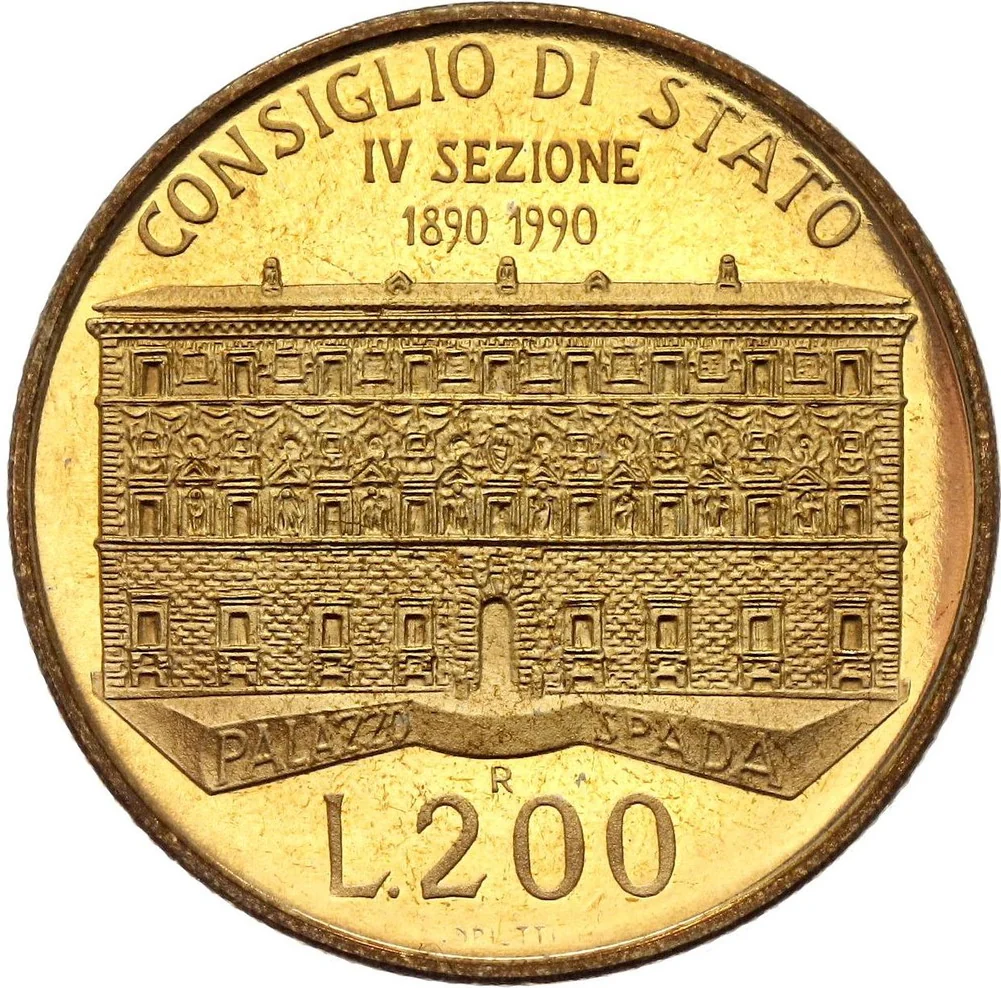
Facade of Palazzo Spada with its name in the foundation. Mintmark, value, and author below; anniversary dates above.
Inscription:
CONSIGLIO DI STATO
IV SEZIONE
1890 1990
PALAZZO SPADA
R
L.200
DRIUTTI
IV SEZIONE
1890 1990
PALAZZO SPADA
R
L.200
DRIUTTI
Translation:
Council of State
Fourth Section
1890 1990
Spada Palace
R
L.200
Driutti
Fourth Section
1890 1990
Spada Palace
R
L.200
Driutti
Script: Latin
Language: Italian
Engraver: Eugenio Driutti
Edge
Reeded
Mints
| Name | Mark |
|---|---|
| Rome | R |
Historical background
In 1990, Italy's currency situation was defined by its pivotal role within the European Monetary System (EMS) and the Exchange Rate Mechanism (ERM). The lira was a central, yet often vulnerable, component of this framework, which aimed to reduce exchange rate variability and achieve monetary stability in Europe ahead of a potential monetary union. Italy's participation was politically crucial for demonstrating its commitment to European integration, but it came at a significant economic cost. The country was required to maintain the lira within narrow fluctuation bands against other ERM currencies, notably the strong German Deutsche Mark, which imposed a strict discipline on its monetary policy.
Domestically, this external constraint clashed with profound internal weaknesses. Italy struggled with persistent structural issues, including high public debt (exceeding 100% of GDP), a large budget deficit, and inflation rates that, while falling, remained higher than those of its key EMS partners like Germany. This divergence created recurring tension: to defend the lira's ERM parity, the Banca d'Italia was forced to maintain high interest rates, which stifled economic growth and increased the cost of servicing the massive public debt. The system essentially required Italy to mirror the anti-inflationary policies of the Bundesbank, regardless of its domestic economic cycle.
Consequently, 1990 represented a year of mounting pressure within this fragile equilibrium. The lira was perceived by markets as one of the weaker currencies in the ERM, leading to periodic speculative attacks. While the crisis would erupt more violently in 1992 with the lira's forced exit from the ERM, the underlying strains were fully apparent in 1990. The year was thus a calm before the storm, characterized by a tense and costly effort to maintain European monetary credibility while grappling with unsustainable domestic fiscal imbalances.
Domestically, this external constraint clashed with profound internal weaknesses. Italy struggled with persistent structural issues, including high public debt (exceeding 100% of GDP), a large budget deficit, and inflation rates that, while falling, remained higher than those of its key EMS partners like Germany. This divergence created recurring tension: to defend the lira's ERM parity, the Banca d'Italia was forced to maintain high interest rates, which stifled economic growth and increased the cost of servicing the massive public debt. The system essentially required Italy to mirror the anti-inflationary policies of the Bundesbank, regardless of its domestic economic cycle.
Consequently, 1990 represented a year of mounting pressure within this fragile equilibrium. The lira was perceived by markets as one of the weaker currencies in the ERM, leading to periodic speculative attacks. While the crisis would erupt more violently in 1992 with the lira's forced exit from the ERM, the underlying strains were fully apparent in 1990. The year was thus a calm before the storm, characterized by a tense and costly effort to maintain European monetary credibility while grappling with unsustainable domestic fiscal imbalances.

🌱 Very Common