

10 centavos – Honduras
Add to wishlist
Honduras
Obverse
Description:
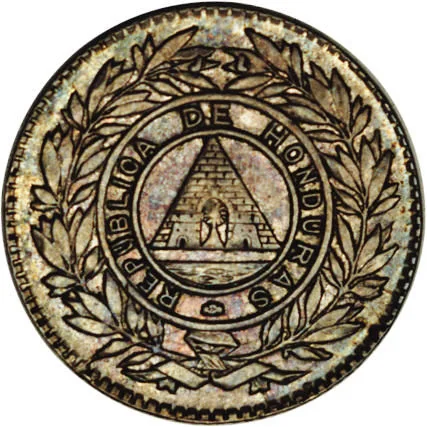
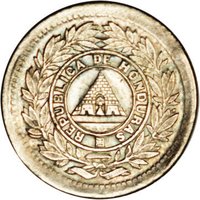
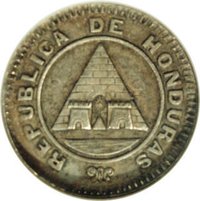
Shield encircled by legend and wreath.
Inscription:
REPUBLICA DE HONDURAS
Translation:
Republic of Honduras
Script: Latin
Language: Spanish
Engraver: Jean-Baptiste Frener
Reverse
Description:
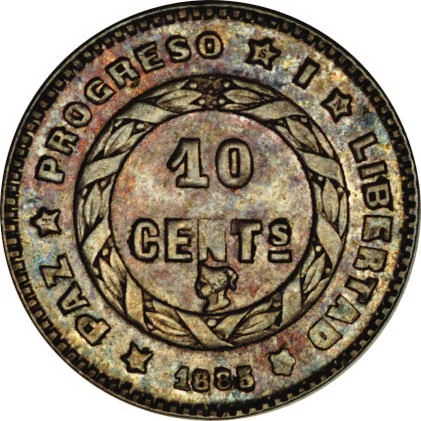
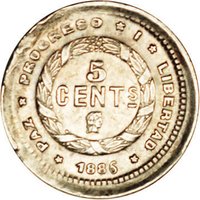
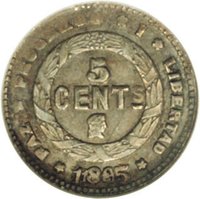
Value and Liberty within wreath. Legend around, date below.
Inscription:
PAZ*PROGRESO*I*LIBERTAD
10 CENTs
1885
10 CENTs
1885
Translation:
Peace, Progress, and Liberty
10 Cents
1885
10 Cents
1885
Script: Latin
Language: Spanish
Engraver: Jean-Baptiste Frener
Edge
Categories
| Symbols> Coat of Arms |
| Symbol> Wreath |
Mints
| Name | Mark |
|---|---|
| Casa Nacional de la Moneda | — |
Mintings
| Year | Mint Mark | Mintage | Quality | Collection |
|---|---|---|---|---|
| 1884 | — | — | ||
| 1885 | — | — | ||
| 1886 | — | — | ||
| 1889 | — | — | ||
| 1893 | — | — | ||
| 1895 | — | 53,000 | ||
| 1897 | — | 16,000 | ||
| 1900 | — | 5,300 |
Historical background
In 1884, Honduras operated under a complex and unstable currency system, a legacy of its colonial past and turbulent early independence. The official currency was the silver Honduran Peso, theoretically tied to the global silver standard. However, the nation's chronic political instability, external debt, and underdeveloped economy meant that the government had little control over the money in circulation. Alongside the official coinage, foreign silver coins—particularly Mexican Pesos, Peruvian Soles, and U.S. Trade Dollars—circulated freely and were often preferred due to their consistent weight and purity, creating a de facto multi-currency environment.
This period was marked by a severe shortage of official coinage, leading to widespread use of private tokens and scrip issued by haciendas, mining companies, and merchant houses to pay workers and facilitate local trade. Furthermore, the global phenomenon of the depreciation of silver against gold in the late 19th century eroded the value of Honduras's silver-based currency, complicating international trade and debt repayment. The government's attempts to manage finances were crippled by the "Ten-Year War" with Guatemala (which had ended in 1883) and overwhelming obligations to British bondholders, leaving little capacity for monetary reform.
Consequently, the currency situation in 1884 was one of fragmentation and weakness. The lack of a strong, unified national currency reflected the broader challenges of state-building in Honduras. It underscored an economy reliant on agricultural exports like coffee and bananas, yet without the fiscal stability or institutional strength to support a sovereign monetary system, leaving the republic vulnerable to global market forces and the monetary policies of other nations.
This period was marked by a severe shortage of official coinage, leading to widespread use of private tokens and scrip issued by haciendas, mining companies, and merchant houses to pay workers and facilitate local trade. Furthermore, the global phenomenon of the depreciation of silver against gold in the late 19th century eroded the value of Honduras's silver-based currency, complicating international trade and debt repayment. The government's attempts to manage finances were crippled by the "Ten-Year War" with Guatemala (which had ended in 1883) and overwhelming obligations to British bondholders, leaving little capacity for monetary reform.
Consequently, the currency situation in 1884 was one of fragmentation and weakness. The lack of a strong, unified national currency reflected the broader challenges of state-building in Honduras. It underscored an economy reliant on agricultural exports like coffee and bananas, yet without the fiscal stability or institutional strength to support a sovereign monetary system, leaving the republic vulnerable to global market forces and the monetary policies of other nations.
💎 Extremely Rare