

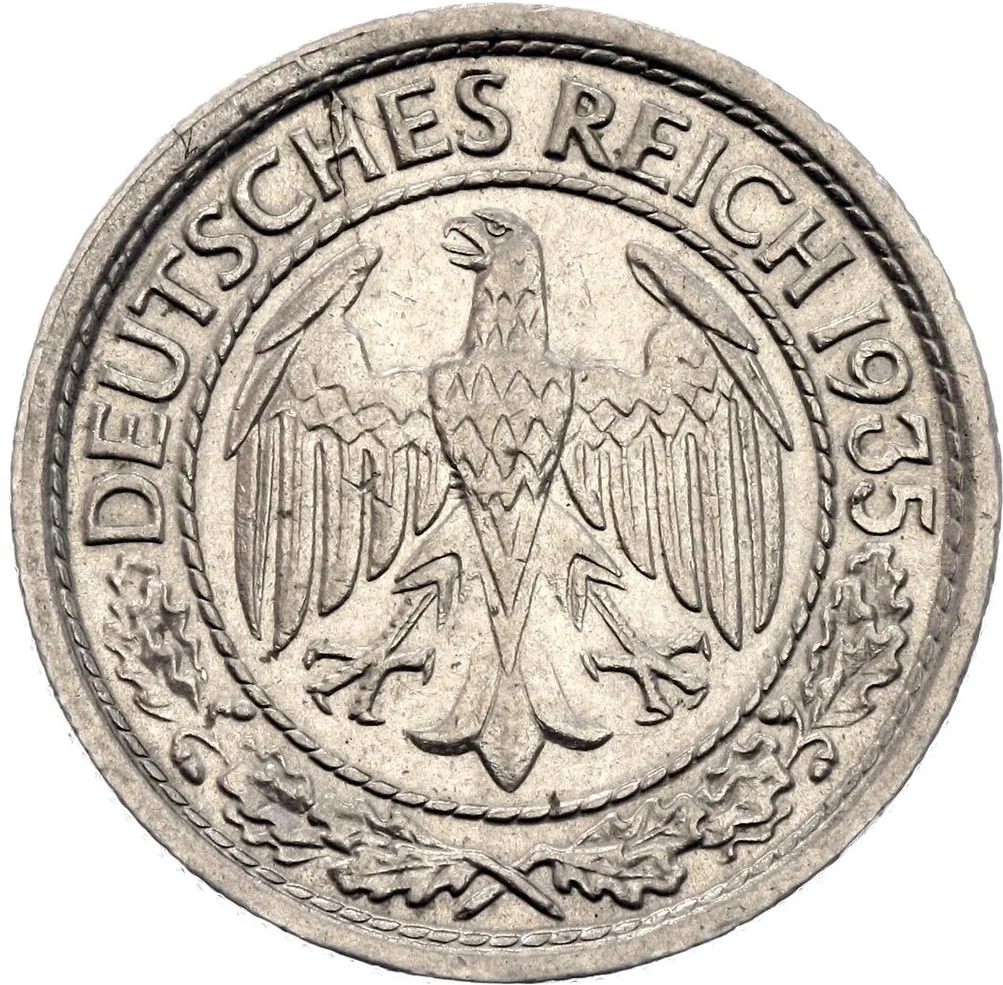
50 Pfennigs – Germany
Germany

Obverse
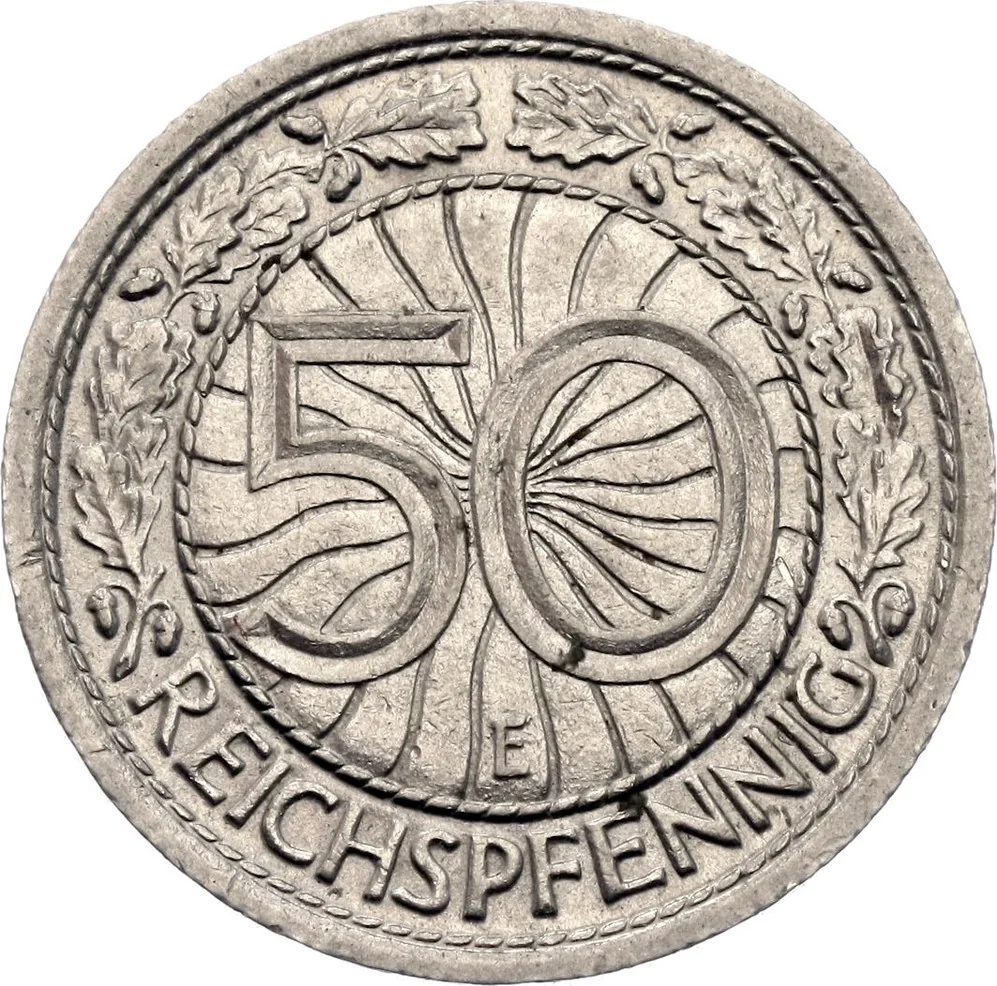
Reverse
Description:
Oak and leaf wreath encircles face value. Mintmark below 50.
Inscription:
50
J
REICHSPFENNIG
J
REICHSPFENNIG
Script: Latin
Edge
Reeded
Mints
| Name | Mark |
|---|---|
| Berlin | A |
| Munich | D |
| Muldenhütten | E |
| Staatliche Münze Baden-Württemberg | F |
| Staatliche Münze Baden-Württemberg | G |
| Hamburgische Münze | J |
Mintings
| Year | Mint Mark | Mintage | Quality | Collection |
|---|---|---|---|---|
| 1927 | F | 1,940,000 | ||
| 1927 | G | 1,756,000 | ||
| 1927 | J | 4,056,000 | ||
| 1927 | A | 16,309,251 | ||
| 1927 | D | 2,227,572 | ||
| 1927 | E | 1,070,000 | ||
| 1927 | E | 23 | Proof | |
| 1928 | A | 43,864,104 | ||
| 1928 | D | 14,087,923 | ||
| 1928 | E | 8,618,000 | ||
| 1928 | E | 93 | Proof | |
| 1928 | J | 6,565,386 | ||
| 1928 | F | 9,954,000 | ||
| 1928 | G | 6,177,150 | ||
| 1929 | A | 10,297,555 | ||
| 1929 | F | 1,162,173 | ||
| 1929 | D | 1,964,590 | ||
| 1930 | D | 1,406,047 | ||
| 1930 | A | 4,127,585 | ||
| 1930 | E | 745,400 | ||
| 1930 | F | 320,000 | ||
| 1930 | G | 610,296 | ||
| 1930 | J | 526,000 | ||
| 1931 | J | 290,576 | ||
| 1931 | G | 60,000 | ||
| 1931 | A | 5,624,390 | ||
| 1931 | D | 1,124,800 | ||
| 1931 | F | 1,484,351 | ||
| 1932 | E | 598,046 | ||
| 1932 | G | 96,000 | ||
| 1933 | G | 332,720 | ||
| 1933 | J | 654,359 | ||
| 1935 | J | 1,634,597 | ||
| 1935 | F | 2,005,791 | ||
| 1935 | G | 650,145 | ||
| 1935 | A | 6,389,828 | ||
| 1935 | D | 2,812,000 | ||
| 1935 | E | 745,100 | ||
| 1936 | D | 843,600 | ||
| 1936 | J | 490,200 | ||
| 1936 | A | 7,696,012 | ||
| 1936 | E | 1,190,174 | ||
| 1936 | F | 601,573 | ||
| 1936 | G | 935,883 | ||
| 1937 | J | 300,000 | ||
| 1937 | A | 10,841,546 | ||
| 1937 | F | 1,700,000 | ||
| 1937 | D | 2,814,000 | ||
| 1938 | E | 1,200,000 | ||
| 1938 | G | 1,298,831 | ||
| 1938 | J | 1,333,349 |
Historical background
By 1927, Germany's currency situation was one of fragile stabilization following the catastrophic hyperinflation of 1923. The old, worthless Reichsmark had been replaced by the new, stable Rentenmark (and later the Reichsmark) under the Dawes Plan of 1924. This plan, backed by international loans primarily from the United States, restored confidence, halted inflation, and reintegrated Germany into the global economy. The period from 1924 to 1927 became known as the "Golden Twenties," a time of relative economic normalcy, industrial growth, and cultural flourishing, all underpinned by the hard currency.
However, this stability was fundamentally precarious and built on foreign debt. The German economy was reliant on a continuous inflow of short-term American loans to service its reparations obligations to the Allies and finance domestic investment. The Reichsbank maintained high interest rates to attract this foreign capital, which in turn suppressed domestic demand and contributed to persistent structural weaknesses. Furthermore, the currency's value was not tied to Germany's own gold reserves but was effectively propped up by foreign credit, creating a vulnerable dependency.
Consequently, while the currency itself was no longer in crisis in 1927, the underlying conditions for future disaster were firmly in place. The economy was overheating, with speculative investments fueled by easy foreign money. Observers, including Reichsbank President Hjalmar Schacht, grew increasingly concerned about the "over-indebtedness" of both public authorities and private enterprises. The system was a house of cards, entirely dependent on the uninterrupted flow of international finance, which would prove fatal when the Wall Street Crash of 1929 triggered a global withdrawal of American capital.
However, this stability was fundamentally precarious and built on foreign debt. The German economy was reliant on a continuous inflow of short-term American loans to service its reparations obligations to the Allies and finance domestic investment. The Reichsbank maintained high interest rates to attract this foreign capital, which in turn suppressed domestic demand and contributed to persistent structural weaknesses. Furthermore, the currency's value was not tied to Germany's own gold reserves but was effectively propped up by foreign credit, creating a vulnerable dependency.
Consequently, while the currency itself was no longer in crisis in 1927, the underlying conditions for future disaster were firmly in place. The economy was overheating, with speculative investments fueled by easy foreign money. Observers, including Reichsbank President Hjalmar Schacht, grew increasingly concerned about the "over-indebtedness" of both public authorities and private enterprises. The system was a house of cards, entirely dependent on the uninterrupted flow of international finance, which would prove fatal when the Wall Street Crash of 1929 triggered a global withdrawal of American capital.
🌱 Very Common