


5 euro – Latvia
Add to wishlist
Non-circulating coins
Commemoration: Personal freedom
Latvia
Context
Material

References
KM: #
Numista: #254508
Value
Exchange value: 5 EUR
Bullion value: $51.08
Inflation-adjusted value: 6.74 EUR
Obverse
Description:
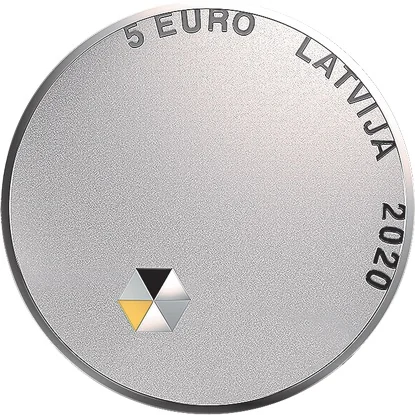
Frosted field with a frosted hexagonal pyramid at lower left, its faces varying in finish: some frosted, others printed black, gold-plated, or mirrored. Inscriptions "5 EURO," "LATVIJA," and "2020" arc along the upper right edge.
Inscription:
5 EURO LATVIJA 2020
Translation:
5 EURO LATVIA 2020
Language: Latvian
Designer: Beate Šņuka
Reverse
Description:
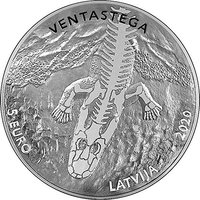
The reverse features a mosaic of low hexagonal pyramids with faces in varied frostings, black print, gold plating, or mirror finish.
Designer: Beate Šņuka
Edge
Two inscriptions LATVIJAS BANKA are separated by rhombic dots.
Legend:
LATVIJAS BANKA ♦ LATVIJAS BANKA ♦
Translation:
LATVIJAS BANKA ♦ LATVIJAS BANKA ♦
Language: Latvian
Mints
| Name | Mark |
|---|---|
| Mint of Poland | — |
Mintings
| Year | Mint Mark | Mintage | Quality | Collection |
|---|---|---|---|---|
| 2020 | — | 3,500 | Proof |
Historical background
In 2020, Latvia was a stable member of the Eurozone, having adopted the euro as its official currency on January 1, 2014. Consequently, its monetary policy was entirely set by the European Central Bank (ECB), with the Latvian central bank participating in the ECB's Governing Council. The year was dominated by the unprecedented economic shock of the COVID-19 pandemic, which necessitated a robust EU-wide monetary response. The ECB implemented significant stimulus measures, including massive asset purchase programs and maintaining historically low, often negative, interest rates, all of which directly shaped Latvia's monetary environment.
The domestic currency situation was therefore characterized by the challenges of a severe, pandemic-induced economic contraction. Latvia's GDP fell sharply, and the government implemented substantial fiscal support packages. The stability of the euro provided a crucial anchor, preventing currency devaluation risks and ensuring continued access to liquid financial markets, which was vital for funding the crisis response. There were no debates about leaving the euro; instead, the focus was on leveraging the security of the common currency to mitigate the recession's depth.
Looking forward, a key financial topic in Latvia during 2020 was the active preparation for the eventual introduction of the digital euro, a project the ECB began seriously exploring that year. Domestically, discussions centered on banking sector stability and ensuring sufficient credit flow to businesses amidst the crisis, all within the framework of the Eurozone's unified monetary policy. Thus, Latvia's 2020 currency narrative was one of reliance on the Eurozone's collective strength to navigate a global emergency, rather than any national currency volatility.
The domestic currency situation was therefore characterized by the challenges of a severe, pandemic-induced economic contraction. Latvia's GDP fell sharply, and the government implemented substantial fiscal support packages. The stability of the euro provided a crucial anchor, preventing currency devaluation risks and ensuring continued access to liquid financial markets, which was vital for funding the crisis response. There were no debates about leaving the euro; instead, the focus was on leveraging the security of the common currency to mitigate the recession's depth.
Looking forward, a key financial topic in Latvia during 2020 was the active preparation for the eventual introduction of the digital euro, a project the ECB began seriously exploring that year. Domestically, discussions centered on banking sector stability and ensuring sufficient credit flow to businesses amidst the crisis, all within the framework of the Eurozone's unified monetary policy. Thus, Latvia's 2020 currency narrative was one of reliance on the Eurozone's collective strength to navigate a global emergency, rather than any national currency volatility.



💎 Extremely Rare