

Obverse
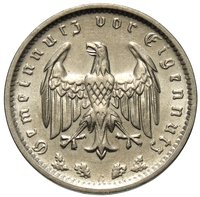
Description:
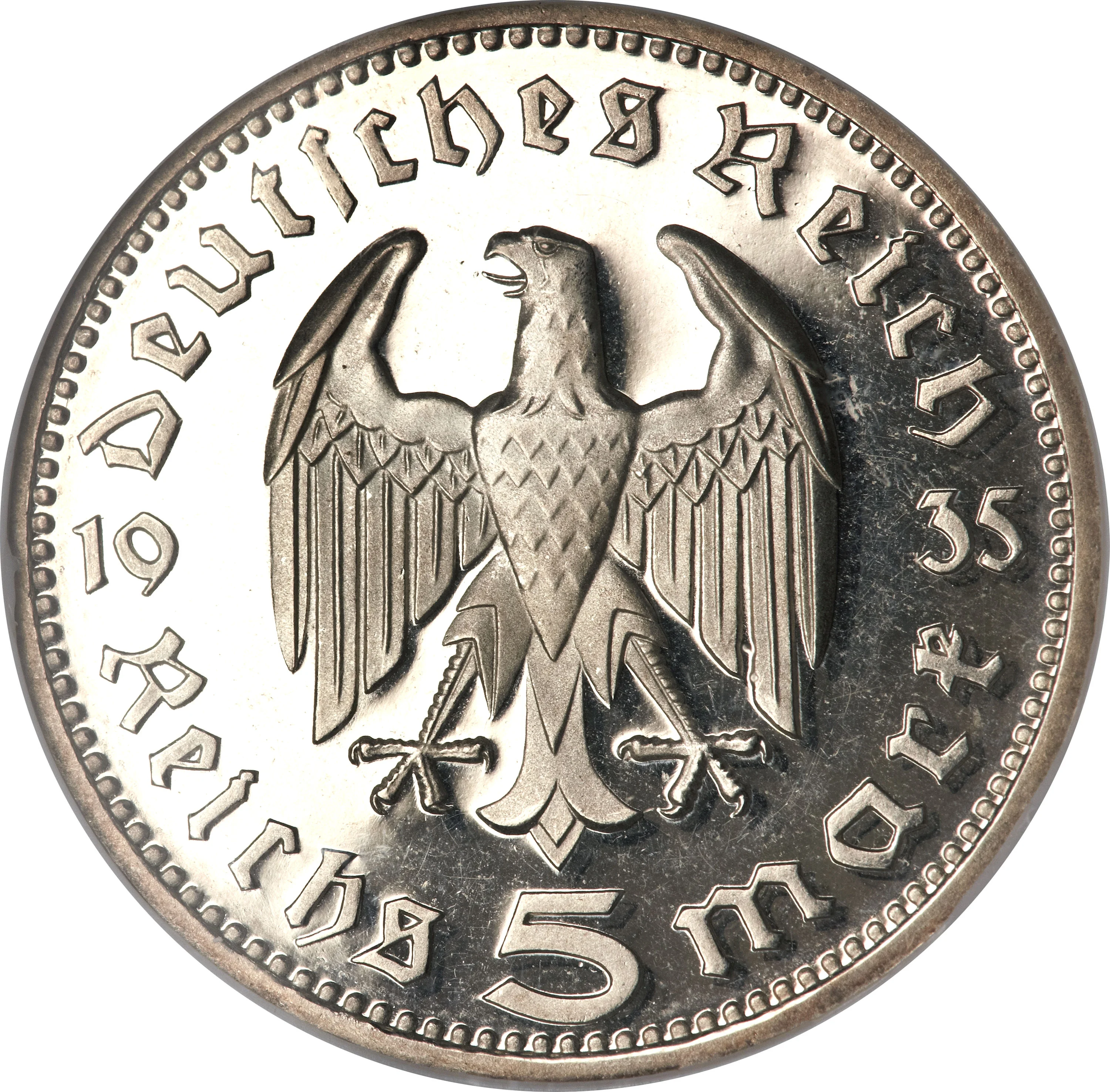
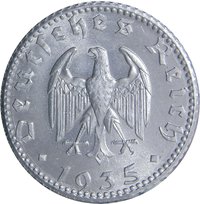
Imperial eagle flanking date and denomination.
Inscription:
Deutsches Reich
19 35
Reichs 5 mark
19 35
Reichs 5 mark
Translation:
German Reich
19 35
5 Marks
19 35
5 Marks
Language: German
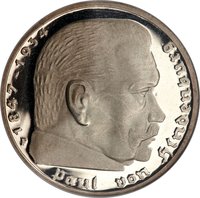
Reverse
Description:
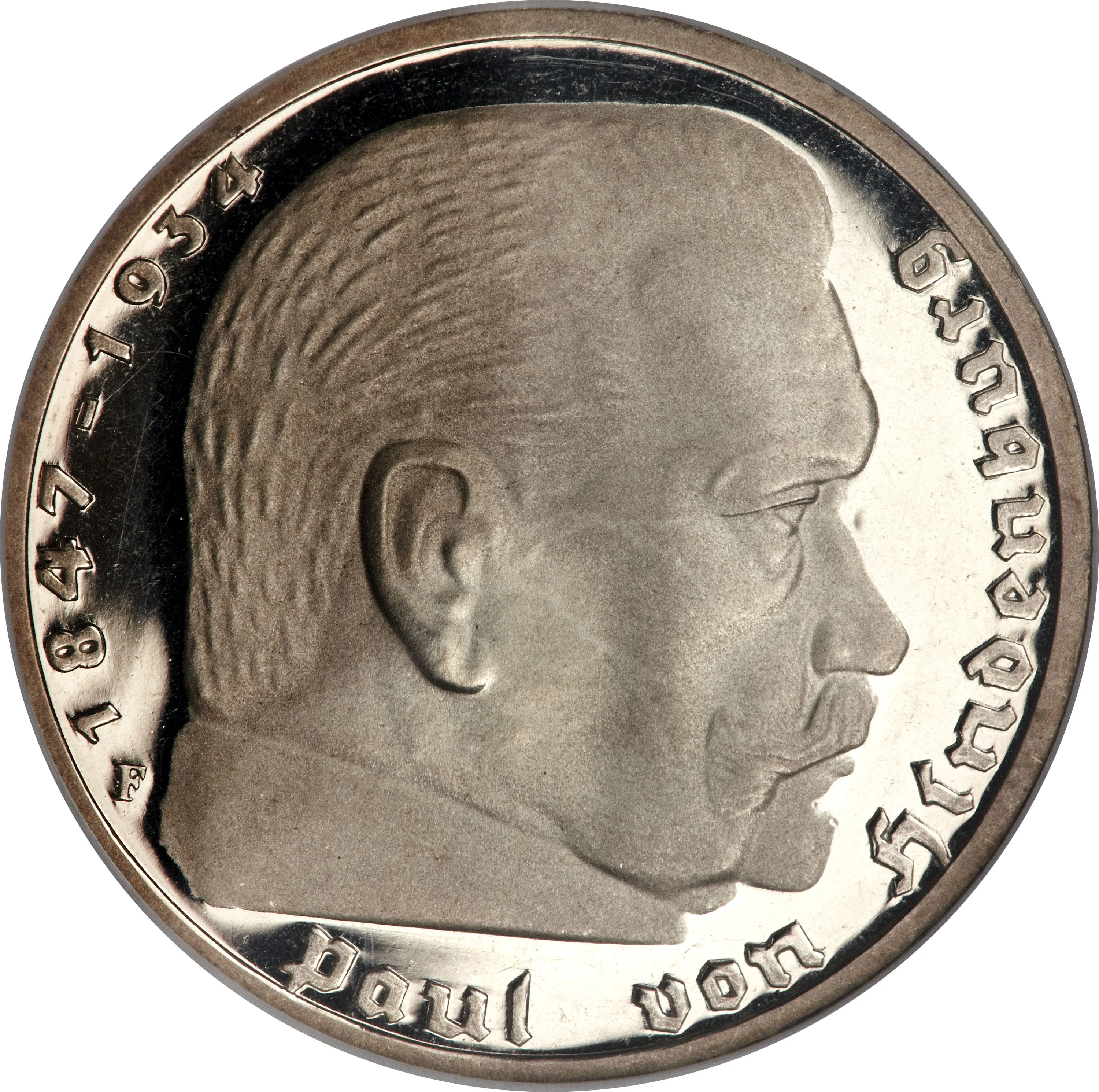
Portrait of Paul von Hindenburg (1847–1934), German soldier, politician, and Reich President (1925–1934), facing right. Mintmark under the date behind his portrait.
Inscription:
1847-1934
F
Paul von Hindenburg
F
Paul von Hindenburg
Edge
Smooth with inscriptions
Legend:
Gemeinnutz geht vor Eigennutz
Translation:
Common utility precedes self-interest.
Language: German
Mints
| Name | Mark |
|---|---|
| Berlin | A |
| Munich | D |
| Muldenhütten | E |
| Staatliche Münze Baden-Württemberg | F |
| Staatliche Münze Baden-Württemberg | G |
| Hamburgische Münze | J |
Mintings
| Year | Mint Mark | Mintage | Quality | Collection |
|---|---|---|---|---|
| 1935 | A | — | Proof | |
| 1935 | F | — | Proof | |
| 1935 | G | 2,370,600 | ||
| 1935 | J | — | Proof | |
| 1935 | J | 2,830,200 | ||
| 1935 | A | — | Matte | |
| 1935 | A | 19,324,843 | ||
| 1935 | E | 3,260,000 | ||
| 1935 | F | 4,372,000 | ||
| 1935 | D | — | Proof | |
| 1935 | E | — | Proof | |
| 1935 | D | 6,596,000 | ||
| 1936 | A | 30,611,157 | ||
| 1936 | A | — | Proof | |
| 1936 | D | 7,032,000 | ||
| 1936 | F | 4,926,000 | ||
| 1936 | F | — | Proof | |
| 1936 | G | 2,734,400 | ||
| 1936 | G | — | Proof | |
| 1936 | D | — | Proof | |
| 1936 | E | 3,320,000 | ||
| 1936 | E | — | Proof | |
| 1936 | J | 3,705,800 | ||
| 1936 | J | — | Proof |
Historical background
By 1935, Germany’s currency situation was tightly controlled and superficially stable, a direct result of the Nazi regime’s aggressive economic policies aimed at rearmament and autarky. The Reichsmark remained the official currency, but its value was entirely artificial and managed through strict capital controls and foreign exchange regulations instituted by Hjalmar Schacht, President of the Reichsbank. To prevent a flight of capital and conserve vital foreign currency for importing raw materials, the government made it illegal for citizens to own or trade gold or foreign currencies. International trade was conducted through complex bilateral clearing agreements to avoid using gold or convertible currencies.
Beneath this enforced stability, the economy was being dangerously distorted to fund massive military expansion. The regime financed its spending primarily through the creation of Mefo bills—promissory notes issued by a dummy company and guaranteed by the state, which the Reichsbank would discount. This created a hidden expansion of credit and money supply, effectively putting the economy on a "war footing" while masking inflationary pressures. Public confidence in the currency was maintained through price and wage controls, as well as propaganda, but the growing debt and diversion of resources from consumer goods to armaments created underlying inflationary tensions and shortages.
Consequently, while ordinary Germans experienced stable prices and reduced unemployment due to public works and conscription, the currency’s integrity was being systematically sacrificed for political goals. The Reichsmark was increasingly isolated from the global economy, non-convertible, and its internal value sustained by compulsion rather than market confidence. This fragile, state-directed system was unsustainable in the long term and was inherently designed to be resolved through future territorial expansion and plunder, setting the stage for the economic conditions of the coming war.
Beneath this enforced stability, the economy was being dangerously distorted to fund massive military expansion. The regime financed its spending primarily through the creation of Mefo bills—promissory notes issued by a dummy company and guaranteed by the state, which the Reichsbank would discount. This created a hidden expansion of credit and money supply, effectively putting the economy on a "war footing" while masking inflationary pressures. Public confidence in the currency was maintained through price and wage controls, as well as propaganda, but the growing debt and diversion of resources from consumer goods to armaments created underlying inflationary tensions and shortages.
Consequently, while ordinary Germans experienced stable prices and reduced unemployment due to public works and conscription, the currency’s integrity was being systematically sacrificed for political goals. The Reichsmark was increasingly isolated from the global economy, non-convertible, and its internal value sustained by compulsion rather than market confidence. This fragile, state-directed system was unsustainable in the long term and was inherently designed to be resolved through future territorial expansion and plunder, setting the stage for the economic conditions of the coming war.
🌱 Very Common